
IN BRIEF
- Under a newly proposed One Nation policy, Australians could access their superannuation earlier and more easily.
- For some Australians, opting into the scheme could mean they lose $25,000 from their retirement fund.
One Nation's plan to allow workers to extract part of their superannuation as take-home-pay could leave Australians poorer in retirement while charging future taxpayers more, experts and critics warn.
One Nation has proposed changes to superannuation that would allow workers paying rent or a mortgage to divert 3 per cent of their super payments straight to their wallet for up to three years — investing only 9 per cent instead of the current compulsory rate of 12 per cent.
Employers would still contribute 12 per cent, but the nominated super fund would invest only 9 per cent — paying out 3 per cent to the customer.
Payments would be taxed at the concessional rate of 15 per cent rather than the personal income tax rate.
Party leader Pauline Hanson said the policy would give households "breathing room" and would help people to buy groceries, power bills and the costs of raising a family.
News that makes sense
Your trusted source for staying up-to-date with the world around you. Get free daily news updates and analysis, straight to your inbox.
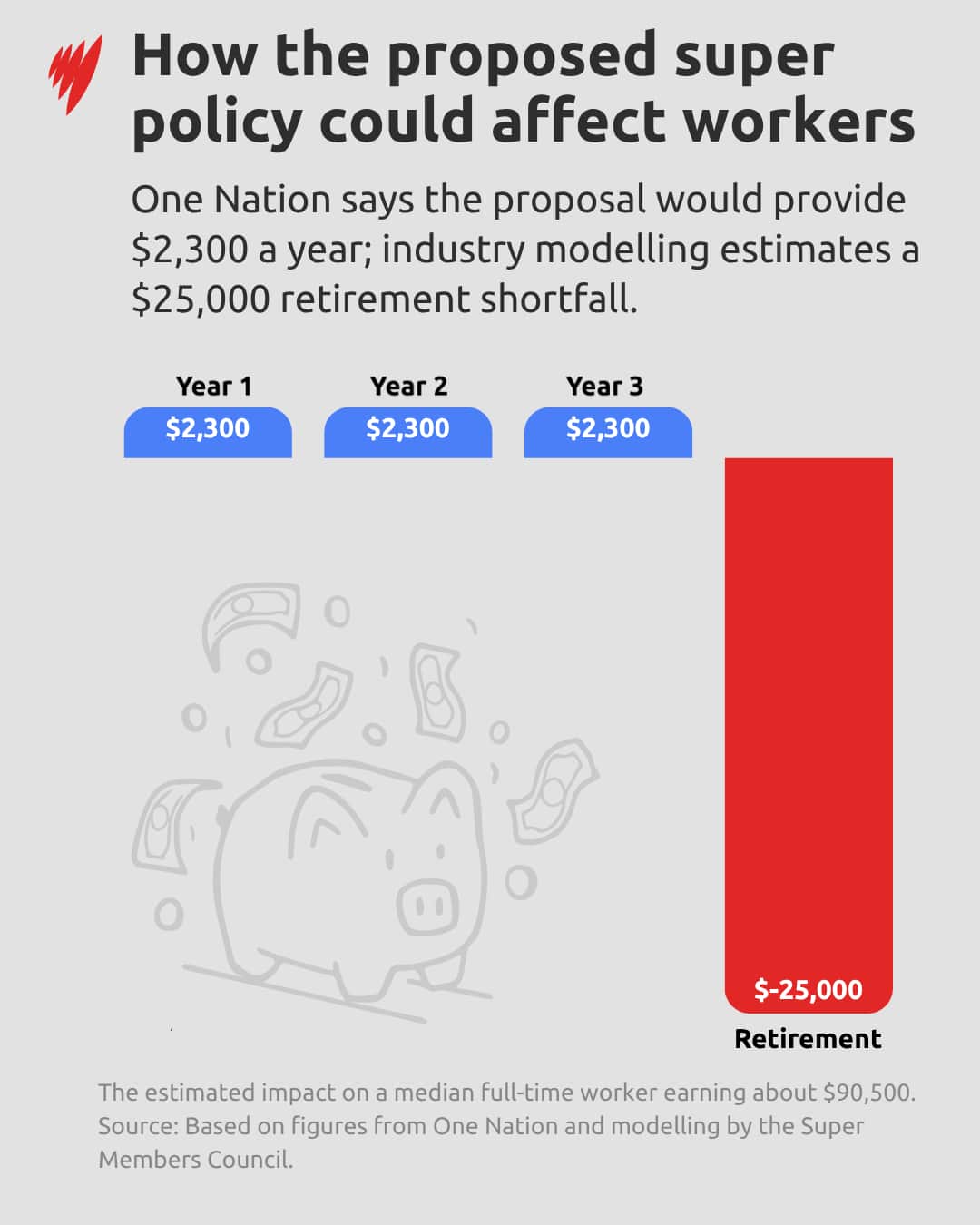
"For a full-time worker earning about $90,500, that means around $2,300 a year after tax, or $44 a week, extra in their pocket," she said.
"For a working couple earning $168,000 between them, it is about $4,300 a year after tax, or $82 a week, back in the family budget.
"That's a real boost to help you pay the rent or the mortgage."
But the policy has been criticised for its potential impact on retirement, with some saying it could leave thousands worse off later in life.
Mardy Chiah, associate professor of finance at the University of Newcastle's School of Business, estimated that it would result in a loss of about $23,000 to $24,000 in invested income.
"If you're earning an average $90,000 salary, the 3 per cent would give you an extra $2,300 a year — which after three years would be $6,900," Chiah said, explaining the calculation.
"This policy essentially gives households more financial breathing room today in exchange for ... much less money invested for their retirement.
"The loss can be quite substantial. You're taking money away from your future self."
A similar loss was projected by the Super Members Council's analysis of the policy, which said a 30-year-old full-time worker on a salary of $90,500 who opts into One Nation's policy would be down $25,000 in retirement superannuation.
The same 30-year-old worker would lose over $18,000 in compounding interest by the time they reach the retirement age of 67.
Super Members Council CEO Misha Schubert said the scheme would damage a person's super and retirement and increase "inflation and interest rates — which would make cost-of-living pressures even worse".
"There are smarter and better ways to help Australians struggling with housing costs ... none of them involve telling Australians to raid their super and their futures."
Currently, the mandatory superannuation contribution rate is set at 12 per cent. Chiah warns investing only 9 per cent could compromise someone's ability to "retire comfortably" — and be a "liability for taxpayers".
"More people would likely have to access the age pension for their retirement, which means future taxpayers would be funding this policy."
Chiah believes the "preservation of a retirement fund" is crucial for all Australians, and interfering with investments should be a "last resort".
"It's really important that people understand that super is meant for your retirement ... if you retire at 67, you will need that money," he said.
The Australian Council of Trade Unions suggested there were better cost of living measures such as minimum wage rises, penalty rates and safer workplaces.
"It's typical that the only pay rise Pauline Hanson could imagine a worker deserving is one at the expense of their own retirement income," ACTU assistant secretary Joseph Mitchell said.
"Forget robbing Peter to pay Paul, this is robbing Peter to pay Peter."
'End of superannuation as we know it'
Treasurer Jim Chalmers warned One Nation's policy could "end superannuation as we know it".
"It's now beyond doubt that any Coalition government with One Nation in it will cut your super," he said during a doorstop interview at Parliament House in Canberra on Monday.
"By ending super as we know it, by making Australian workers poorer as a consequence ... this is exactly why One Nation poses an unacceptable and dangerous risk to Australian workers."
Hanson rejected Chalmers' comments, saying she's "not intending to shut super down".
"If it comes to a point of someone being out in the streets and living in a tent or on the cusp of losing their home, I would rather see them get that help and assistance that they need now, not later in life."
Nationals MP David Littleproud said the policy could see "unintended consequences" such as higher inflation.
"When you've got inflation out of control at the moment, and you fuel that with putting more money into the economy, the unintended consequence is that inflation will go up and interest rates will go up," he told News24 on Monday.
However, One Nation's treasury spokesperson Barnaby Joyce also told News24 the impact on inflation would be "undetectable" or "incredibly small".
"In the circumstances where you're tying the money up in a house payment, I can't see how the volume of money in the economy would be exacerbated that much," he said.
"If your rent payments are $600 a week, your rent payment would still be $600 a week and therefore the money that the person collecting the rent is getting is still $600 a week. If the money is going to your house payments, it's still the same.
"You could say that if the volume increases there is an inflationary aspect, that's a statement of fact. The proportion, I would say, would be incredibly small."
Deputy Liberal leader Jane Hume ridiculed the policy.
"This so far is nothing more than a headline," she told ABC News Breakfast.
"One Nation does have a bit of a habit of putting out a headline and putting out on details — they don't think this is a serious thing."
For the latest from SBS News, download our app and subscribe to our newsletter.







