
The following are significant North Korean nuclear events and the international community's response:
October 9, 2006: North Korea carries out its first atomic test.
October 14, 2006: In response, the UN Security Council issues commercial sanctions against Pyongyang, banning the import of all luxury items and ballistic missile technologies. It also freezes the assets of persons engaged in or supporting, the secretive state's nuclear and ballistic missile programs.
May 25, 2009: North Korea conducts its second atomic test.
June 12, 2009: The UN Security Council bans financial transfers to people or institutions that could contribute to Pyongyang's nuclear programs.
January 2013: In response to a set of North Korean rocket launches, the UN beefs up asset freezes, and travel bans are extended to several North Korean organisations.
February 12, 2013: North Korea appears to carry out its third atomic test, according to seismic data. Pyongyang claims it used a miniaturised nuclear device, but no radiation was detected.
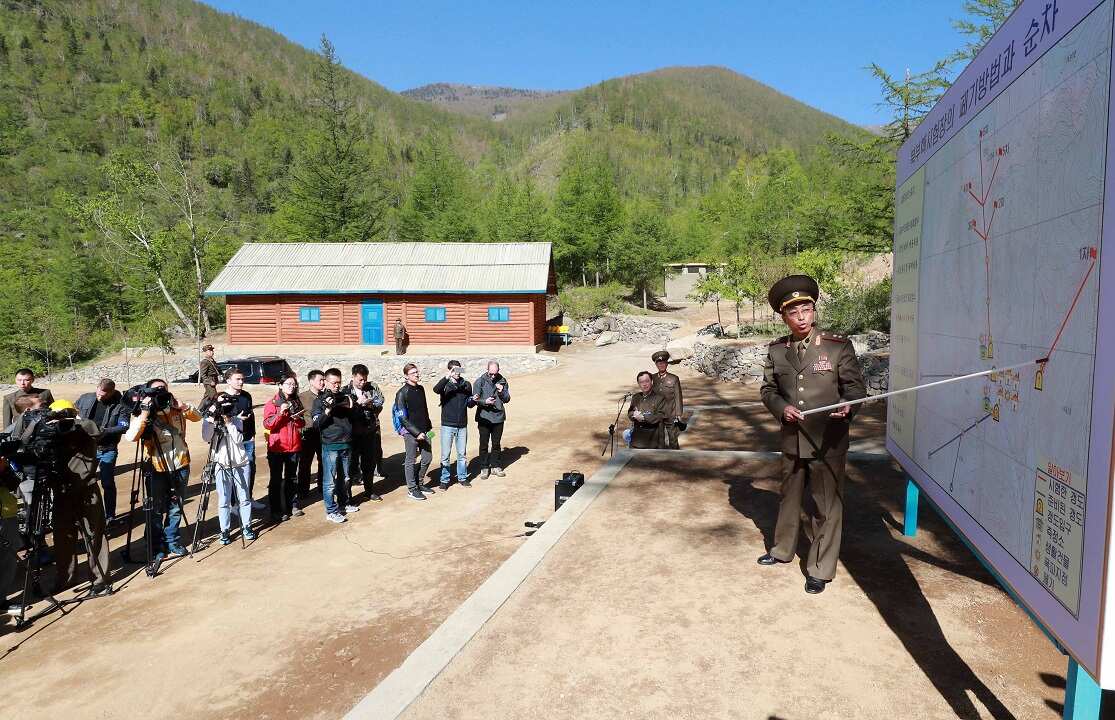
May 24, 2018: North Korea explains to foreign press the process of dismantling the Punggye-ri nuclear test site. Source: AAP
March 2013: The Security Council adds targeted financial sanctions and expands the list of banned export items related to nuclear and ballistic missile development. It also adds new names to the asset freeze and travel ban list.
September 15, 2015: North Korea says it restarted operations of the nuclear reactor at its Yongbyon facility after making "innovations" at the complex.
January 6, 2016: North Korea claims it successfully tested a hydrogen bomb - its fourth test of an atomic device. Western experts doubt the explosion had the power of a hydrogen bomb.
February 7, 2016: North Korea launches a long-range rocket and puts Earth observation satellite Kwangmyongsong-4 into orbit, although US reports say it is not operating correctly. The rocket launch is seen as a test of nuclear-capable weaponry.
March 2, 2016: UN imposes new sanctions on Pyongyang: Countries are banned from selling weapons or any other item to North Korea that could bolster the country's military, though food and medicine are excluded from the ban. All cargo going in or out of the country is now subject to inspection, and North Korea is banned from chartering ships or aeroplanes.
September 9, 2016: North Korea carries out a fifth nuclear test.
June 2017: Repeated rocket launches cause the UN to issue sanctions against state entities, including Koryo Bank, while 14 new individuals are blacklisted with asset freezes and travel bans.
July 4, 2017: Pyongyang claims its first successful test of an intercontinental ballistic missile (ICBM).
July 28, 2017: North Korea tests its second intercontinental missile and claims all of the US mainland is within its striking range.
August 5, 2017: The UN imposes its harshest sanctions yet on North Korea, stepping up the existing restrictions on coal, iron and iron ore exports to a full ban and prohibiting exports of lead, lead ore and seafood. The measures are expected to cut North Korea's export revenue by a third.
August 25, 2017: Japan imposes sanctions on companies and individuals aiding North Korea's nuclear missile program, including those in China.
September 3, 2017: North Korea says it has successfully tested a hydrogen bomb.
September 11, 2017: The UN Security Council increases sanctions on Pyongyang, including export bans, asset freezes and travel bans on officials. North Korea calls the new sanctions "a brutal criminal act that indiscriminately infringes upon the right to existence of the peaceful civilians".
November 29, 2017: Pyongyang's launches an intercontinental ballistic missile which it again claims can reach the US mainland, a claim backed up this time by the South Korean government, which estimated it could reach as far as 13,000km.
December 22, 2017: UN Security Council unanimously votes to cut deliveries of petroleum products such as gasoline, diesel and heavy oil to North Korea from 2 million barrels per year to only 500,000 barrels beginning January 1, 2018.
Share


