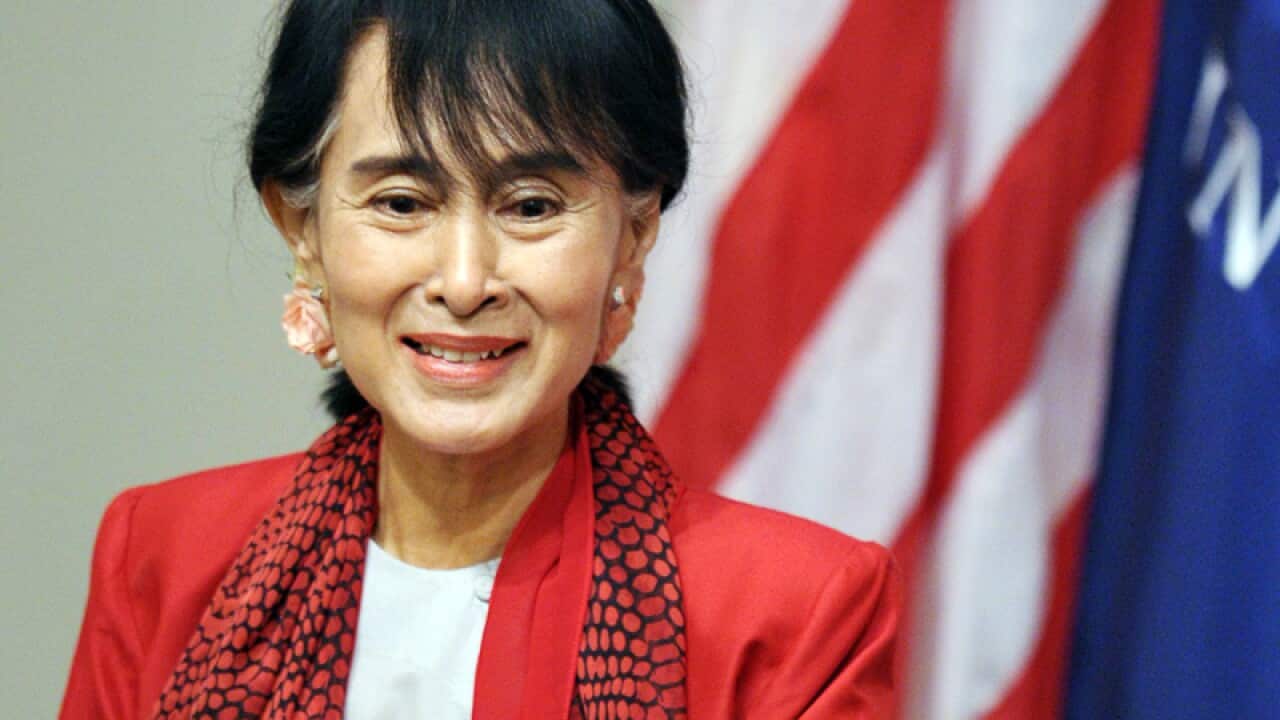
Oddly, the year 2012 has marked half a century of military rule in Burma.
Oddly, because, at the same time, the military actually has shown its first signs of allowing a transition to civilian rule.
(Transcript from World News Australia Radio)
News that makes sense
Your trusted source for staying up-to-date with the world around you. Get free daily news updates and analysis, straight to your inbox.
As part of our look back at 2012, Ron Sutton looks at The Year That Was in Burma.
"Just like this, Aung San Suu Kyi wins, so we are very happy and very proud. So after Suu Kyi wins, if our country has better politicians, we'll be much happier than now."
It was Election Day in Burma, April the 1st, 2012, and National League for Democracy supporters like Than Da Myint Aung Kyi were euphoric.
Not only had long-time people's choice and former Nobel Peace Prize winner Aung San Suu Kyi won a seat in parliament.
But when the military government opened a small crack in the door to democracy, the people had forced it on open with a resounding crash.
Of the 46 parliamentary seats available in the by-election, Aung San Suu Kyi and her opposition National League for Democracy party won all but one of the 44 they pursued.
And this time, unlike 1990 when the military stepped in to annul the party's landslide victory in national elections, it kept its word and allowed the by-election to herald a new day.
It was, Ms Suu Kyi told her celebrating supporters, a moment that went far beyond the party's success.
"It is not so much our triumph as a triumph of the people, who have decided that they must be involved in the political process of this country. So what is important is not how many seats we have won -- although, of course, we are extremely gratified that we have won so many -- but the fact that the people are so fantastic about participating in the democratic process. We hope that this will be the beginning of a new era where there will be more emphasis on the role of the people in the everyday politics of our country."
It has, indeed, proved to be a year of revolutionary change in Burma -- but without the revolution.
Ruled by the military since 1962, Burma's by-election was only the first step in the process.
Within days, that change inside the country began to be matched by change towards the country from outside.
Three days after the elections, the United States became the first foreign country to announce it would lift some of its long-standing sanctions against Burma.
The sanctions had been designed to force some of the very changes which had now begun.
And US Secretary of State Hillary Clinton said it was clear that democracy was making inroads in the country.
"We fully recognise and embrace the progress that has taken place, and we will continue our policy of engagement that has encouraged these efforts. The leadership has shown real understanding and commitment to the future of the country. That development, we hope, will be sustainable."
In reality, the election conquest still amounted to only about 15 per cent of the seats in parliament overall.
The military-backed ruling party, voted into power in heavily-criticised national elections in 2010, still holds all the power in every sense of the word.
And yet President Thein Sein has continued to yield that power in ways that keep offering hope to democracy supporters, inside and outside Burma.
Early in the year, before the by-elections, the government had signed a cease-fire with ethnic Karin rebels and began releasing some prominent political prisoners.
Then, as the year went on, hundreds of political prisoners were released -- although human-rights groups were quick to point out hundreds still remained, too.
In August, the government announced it would no longer censor private publications, a move welcomed by Burmese journalists as a major step towards media freedom.
Toe Zal Latt,Thailand bureau chief of the Democratic Voice of Burma, an independent Burmese media organisation, was one -- despite his reservations.
"What we are not clear on is what will happen post-censorship. Because, if somebody is (not) subject to a censor, are they going to suspend their registration or their publication? We are very unclear about this at this stage. But we are very excited to see this remarkable media landscape happen in Burma."
Toe Zal Latt's embrace of change at the same time as he retained doubts about the government's full intent was a common reaction to moves throughout the year.
But the balance of belief has steadily swung in the government's favour, largely because Aung San Suu Kyi was the one calling most clearly reacting positively.
When Ms Suu Kyi urged governments around the world to suspend their sanctions, they began to do it.
Australia's Foreign Minister, Bob Carr, had outlined just such a sequence even as the by-election was playing out.
"We're ready to peel back sanctions if the progress is genuine and if it's authenticated by the opposition forces -- including Aung San Suu Kyi, whose campaigning we've been inspired to witness."
Several days after the US sanctions fell, British Prime Minister David Cameron visited Ms Suu Kyi at her home and announced Britain, too, was suspending sanctions.
From her veranda, where she had spent much of the past two decades under house arrest, Ms Suu Kyi embraced the idea wholeheartedly.
"I support the idea of the suspension, rather than the lifting, of sanctions, because this would be an acknowledgement of the role of the President and other reformers. This suspension would have taken place because of the steps taken by the President and other reformers, and it would also make it clear to those who are against reform that, should they try to obstruct the way of the reformers, then sanctions could come back. So, this would strengthen the hand of the reformers, not just the suspension but the fact that there is always a possibility of sanctions coming back again if the reformers are not allowed to proceed smoothly."
Eight months later, they have largely proceeded smoothly.
In June, Aung San Suu Kyi took the trip she had avoided for 21 years out of fear she would not be allowed to return.
She travelled to Oslo, Norway, to deliver her acceptance speech -- for the Nobel Peace Prize she won in 1991.
As diplomats and royalty alike dabbed at tears after a long, standing ovation, Ms Suu Kyi described the isolation she had felt in those years of house arrest.
And she talked of how the prize had ultimately sustained her.
"As the days and months went by, and news of reactions to the award came over the airwaves, I began to understand the significance of the Nobel Prize. It had made me real once again. It had drawn me back into the wider human community. And, what is more important, the Nobel Prize had drawn the attention of the world to the struggle for democracy and human rights in Burma. We were not going to be forgotten."
In late October, Foreign Minister Bob Carr announced that Australia would step up its engagement with Burma through advice on elections and government structures.
Speaking at the UN headquarters in New York, Senator Carr said there was evidence that Burma was on an irreversible path towards democracy.
He noted that election reforms currently under consideration in Burma included greater freedom of assembly and speech, and the use of public spaces for independent political rallies.
The Foreign Minister said through its aid program, Australia would be lending experience and personnel to Burma on development of systems to register political parties, and to conduct elections.
Burma's President Thein Sein also travelled to the UN headquarters late in the year, and it was there that another first was achieved.
He mentioned Aung San Suu Kyi's name for the first time ever before a world body.
Speaking to the U-N General Assembly after she had been awarded the US Congressional Gold Medal -- the country's highest civilian award -- he openly congratulated her.
"The former main opposition leader, Nobel laureate Daw Aung San Suu Kyi, is now participating in parliament, not only in her capacity as a member of parliament but also as chairperson of the Rule-of-Law and Stability Committee of parliament. This week, she is also in New York. As a Myanmar (Burmese) citizen, I would like to congratulate her on the honour she has received in this country in recognition of her efforts on behalf of democracy."
It is still early in that democratic process, but perhaps Thein Sein's most telling comment came a few days after that.
In an interview with the BBC, he was asked if he would accept Aung San Suu Kyi as president if the people voted her in in Burma's 2015 national elections.
His response?
"It all depends on the people. If the people accept her, I will have to accept her. As I said before, we are now working together. There are no problems between me and Aung San Suu Kyi."







