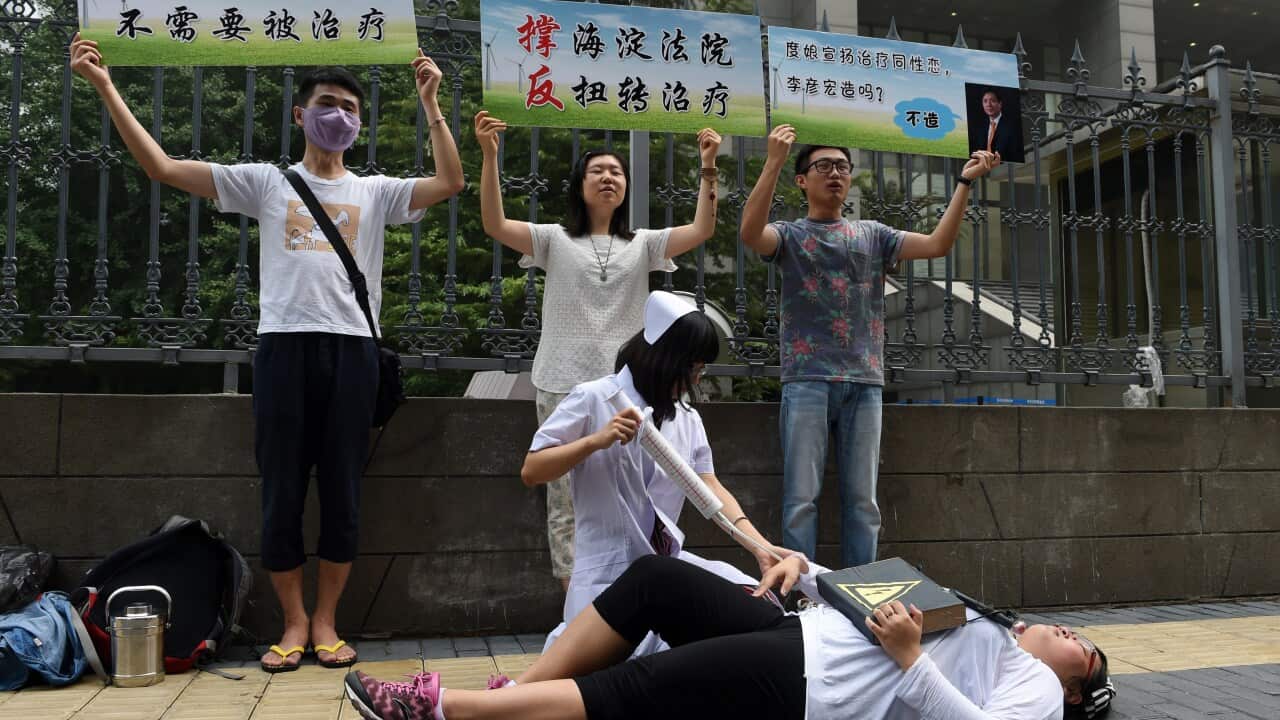
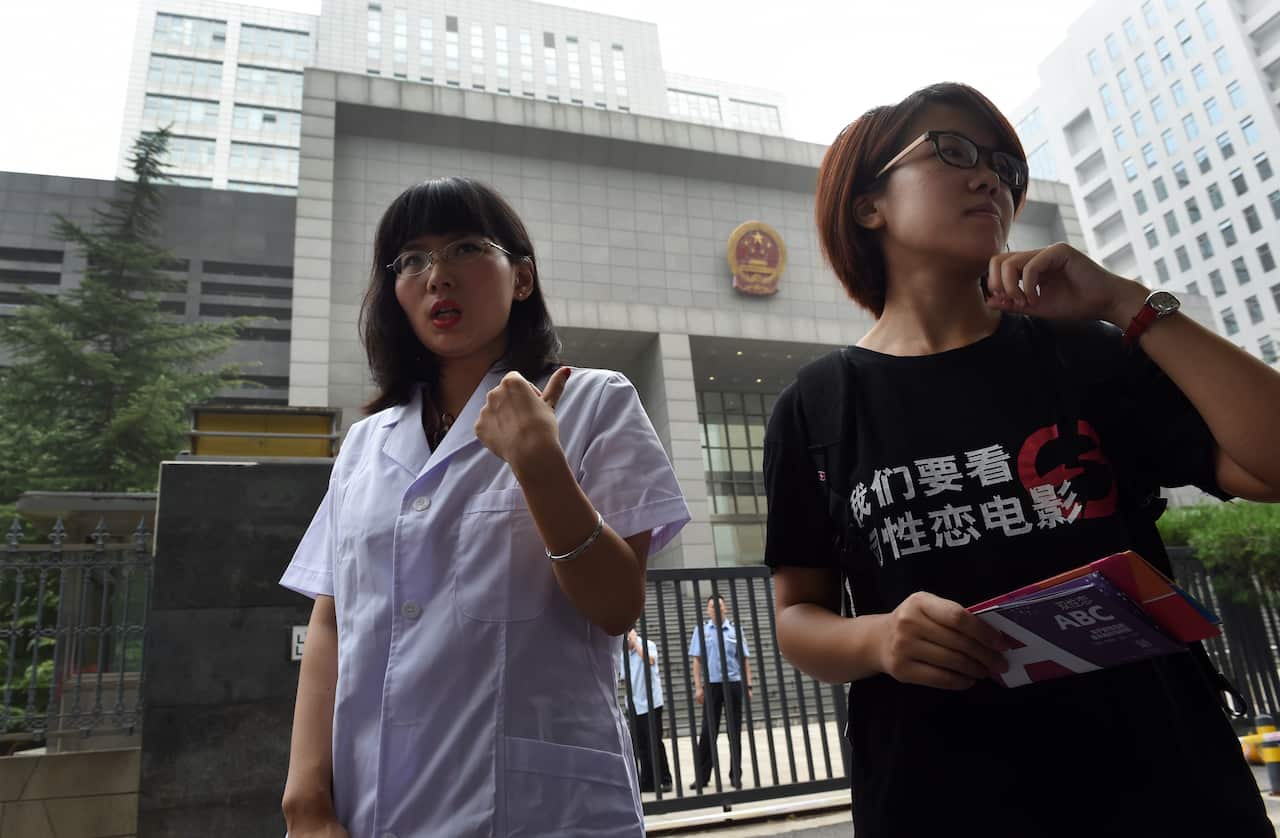
Gay activists staged a protest outside a Beijing court before the case was heard and said they hoped that the trial would persuade the medical community to change its policies on homosexuality and its practice of diagnosing it as a disorder.
Meanwhile, inside the court, a 30-year-old man from southern China said he suffered trauma when a counseling center in the city of Chongqing tried to cure his homosexuality through electric shock therapy and hypnosis. As part of his case, the man also sued Baidu.com, China's largest search engine company, for false advertising because it ranked the center's website high in results generated for the search terms "homosexual" and "homosexual treatment."
In an interview outside the courthouse, the man asked to be referred to as "Xiao Zhen" instead of using his real name for fear of discrimination among his friends and relatives who don't know he is gay. He said he has not told his parents about his lawsuit because he hopes to win the case and use it to soften their opposition to his homosexuality.
Offering "gay conversion therapy" is not uncommon among psychological counseling centers here. While such therapies are often promoted by conservative Christian groups in the West, in China the pressure more often than not comes from gay people's peers and especially parents, activists said.
Xiao said that after his parents found out he was gay last year, they refused to accept it. And when they saw an advertisement for gay conversion therapy, they pressured him to seek help at the Chongqing Xinyupiaoxiang Counseling Center in February.
News that makes sense
Your trusted source for staying up-to-date with the world around you. Get free daily news updates and analysis, straight to your inbox.
On its website, the center claims to have successfully cured 10 patients in 2011 and seven in the first six months of 2012. It charges $80 per counseling session and $4,860 for a full-course treatment.
Representatives of the center and an attorney for Baidu declined to discuss the case with reporters, leaving the courthouse quickly after the hearing.
The Chongqing center explains its views on homosexuality on its website: "Any type of homosexuality is not really homosexuality. It's just a wrong way of sexual release. They just need to be guided."
Xiao said a counselor at the center put him under hypnosis after laying him on a bed. The counselor told him to relax and imagine being intimate with another man. Then, he gave Xiao an electric shock.
The shock itself was not strong, Xiao said. "It was the fear of the shock that's most unbearable," he said. "I was told that they would repeat this process many, many times."
Homosexuality was deemed a crime in China until 1997 and considered a mental disease until 2001, when it was removed from the Chinese Classification of Mental Disorders, or CCDM-3. But the manual still classifies homosexuality and bisexuality as a "sexual orientation disorder," which gay activists are lobbying to change.
The manual explains that although the behavior may not be abnormal, "some people might not want this or feel hesitant, and feel anxious, depressed and pain as a result. Some might seek treatment to change it."
Although Chinese society has grown more accepting in recent years toward homosexuality, conflicts remain because Chinese traditions put great emphasis on having children to continue the family bloodline. As a result, accounts abound of gay people keeping their homosexuality a secret, so they can marry and have children.
China's gay community, however, also has grown more vocal in recent years, activists say. They said they hope that the trial might further persuade society at large to change its attitude toward homosexuality
Among the protesters and supporters outside the courthouse Thursday was Lin Xianzhi, 60, whose son came out to him four years ago at age 28.
For years, Lin said, he and his wife had urged their son to get married. When their son finally told them he was gay, "I felt the sky had fallen. We felt that everything we planned for him was destroyed," said Lin, who worked as a civil servant in Jiangxi province.
"We had heard about the word 'gay' before but thought it only existed in foreign countries. Not here, and certainly not in our family," he said.
Lin said he and his wife agonized over their son's revelation for a long time. "We also considered whether this could be treated; after all [China] has very advanced medical techniques now," he said. But after reading more on the subject, they gradually began to come to terms with it and now do community outreach to spread awareness among others with children who are gay.
Xu Yangjingjing contributed to this report.