And an Australian navy patrol boat and a surveillance aircraft will take part in the search-and- rescue operation when it resumes later on Monday.
Australian Federal Police (AFP) officers have been deployed from Jakarta at the request of the Indonesian National Police.
Home Affairs Minister Jason Clare says the boat's departure in monsoon season, with rough seas, shows how people smugglers act with callous disregard for human life.
"It's a business designed to make money, to take money off people," he told ABC Radio.
"Often, as we see yesterday, it means they take people's lives."
Mr Clare said the government remained committed to offshore processing as did the opposition.
"We have to work together to get this done," he said, referring to the coalition's refusal to support the government's preferred option of a people-swap arrangement with Malaysia.
"We have to work together to make sure things like this don't happen again."
RESCUERS BATTLE HIGH SEAS
Rescuers have battled high waves as they searched for 200 asylum seekers feared dead after their overcrowded ship, headed for Australia, sank off Indonesia's main island of Java.
So far only 33 people have been plucked alive from the choppy waters.
Two were children, aged eight and 10, found clinging to the broken debris of the boat five hours after the accident on Saturday.
"It's really a miracle they made it," said Kelik Enggar Purwanto, a member of the search and rescue team, as horrifying accounts emerged of the disaster.
Nearly 250 people fleeing economic and political hardship in Afghanistan, Iraq, Iran and Turkey were trying to reach Australia in search of a better life when they ran into a powerful storm 32 km off Java's southern coast.
After being slammed by a three-metre-high wave, the fibreglass ship - carrying more than twice its capacity - broke apart, survivors said, disappearing tail first into the dark waters.
Soon after, 25-year-old local fisherman, Jambe, spotted several dark dots from his own tiny wooden fishing vessel and decided to investigate.
He and his three-member crew were horrified at what they found: more than 100 hysterical and exhausted people clinging to anything that floated.
Survivors immediately started racing toward them.
"They were all fighting, scrambling to get into my boat," Jambe told AP, adding there was only room for 10.
In the end he managed to get 25 on board, many of them injured and all begging for water to drink.
Those left behind were screaming and crying.
"I'm so sad ... I feel so guilty, but there were just too many of them," said Jambe, who like many Indonesians uses only one name.
"I was worried if we took any more we'd sink, too."
Indonesia, a sprawling nation of 240 million people, has more than 18,000 islands and thousands of kilometres of unpatrolled coastline, making it a key transit point for smuggling migrants.
Many risk a dangerous journey on rickety boats in hopes of getting to Australia, where they face years in crowded detention facilities. Australia's harsh immigration policy has loosened up in recent months, however.
Those on the ship that sank on Saturday had passed through Indonesia's capital, Jakarta, days earlier without any legal immigration documents, according to police.
An unidentified group loaded them onto four buses and took them to a port, promising to get them to Christmas Island.
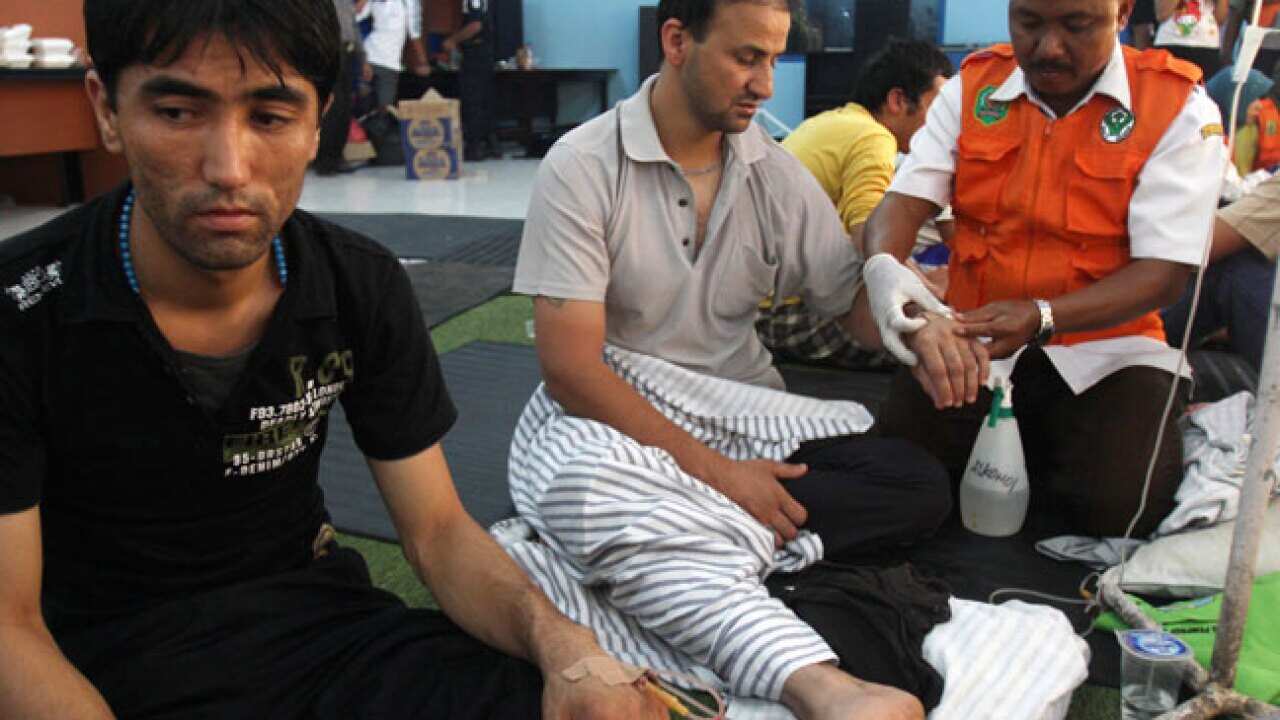
Local television showed half a dozen survivors at a shelter in Trenggalek, the Javanese town closest to the scene of the sinking, some with dazed, empty expressions as they sat on the floor drinking and eating.
Several others were taken to a nearby hospital in critical condition.
Khadzim Huzen, a 30-year-old Afghan, told AP that after the big wave hit, the ship started tipping into the water, and everyone rushed to the front.
A fight broke out for life jackets.
There were only 25, he said, and nine already had been taken by the crew.
"In the end, as everything was being swallowed up by the water, we just grabbed hold of anything we could," he said. "We formed small groups in the water and tried to help each other stay afloat."
At Prigi, the nearest port, several members of the national search and rescue team were getting ready to head out to sea, empty body bags stacked up on the deck, local television footage showed.
Lieutenant Alwi Mudzakir, a maritime police officer, said so far 33 people have been rescued, many suffering from severe dehydration and exhaustion.
He was worried - as the hours passed - that no one else would be found alive.
Weather was bad on Sunday and four fishing boats, two helicopters and a navy ship already involved in the operation were battling four-metre-high waves.
"They have scoured an 80-km radius but haven't found anything," Mudzakir said, adding that currents were very strong.
Share


