
With federal officials’ acknowledgment that nearly an entire unit of FBI forensic examiners overstated testimony about hair matches for decades, legal analysts say the question now is how courts and prosecutors will respond to criminal convictions that may have relied on such evidence.
A sampling of cases in Massachusetts and North Carolina shows the challenges facing convicts seeking to appeal. They also pose a reminder that state and local forensic experts trained by the FBI testified against defendants, too, using the same microscopic hair comparison methods now deemed scientifically erroneous.
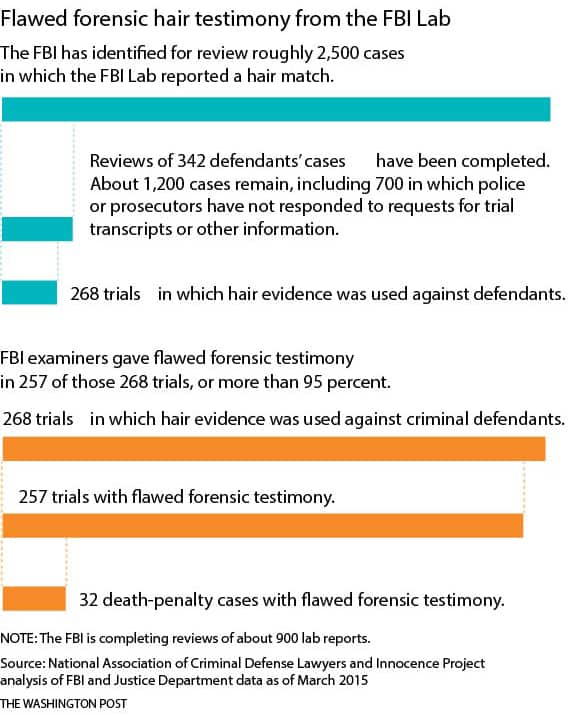
In a joint statement Monday with the two outside legal groups assisting them, the Justice Department and the FBI acknowledged that 26 of 28 FBI examiners gave flawed testimony or reports in at least 90 percent of the 500 criminal cases reviewed so far, including in 96 percent of the 268 trials in which examiners gave evidence against defendants. The cases in question date to 1972.
“Such statements are no longer being made by the FBI,” which now conducts DNA testing on hair in cases of visual matches, said Amy Hess, FBI executive assistant director for science and technology.
News that makes sense
Your trusted source for staying up-to-date with the world around you. Get free daily news updates and analysis, straight to your inbox.
Sen. Patrick J. Leahy (Vt.) and Rep. Eddie Bernice Johnson (Tex.), the ranking Democrats on the Senate judiciary and House science committees, called on Congress to pass forensic-science reforms to hold examiners to the highest standards. “This kind of gross misconduct simply cannot be tolerated in our criminal justice system,” Leahy said.
Prosecutors and defense lawyers are being notified to determine if the outcome of cases hinged on the problem testimony. The FBI has offered new DNA testing, and the Justice Department will drop procedural objections to appeals in federal cases.
But the picture is different in state cases, where most errors occurred. Biological evidence in these cases often is lost, destroyed or degraded. Only California and Texas specifically allow appeals when experts recant or when scientific advances undermine forensic evidence at trial.
According to the Innocence Project, which along with the National Association of Criminal Defense Lawyers participated in the government review, scientifically invalid forensic testimony should be considered a violation of due process and grounds for appeal, as courts have held with false or misleading testimony.
“Nobody disputes that mistakes are made or that mistakes are inevitable,” said M. Chris Fabricant, director of strategic litigation for the Innocence Project. “But here we have an ethical and moral obligation to address these individual cases.”
In Massachusetts, attorneys for George Perrot, in prison for nearly 30 years after being convicted of raping a 78-year-old woman in Springfield in 1985, are seeking a new trial. Perrot is among the first defendants notified of the FBI errors who have asked for new trials in the absence of DNA evidence.
Perrot, who was 17 at the time of the rape and had multiple burglary arrests, was identified in a purse-snatching the night of Dec. 7, 1985. After lengthy interrogation, he confessed to burglarizing the homes of two elderly women in his neighborhood a week earlier but denied attacking one of the women who said she was raped, according to court papers.
The victim declined to identify him. But at trial, an FBI expert testified that he had found a hair matching Perrot on the victim’s bedsheet, court papers said.
“It would be a substantial miscarriage of justice to keep Perrot imprisoned on the basis of this now indisputably false and misleading forensic testimony,” his lawyers wrote in seeking a new trial.
Interactive: Flawed forensic hair testimony from the FBI Lab
Perrot’s attorneys say the original prosecutor was reprimanded by the state bar for falsifying Perrot’s signature on a confession to the crime and other similar crimes, in an attempt to get alleged co-conspirators to confess. They also say inconsistencies with other evidence suggest police misconduct and perjury.
Prosecutors say biological evidence has been destroyed and cannot be tested for DNA. They say that Perrot did not appeal in a timely manner and previously challenged the FBI evidence, and that there was other evidence of guilt.
“The Commonwealth’s case against the defendant was strong. Justice was done in the defendant’s case,” the Hampden district attorney’s office wrote.
In North Carolina, Timothy Scott Bridges is seeking a new trial while serving life for the rape of an 83-year-old woman in Charlotte in May 1989. The disabled victim, who died of unrelated causes in 1990, gave varying descriptions of her attacker and never identified Bridges.
A Charlotte forensic expert, among hundreds trained by the FBI before 2000, matched two hairs at the crime scene to Bridges, then 22, according to court papers. The expert asserted there was only a 1 in 1,000 chance that they might have come from someone else, testimony the FBI review states “exceeds the limits of the science.”
There is no accepted research on how often hair from different people may appear the same. The FBI now uses DNA testing in combination with hair examination.
“If offered today, the hair evidence would be inadmissible, and without the hair evidence there was insufficient evidence to convict Mr. Bridges,” wrote his attorney, Lauren E. Miller, with North Carolina Prisoner Legal Services.
A spokeswoman said that the Mecklenburg County district attorney’s office has been communicating with Bridges’s defense team and that “the matter is under review.”
© The Washngton Post 2015







