
IN BRIEF
- Canadian Prime Minister Mark Carney is in Australia for a state visit, meeting with Prime Minister Anthony Albanese.
- Albanese told reporters "the world wants to see a de-escalation" while Carney said civilians must not be targeted.
Prime Minister Anthony Albanese has shifted his language regarding the war in the Middle East, putting him closer in line with his Canadian counterpart during an Australian visit, where critical mineral alliances have been strengthened.
The joint United States and Israeli strikes on Iran on Saturday have triggered retaliatory strikes on 11 countries, including towards Türkiye overnight before NATO air defences shot a ballistic missile down.
It has prompted countries like France and China, both permanent members of the United Nations Security Council, to speak against Israeli-US action and commit to promoting de-escalation and "resist any violation of international law and reject double standards".
On Wednesday, Canadian Prime Minister Mark Carney joined them, clarifying that his initial stance to support US-Israeli strikes did not grant the Trump administration a "blank cheque" and urged a "rapid de-escalation of hostilities".
Albanese, the first world leader to support the US-Israeli strikes on the weekend, had initially expressed concern about "regional escalation".
News that makes sense
Your trusted source for staying up-to-date with the world around you. Get free daily news updates and analysis, straight to your inbox.
On Saturday night, Albanese said Iran's nuclear program was a "threat to global peace and security" and the international community had been clear the regime "can never be allowed to develop a nuclear weapon".
"We support the United States acting to prevent Iran from obtaining a nuclear weapon and to prevent Iran continuing to threaten international peace and security," he said.
On Sunday, asked if Australia would support a more protracted conflict, Albanese said he was concerned about regional escalation, and called Iran's retaliatory attacks on the United Arab Emirates "an aggression and an escalation by Iran that is consistent with the nature of the regime."
On Thursday, as he stood side-by-side with Carney, there was a shift, as Albanese appeared to call for broader "de-escalation" of the conflict.
"I think the world wants to see a de-escalation, and wants to see Iran cease to spread the destinations of its attacks," he told reporters in Canberra.
Carney echoed the lines, stopping short of calling for a ceasefire, stating that "right now there is a spreading of hostilities and before we get there, there needs to be ending of targeting civilians and civilian infrastructure".
Both leaders faced questions from journalists about why their initial statements did not urge de-escalation, with their European counterparts used as an example.
Carney said the statement issued by both Canada and Australia took place at the very beginning, stating that while a wider war was a possibility, "there are no certainties in conflict".
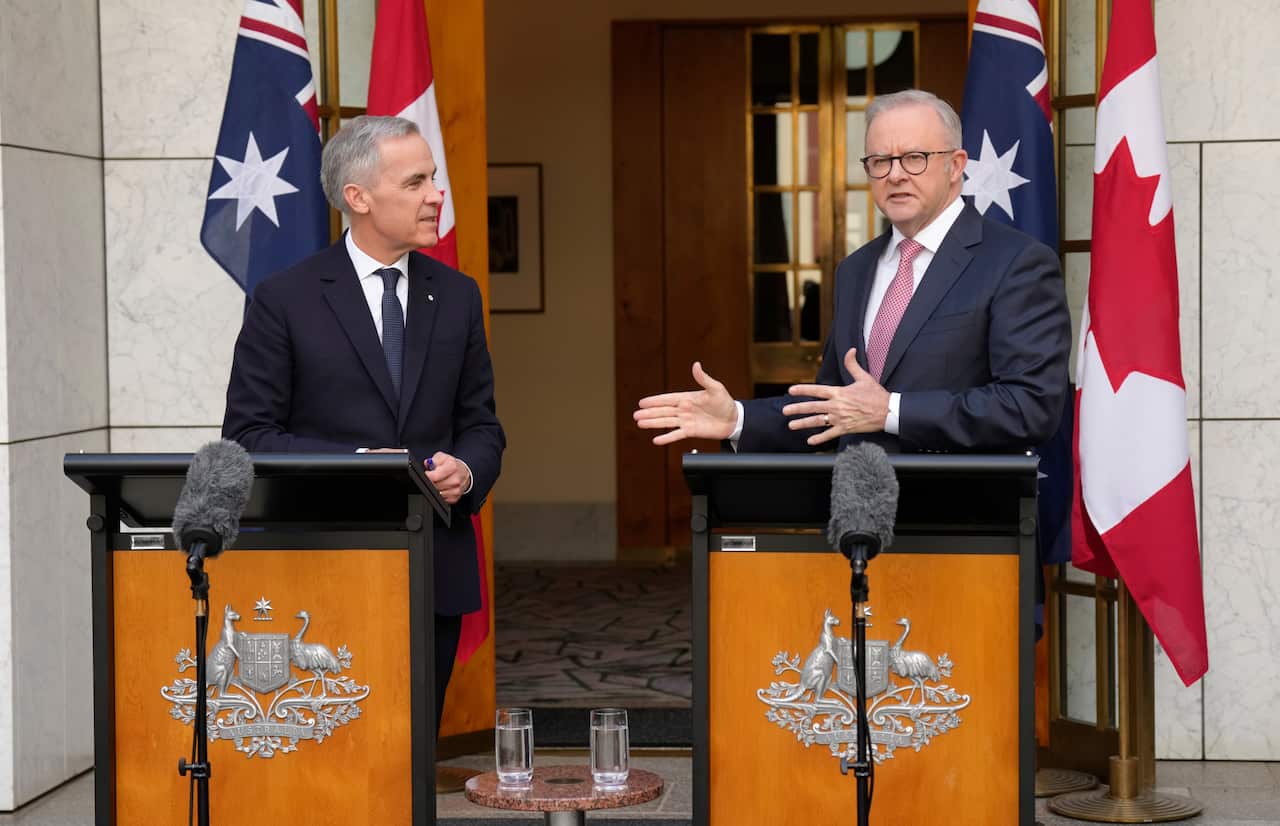
"So, now that the conflict has moved on, now that the conflict is involving ... a much wider group," Carney said.
"We absolutely stand by the fundamental principle that Iran should not be allowed to have a nuclear weapon and to continue to be a serial violator of international law," he added.
The US and Israel have argued that their attacks on Iran are to prevent the country from acquiring nuclear weapons.
Carney urges convening of 'rare' middle powers
It followed an announcement that Australia would join a critical minerals alliance run by the G7, with Carney urging the two countries boost their co-operation on a range of fronts.
"Under increasing pressure, we want to work together and with our partners to uphold and defend peace, security and prosperity," Carney said in a major address to federal parliament.
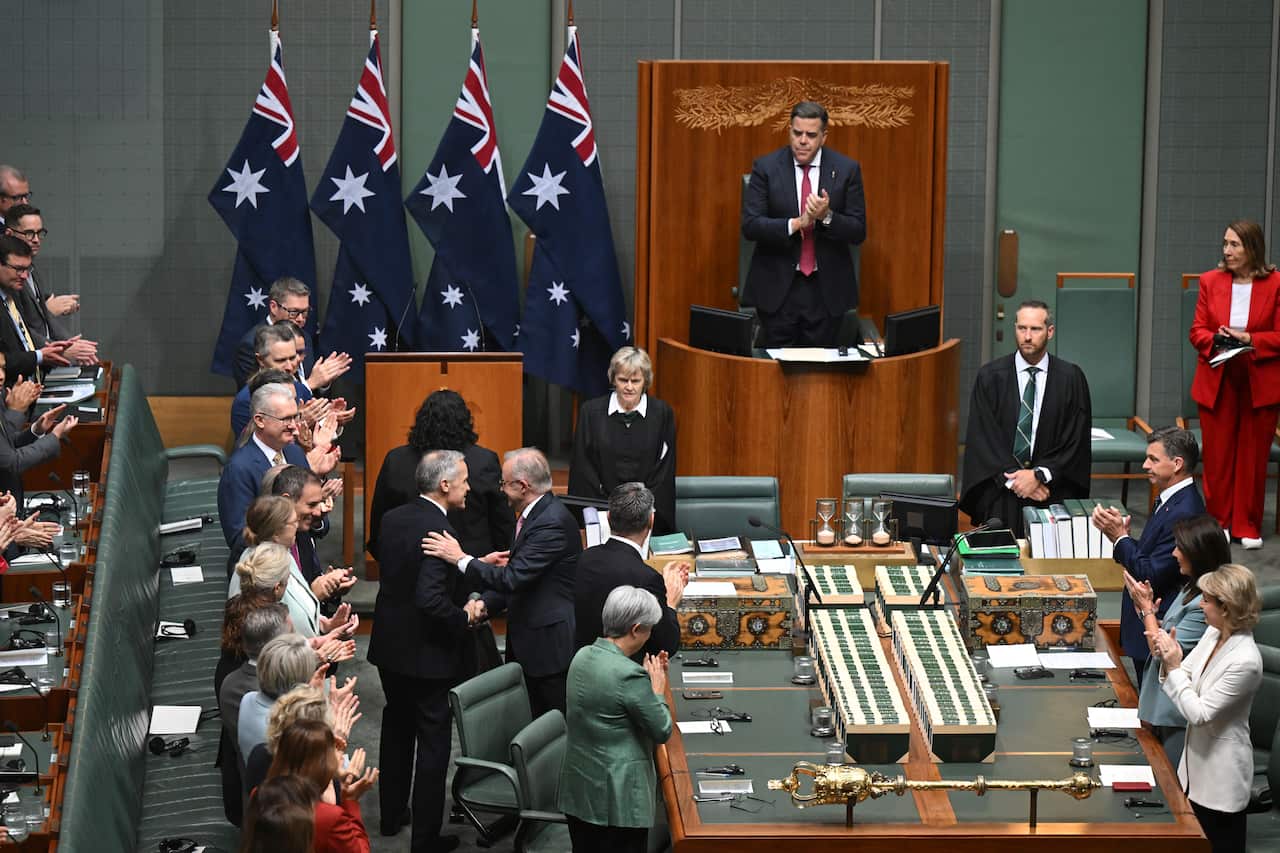
He referenced an abandoning of the rules-based world order, saying that "from this rupture, we can build something better, more prosperous, more resilient, more just".
Carney has described Canada and Australia as strategic cousins, saying the relationship between the two countries has been built up by choice, not by geography, over centuries.
"Great powers can compel. But compulsion comes with costs, both reputational and financial. Middle powers must convene to matter, but not everyone can," he said.
"Middle powers like Australia and Canada hold this rare convening power. Because others know we mean what we say and we will match our values with our actions."
— With additional reporting by the Australian Associated Press.
For the latest from SBS News, download our app and subscribe to our newsletter.







