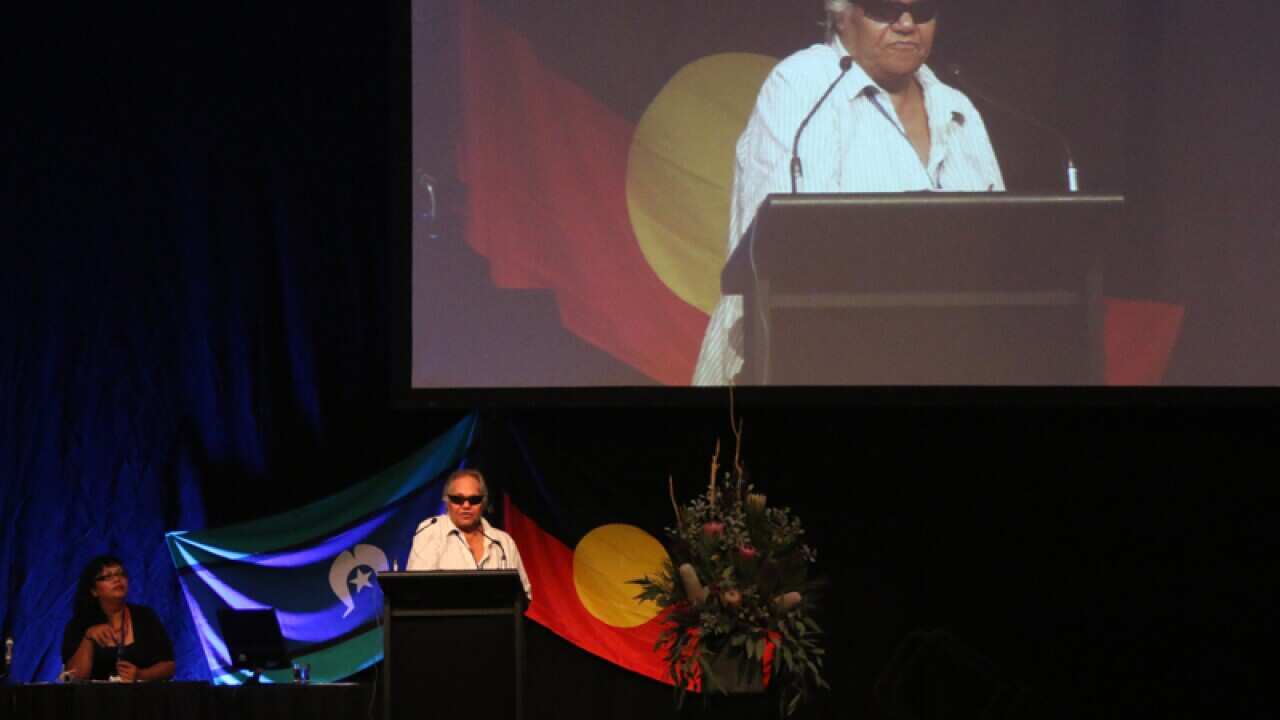
Rosalie Kunoth-Monks has questions about the way people she loved ended their lives that might never be answered.
"What drove our loved one to grab a rifle, put it in their mouth and blow their brains out? What drove a 14 year old ... to fashion a noose, and to jump and swing from a tree?" asks the political activist and elder from the Utopia region of Central Australia.
Almost 400 people gathered in Alice Springs from around the country have similar questions, and they have united for Australia's first conference on the prevention of indigenous suicide.
Suicide is the leading cause of death for indigenous people aged 15-35, and if not collectively addressed soon "we are headed for catastrophe", said Richard Weston, CEO of the National Healing Foundation.
The conference heard the causes are complex and varied but can generally be traced back to intergenerational trauma relating to white settlement, cultural dislocation, alcohol and drug abuse, family violence, a lack of early childhood support, poor educational attainment, a lack of work and welfare dependency.
The issues lead to a sense of isolation and decimated self-esteem that for some people can only be resolved by ending their own lives.
Dorrie Wesley from the Central Australian Aboriginal Congress said the early childhood period is critical to the prevention of self-harm and Aboriginal children are 24 times more likely to be behind their non-Aboriginal peers when starting school.
"If more of our children are well cared for and protected from the effects of alcohol and violence in their early years they will have the capacity and capability to get a job and lead a stable life, as well as the capacity and capability to play a part in their culture," she said.
Otherwise they become distressed and violent and lack the emotional regulation to control their feelings, which either turns outwards to others and sees them thrown in jail, or turns inwards and results in suicide, Ms Wesley said.
In the NT, where women are 80 times more likely to be hospitalised for assault than non-Aboriginal women and children are seven times more likely to be subjected to violence and abuse, men hold the key to solving this problem, she said.
"It is men who can stop this, men who can stop the violence and rape, it is men and not everyone else who has to change," she said.
The conference continues.
INDIGENOUS SUICIDE IN AUSTRALIA:
* Under 14s are almost 9 times more likely to take their own lives than non-indigenous children
* One in three 15-35-year-olds die by suicide
* Nearly half of all deaths for people aged 18-29 is by suicide
* Estimated to account for 10% of all indigenous deaths
* It is on the rise year on year
* The Kimberley in WA has one of the highest suicide rates in the world
(SOURCE: Gerry Georgatos, researcher, Institute of Social Justice and Human Rights; May 2016)
Share


