The alleged gunmen behind Sunday's attack at Sydney’s Bondi Beach had "aligned" themselves with a terrorist organisation and travelled to the Philippines shortly before the attack was carried out, police say.
Fifteen people were killed by two gunmen during the attack, which targeted a Hanukkah celebration, with the victims' ages ranging from 10 to 87.
Police allege the massacre, which has been declared a terror attack, was carried out by 50-year-old Sajid Akram and his 24-year-old son Naveed Akram. The 50-year-old was killed in a shootout with police during the attack, while his son remains in a coma under police guard in hospital.
NSW Police commissioner Mal Lanyon said during a press conference on Tuesday that a vehicle registered to Naveed Akram, seized by police at the scene of the attack on Sunday, contained two homemade flags representing the self-proclaimed Islamic State (IS) group, along with improvised explosive devices.
Lanyon also confirmed media reports that the two alleged offenders travelled to the Philippines last month, but said the purpose of that trip and where exactly they travelled within the country remained under investigation.
News that makes sense
Your trusted source for staying up-to-date with the world around you. Get free daily news updates and analysis, straight to your inbox.
"We continue to work through the motive of this tragedy," he said.
Attack appeared 'inspired by' IS, prime minister says
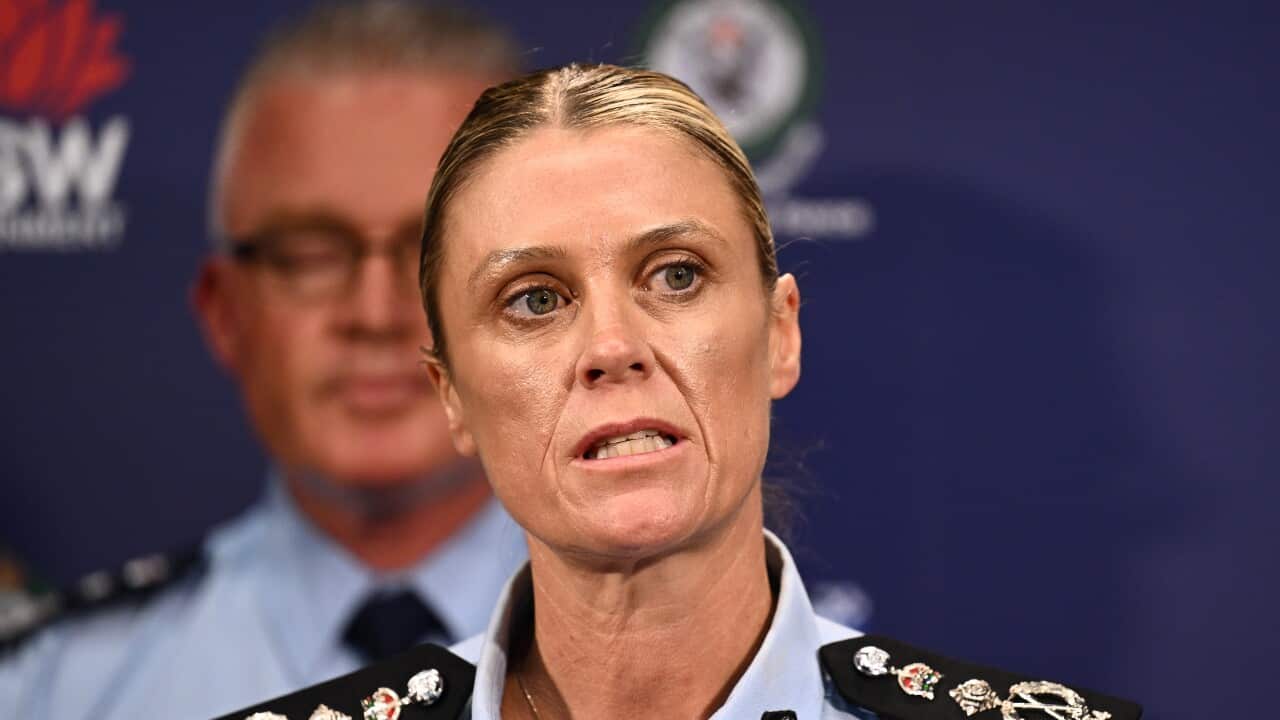
Prime Minister Anthony Albanese and Australian Federal Police commissioner Krissy Barrett both said there were early indications the attack appeared to be "inspired by [IS]" during Tuesday's press conference.
Barrett, in her first public comments on the incident since returning to Australia from an overseas work matter, said there was no evidence to suggest there were others involved in the attack, but said that could change given how early the investigation was.
"Alleged evidence has provided investigators with a swathe of information that has enabled them to make this initial assessment about the alleged individuals involved and their motivations," she said.
"These are the alleged actions of those who have aligned themselves with a terrorist organisation, not a religion."
Barrett said the NSW joint counter-terrorism team — including the AFP, NSW Police, ASIO and NSW Crime Commission — was continuing to review material seized during search warrants.
Lanyon also corrected earlier details provided about the firearms licence registered to Sajid Akram. Initially, it had been said that he had held a firearms licence since 2015.
Lanyon said that Akram had applied for a licence in October 2015, but did not get a photo taken as required during the process, and it lapsed in 2016.
He applied for a second category AB licence — permitting him to own the long-barrelled firearms allegedly used in the attack — in 2020, and it was issued in 2023.
The father legally owned six registered firearms, with four found at the scene of the attack and two recovered by police from a house in Campsie during a raid.
"He was licensed to hold a Category AB licence, and the firearms that we have seized were attached to that licence appropriately," Lanyon said.
The 2023 licence was granted after four years after Sajid's son Naveed Akram had been investigated by the Australian Security Intelligence Organisation because of his connections with two people who both subsequently went to jail, but there had been "no evidence" Naveed had been radicalised.
NSW Premier Chris Minns suggested a "controversial" aspect of future gun law reform in the state could be allowing police to rely on criminal intelligence, not just a criminal record, to determine whether someone should be granted or retain a gun licence.
For the latest from SBS News, download our app and subscribe to our newsletter.







