
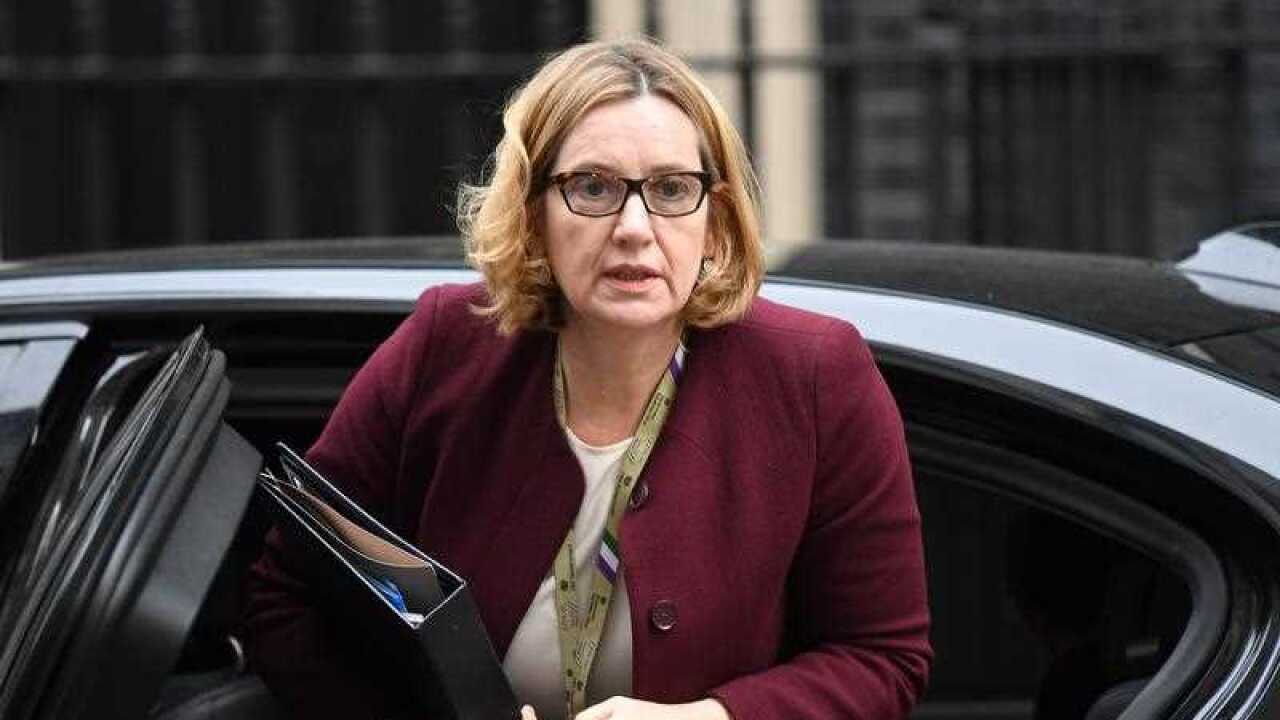
Britain's interior minister Amber Rudd resigned on Sunday amid claims she misled lawmakers over whether her department held targets for removing illegal immigrants in the country.
"The prime minister has tonight accepted the resignation of the home secretary," said a spokesman for the office of premier Theresa May.
Rudd telephoned May to inform her of the decision following a week of intensifying pressure over an immigration scandal and increasing calls for her to quit.
That had followed weeks of scrutiny of her handling of another Home Office scandal: the targeting of the so-called Windrush generation.
Commonwealth citizens primarily from the Caribbean who came to Britain in the post-World War II decades had been wrongly threatened with deportation, provoking an outcry when it emerged earlier this month.
Rudd was forced onto the defensive after this week telling a parliamentary committee the Home Office did not keep targets for the number of illegal immigrants removed from Britain.
Despite maintaining she was unaware of the existence of such lists, mounting evidence about the extent of the knowledge within the Home Office of the targets made her position increasingly untenable.
Rudd a 'human shield' for May: Opposition
The erroneous targeting of the Windrush generation stemmed from a "hostile environment" immigration policy pioneered by May when she was interior minister between 2010 and 2016, and then continued by Rudd.
The opposition Labour Party had accused Rudd of incompetence and being a "human shield" for May.
"This was inevitable, the only surprise is that it took so long," said shadow interior minister Diane Abbott following Rudd's resignation.
"The architect of this crisis, Theresa May, must now step forward to give a full and honest account of how this inexcusable situation happened on her watch."
Rudd's decision to step down will come as a major blow to Conservative leader May, who publicly declared her "full confidence" in Rudd as recently as Friday and faces potentially bruising local elections across England this Thursday.
She had been due to make another appearance before parliament on Monday, but instead opted to resign late Sunday.
Rudd's departure shifts Cabinet's Brexit balance
Rudd, who had led the Home Office since 2016, was seen as a moderate on the European Union and a balancing force in a cabinet made up of several big-name pro-Brexit figures, such as Foreign Secretary Boris Johnson and Environment Secretary Michael Gove.
Thousands of people from the "Windrush generation" were invited to Britain to plug labour shortfalls between 1948 and 1971, but some of them and their descendants have been caught out by tighter immigration rules.
Some of these migrants have been asked to provide documentary evidence of their life in Britain they had never previously been required to keep, and in some cases denied rights, detained and threatened with deportation.
The crisis has cast Britain in an unsympathetic light and raised awkward questions about how the aggressive pursuit of lower immigration sits alongside the desire to be an outward-looking global economy.





