This audio is voiced by AI and may occasionally mispronounce words.
Share your feedback and help us improve this feature. Read more about how we use AI at SBS here.
Lauren (not her real name) used to speak with an American accent. It would constantly start conversations about United States politics — far from her first choice of small talk — while out walking her dogs in her Brisbane neighbourhood.
Since hiring a dialect coach and introducing Australian inflections to her speech, it's been "a relief not serving as the unofficial US representative for my postcode", she tells SBS News.
She can now chat about things she actually enjoys discussing, like her pets and local community.
"Seeing news in the US sometimes feels like watching the house you grew up in catch fire," she says.
SBS News spoke with a dozen Americans living in Australia about navigating life abroad at a time when the US, under Donald Trump's second presidency, looms particularly large in global conversation and is being viewed far more negatively by Australians than in years past.
News that makes sense
Your trusted source for staying up-to-date with the world around you. Get free daily news updates and analysis, straight to your inbox.
Almost all of them say they're continuously fielding questions about what's going on back home, whether they're at work, the pub, seeing friends or interacting with strangers. Many of them find it exhausting or difficult to escape at times.
"Sometimes I don't even want to open my mouth or [I want to] fake my Aussie accent, because, you know, girl, I just want to get my hair cut," says Melissa Vincenty, an immigration lawyer and dual citizen who splits her time between Sydney and Hawaii.

Mallory Fish, a former Connecticut resident now living in Melbourne, says whenever the topic of politics comes up, she "can literally feel [her] blood pressure rising".
"A lot of people have a lot of curiosity, and to them, they don't get an opportunity to interact with Americans a lot. Whereas I'm having this conversation multiple times a week," Fish says.
For some, they're already dealing with complicated feelings of guilt, estrangement or distress as they process seismic political shifts in the US from afar — while members of their families continue to live there.
Having to discuss it routinely with strangers can compound the stress.

"It's very draining," says Jack Cutler, a Sydney-based dual national born in New York.
"I feel like I always have to answer for everything that's going on over there."
Interactions 'quite telling'
The US' image has declined in many countries since last year amid low confidence in Trump, according to data from the Washington DC-based Pew Research Center.
Of 24 countries surveyed, Sweden recorded the least favourable views: 79 per cent held a negative opinion, up from 44 per cent a year earlier.
Australia and Türkiye jointly ranked second at 71 per cent.
A majority of Australians — 58 per cent — said they had no confidence at all in Trump as a world leader.
Other polls indicate Australians are concerned about the effects of Trump's presidency on democracy and security.
According to a recent survey by the United States Studies Centre at the University of Sydney, only 16 per cent of Australians think Trump's second term has been good for Australia so far, while almost 75 per cent are concerned about the future of US democracy.

Cory Alpert is a PhD researcher at the University of Melbourne. He moved to Australia last year after serving the Biden administration for several years as part of the advance team, primarily coordinating travel for then-vice president Kamala Harris and her husband Doug Emhoff.
Sometimes people will talk to me as if I come from like, a war-torn country that deserves their pity.
"It's kind of an odd interaction when I think about [how] I come from the wealthiest country on Earth, and yet people are talking to me as though I'm sort of fleeing some really dangerous situation," he tells SBS News.
"I think it's quite telling for how we broadly think about what's happening in the United States."

It's not hard to see how people feel that way, Alpert says, pointing to immigration raids in which people have been swept off the street and deported, reports of visitors being denied entry over their political views, and what he describes as a rapid slide toward "very scary authoritarian politics".
He suspects the "really intense curiosity" comes from people trying to make sense of the overwhelming stream of information reaching them through social and traditional media.
"I think there's something in there of: 'Okay, you're a person with lived experience of this place that is both fascinating and terrifying and all encompassing of everything that's in my news world'."

There are around 118,000 US-born people living in Australia, according to 2024 data from the Australian Bureau of Statistics — a comparatively small migrant cohort. It falls outside the top 10 overseas-born groups, which are led by England (963,560), India (916,330) and China (700,120).
'Everybody is paying attention'
The US has long been a dominant source and subject of international news, but its news cycle has been particularly relentless in recent years.
Australian news audiences are much less politically polarised than those in the US and more likely to identify with the political centre, the University of Canberra's 2025 Digital News Report observed.
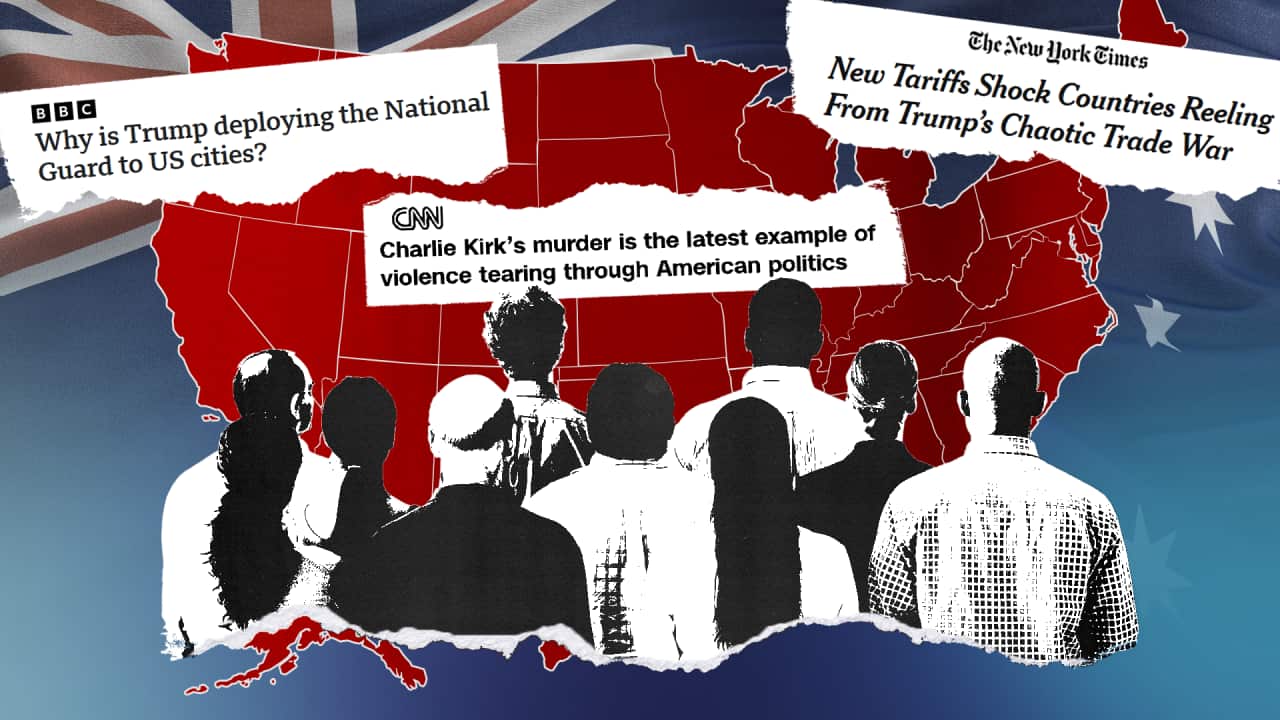
After an intense 2024 presidential election season, Australian media outlets this year have continued to devote substantial coverage to Trump's hardline mass deportation agenda, his sweeping cost-cutting and regulatory rollbacks, escalating tariff fights with trade partners, deployments of National Guard troops to American cities, and a series of interpersonal clashes with world leaders and US allies.

Major US flashpoints — including the assassination of conservative activist Charlie Kirk, the protracted government shutdown and other rolling crises in Washington — have all received prominent attention in Australia.
Even internal factional disputes within the Republican Party and local elections are now drawing Australian audiences, underscoring how closely many are following US political drama.
For Americans living in Australia, that outsized focus in the news can make everyday interactions feel more politically charged.
Vincenty, who moved to Australia in 2012 with her family, says moments like this can catch her off guard.
"Yesterday I was volunteering at Bunnings … and someone was asking me about [US Congresswoman] Marjorie Taylor Greene," she says.
"And I'm like, 'What are you talking [about]?"
Another American expat, Ashley, who lives in regional Victoria, says she often meets people with granular knowledge of the US political system who are not particularly engaged with Australian civic life.
"I think a lot of Australians don't even know who their MP is," she tells SBS News.
"But then I have people who … start talking to me about the House of Representatives and the Senate and elections and protests, the Supreme Court, Ninth Circuit judges in the US."
Bruce Wolpe is an author and commentator on US politics in Australia, and a senior non-resident fellow at the United States Studies Centre at the University of Sydney.
He says Trump's "unique ability to take all the oxygen out of the room" has driven a change in audience appetite and, in turn, the editorial decisions made by major news organisations in Australia.
"When we wake up every morning … the lead story is what happened in Washington. What the hell did [Trump] do today? And that displaces Australian news. It's really shocking."
Whether people love or hate Trump, Wolpe says, "everybody is paying attention".
Evolving views under Trump v Obama
Australian interest in the US grew during former president Barack Obama's term in office, but that has now ballooned into "intense interest" under Trump, according to Wolpe.
Interest doesn't equate to endorsement, however. The perception that former Liberal leader Peter Dutton was modelling his leadership on Trump's was a political drag in this year's Australian federal election, Wolpe notes, pointing to the Liberals' resounding loss.
Whereas Obama, Trump's Democratic predecessor, was seen by many Australians as a source of "optimism and hope" and "a real turning of the page of America and its history".
A 2008 survey by the University of Sydney found Obama polling at 76 per cent among Australians in the weeks leading up to that year's presidential election, compared with 13 per cent for his Republican rival John McCain.
When Trump took office for the first time in 2017, just 22 per cent of respondents in Australia expressed confidence that he would "do the right thing" regarding international affairs, a Pew Research Center survey found at the time.
Comparatively, 64 per cent expressed confidence in Obama in the final years of his presidency.
Several Americans who have lived in Australia since the Obama era described to SBS News a noticeable shift in their day-to-day interactions since Trump was first elected.
"I've gone from arriving during the Obama era when Aussies swooned over anything America to watching a negative shift once the Trump era began," says Shelby Lynne, who moved from Maryland, US, to Victoria more than a decade ago.
"It's been a wild experience seeing how differently people view Americans and the US over the past decade. It's a total fall from grace."
I felt proud to say I was American, and now it's almost embarrassing to say that I am an American.
For American expats right now, the distance from home can bring a conflicting blend of emotions.
"Living in Australia as an American, there's a mix of gratitude and ache," Ashley explains.
"I'm incredibly grateful for the stability, the healthcare and the general calm here that isn't necessarily in the US right now.
"I'm proud to be an American. I love my country and the people, but I'm also heartbroken by everything that's happening there."
For the latest from SBS News, download our app and subscribe to our newsletter.







