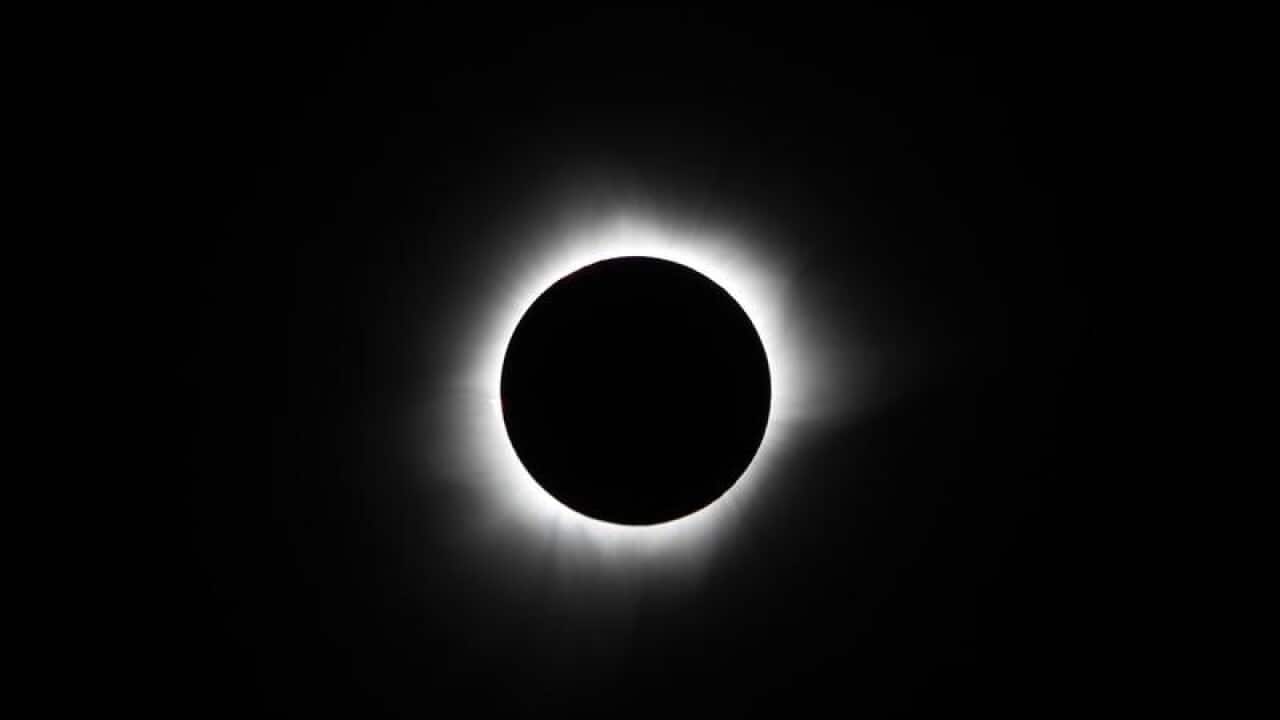
Q&A ON WHAT WILL OCCUR DURING A SOLAR ECLIPSE:
Question: How does a total solar eclipse occur?
Answer: It occurs when the moon comes between the Earth and sun, completely obscuring the sun in the process. It is only observable during a new moon, when the Earth, moon and sun come into direct alignment. In broad daylight it becomes dark for a few minutes, and stars are visible in the sky.
Only in a narrow swathe of the Earth's surface, a maximum of 270km wide, will the total eclipse be visible - where the core shadow of the moon falls onto the planet. Those finding themselves in the half shadow will experience a partial eclipse in which the moon blocks only part of the sun.
Q: Why doesn't it happen every month?
News that makes sense
Your trusted source for staying up-to-date with the world around you. Get free daily news updates and analysis, straight to your inbox.
A: Because the moon's orbit is tilted slightly toward Earth's orbit. Therefore the new moon wanders away from the Earth, either above or below the sun. Only when the sun, moon and Earth are aligned in a straight line will the moon cast its shadow upon the Earth, and only then do we experience a solar eclipse.
Q: Where is the total solar eclipse visible on August 21?
A: It will be visible in 14 US states - from Oregon in the northwest to South Carolina in the southeast. It will be experienced as a partial eclipse in parts of Europe, Africa and South America.
Q: How long is the total eclipse visible?
A: In the individual US regions, the total solar eclipse will last a maximum of two minutes and 40 seconds.
An eclipse can, depending on the circumstances, last up to seven and a half minutes. For example, on July 22, 2009, a total eclipse over China and the western Pacific Ocean lasted 6 minutes and 39 seconds.
The duration of an eclipse is influenced, among other things, by the apparent diameters of the moon and the sun combined with the distance of each from Earth during their respective orbits.
Q: Why is a total eclipse something special?
A: It is quite rare for a human to experience the phenomenon more than once in the same place. The next total solar eclipse is expected on July 2, 2019, and will be visible over the Pacific Ocean, including some cities in Argentina and Chile.
Q: Where in Europe will it be possible to witness the phenomenon on August 21?
A: In western Europe, including Portugal, Spain, western France and Britain, a partial eclipse will be visible. In Lisbon, for example, barely a fifth of the sun will be obscured.







