In brief
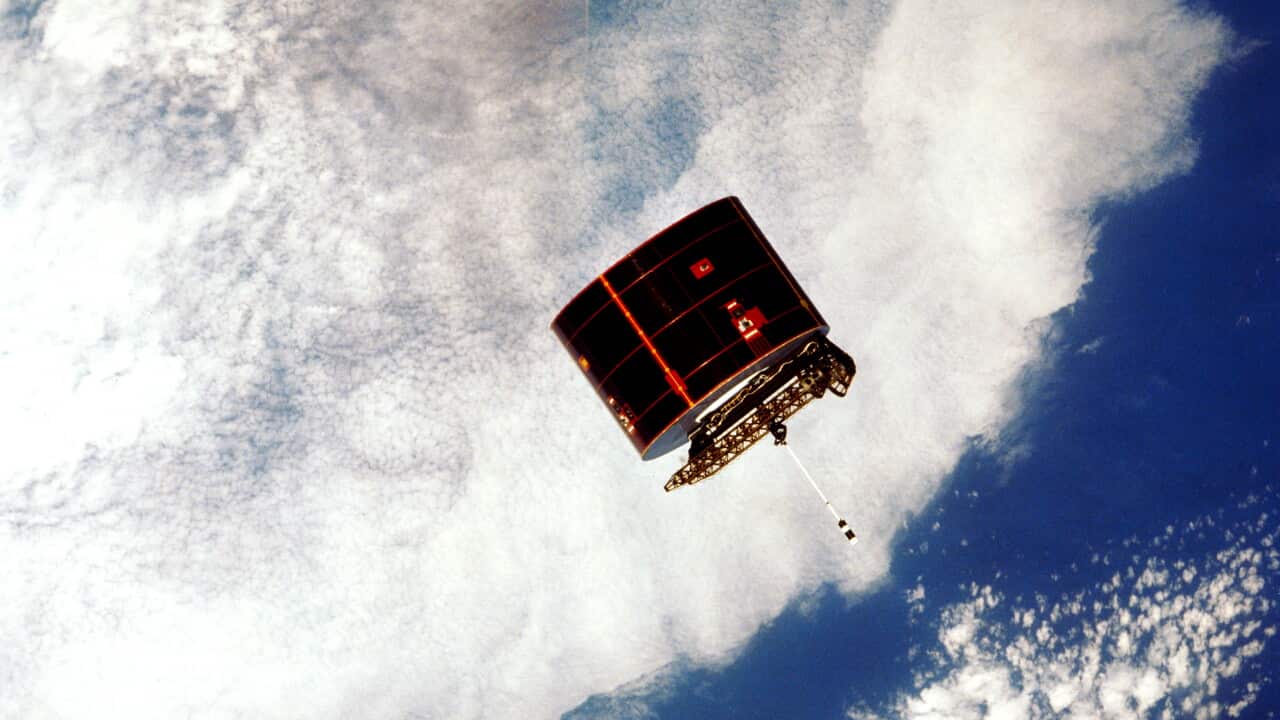
- The US has acknowledged, for the first time, that it has deployed weapons in orbit around Earth.
- Experts fear the timing of the announcement may kickstart a weapons-centric space race internationally.
The United States has confirmed for the first time that it has deployed weapons in space, a remarkable revelation after warnings about countries such as Russia possibly weaponising a global frontier long agreed in treaties to be used for only peaceful purposes.
US Air Force secretary Troy Meink said the US has fielded "on-orbit space control weapons capable of defending the Joint Force against hostile adversary action".
Meink did not detail what the weapons were, how they work or if they were targeting other objects in space or on Earth.
The US had warned two years ago that Russia was developing a new space-based, anti-satellite weapon, though the White House said the danger wasn't imminent at the time.
But reports of the anti-satellite weapon reflected longstanding worries about space threats from Russia and China, given that much US infrastructure is dependent on satellite communications. The US has also previously demonstrated its own abilities to shoot down satellites from Earth.
News that makes sense
Your trusted source for staying up-to-date with the world around you. Get free daily news updates and analysis, straight to your inbox.
In his remarks to the Air and Space Forces Association's Air, Space & Cyber Conference on Tuesday AEST, Meink also said the Air Force was adding more autonomous systems to its capabilities and predicted the service would look "radically different" by 2032.
For example, he foresaw one-way attack drones replacing artillery as the "primary killer".
"We are increasing readiness against existing threats," he said.
Analysts said that the revelation by the US confirmed an open secret, but the timing of the announcement risked exacerbating tensions with China and the risk of a weapons race in space.
The revelation comes as the Trump administration puts a growing focus on space.
Why does the US want weapons in space?
In 2019, during his first term, US President Donal Trump created the Space Force as a separate military branch. In his second term, he has announced the Golden Dome missile defence system, which includes plans to put US weapons in space.
Trump said last year that he expected the system would be "fully operational before the end of my term", which ends in January 2029.
He said the system would have the capability of intercepting missiles "even if they are launched from space".
Trump also directed the Pentagon to pursue the space-based interceptors in an executive order during the first week of his presidency.
The Congressional Budget Office estimated that just the space-based components of the Golden Dome could cost as much as US$542 billion ($760 billion) over the next 20 years.
For the US, both Russia and China — its two main geopolitical rivals — pose potential threats to US interests in space.
China "develops and operates space and counterspace capabilities as part of a military modernisation strategy," according to the US Space Force.
Russia, meanwhile, "views space as a warfighting domain and believes space supremacy will be a decisive factor in future conflicts", it said.
The militarisation of space is as old as the space race itself — as soon as the USSR's Sputnik was launched into orbit as the first probe in space in 1957, the US and Russia began exploring ways to both arm and destroy satellites.
India in March 2019 said it had destroyed a low-orbiting satellite, following in the footsteps of Russia, China and the US, in a missile test that proved the nation was among the world's most advanced space powers.
What are the US capabilities?
The US statement did not provide concrete details about what weapons are deployed in space and how many.
"Space control encapsulates the mission areas required to contest and control the space domain — employing kinetic and non-kinetic means to affect adversary capabilities," the statement said.
"These capabilities can be employed for offensive and defensive purposes," it added.
Non-kinetic means could include lasers to blind satellites, or even electromagnetic or cyber jamming of their data links.
Can weapons in outer space be regulated?
The biggest worry was once about nuclear weapons in space, but the superpowers and other countries signed the Outer Space Treaty in 1967, banning weapons of mass destruction in orbit.
Since then, Russia, the United States, China and India have explored ways to fight in space outside of that treaty, including by targeting rivals' satellites, which are key for military communications, surveillance and navigation.
"There is a regulatory vacuum because Article 4 of the 1967 treaty only forbids weapons of mass destruction and nuclear weapons in orbit," said space law expert Laetitia Cesari.
She said the topic would likely be on the agenda at the next UN disarmament meeting in November.
"Moscow and Beijing have been wanting to work for about 20 years on a treaty to prevent the placement of weapons in space," while "Western states are trying instead to work on the notion of responsible behaviour," Cesari said.
The US announcement "will likely give impetus to the restrictive approach that Moscow and Beijing are pushing for," she added.
Russia responds
Following the US' announcement, Russia called for weapons to be kept out of space.
"We believe that space must be free of any weapon," Kremlin spokesman Dmitry Peskov told reporters.
"We are counting on broad international consolidation to continue working toward the complete demilitarisation of space."
The Biden administration announced in 2024 that Russia was developing a space-based nuclear weapon that could loiter in space for long durations, then release a burst that would take out satellites around it.
That kicked off a renewed debate on the idea of weapons in space at the United Nations.
In April 2024, Russia vetoed a joint US-Japanese resolution that would have called on all countries not to develop or deploy nuclear arms or other weapons of mass destruction in space, as banned under a 1967 international treaty that included the US and Russia.
The treaty also declared that outer space was a global commons that could be used for only peaceful purposes.
The Russian delegation called the resolution hypocritical and a double standard and instead proposed a rival resolution to ban all weapons in space "for all time". It ultimately failed.
How might China react?
China on Tuesday warned against turning outer space into a "battlefield".
China's foreign ministry opposed the move, warning against the "weaponisation of outer space, turning it into a battlefield, as well as an arms race there".
"We urge the US side to stop expanding its military capabilities and preparing for war in outer space," ministry spokesman Guo Jiakun told a news briefing.
Song Zhongping, an independent military commentator based in Hong Kong and former Chinese army instructor, told the Agence France-Presse news agency the announcement was "no surprise at all" as the fact that the US possesses such weapons "has long been an open secret".
"The only difference is that the US used to keep it ambiguous, whereas now it has gone public, which shows that Washington is no longer trying to hide it."
"China will not stand by and do nothing", he warned, noting Beijing already has its own space station in orbit.
"Whether China deploys weapons in space will depend entirely on whether the United States moves in that direction," he said.
The Wall Street Journal said China supplied Iran with satellite imagery that enabled Iran to precisely target military facilities and kill US service members in Jordan in July — a claim China has denied.
For the latest from SBS News, download our app and subscribe to our newsletter.







