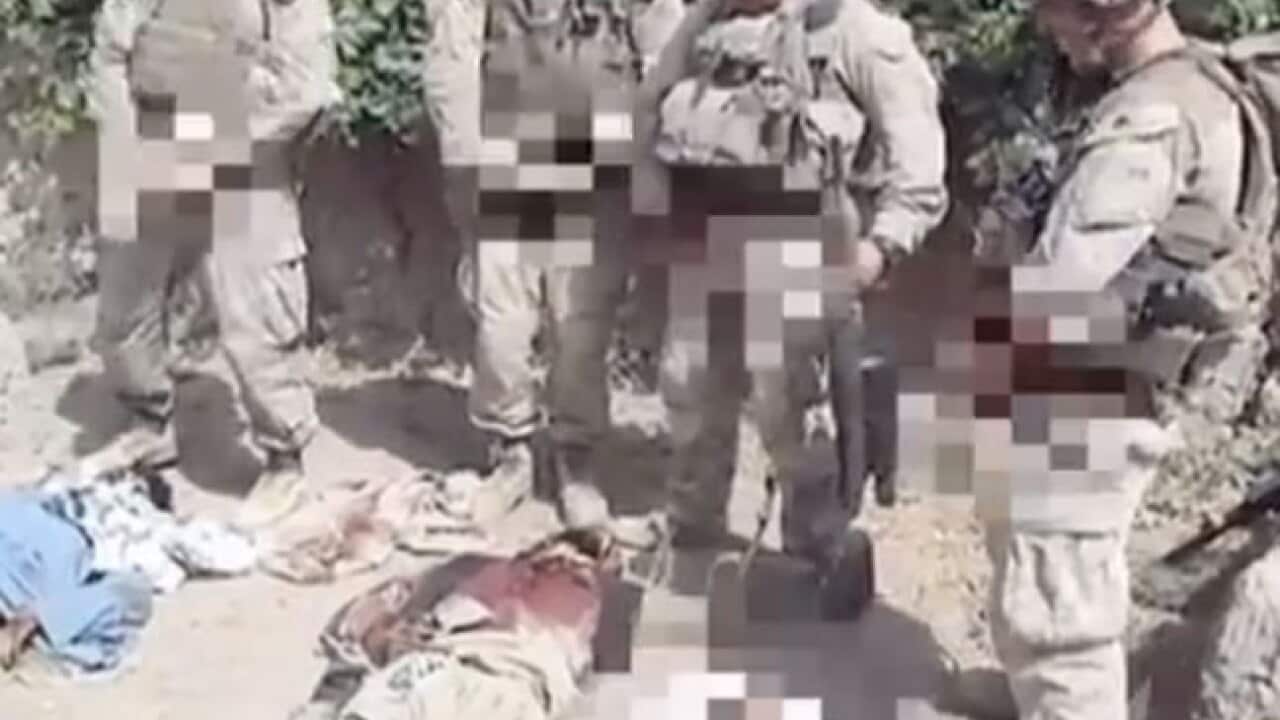
A video that emerged this week showing four US Marines apparently urinating on Taliban corpses prompted American condemnation and a Pentagon probe, with US Defence Secretary Leon Panetta pledging that 'those found to have engaged in such conduct will be held accountable to the fullest extent.'
The event evoked memories of previous abuses committed by US troops in Iraq and during the decade-long Afghan war.
In 2010, a so-called "kill team" was found responsible for a series of murders of Afghan civilians. Troops had planted weapons on the bodies to make them look like fighters, and removed teeth and fingers to show off as trophies.
In 2005, the bodies of two Taliban were burned, in blatant violation of Islamic customs, sparking tensions between Afghanistan and the US. Although there are many cases of body desescrations in conflict zones (Images of a slain US soldier's body being dragged through the streets of Mogadishu caused shock in 1992), but those carried out by a ligitimate army spark the most outrage.
SBS spoke to Dr Lynne McCormack from the University of Canberra about the psychology behind this type of behaviour.
News that makes sense
Your trusted source for staying up-to-date with the world around you. Get free daily news updates and analysis, straight to your inbox.
Q: This type of behaviour is not unheard of in warzones. Why do you think soldiers carry out these types of actions?
A: If you think about the role of soldiering, you've got young men - behaving and thinking like adolescents - sent off to kill. The training they get is necessarily about dehumanising, because you can't kill someone, or pull a trigger with the intent of killing someone, unless you to some degree dehumanise that person that you're going to kill.
There are studies that show that many soldiers, even though they are trained to kill, pull the trigger but do not aim directly at the person. This shows that they're not quite indoctrinated or completely without self-direction in some of these actions. So when you think about the training of soldiering which includes dehumanisation, you can't just switch on and off from that sort of training.
Peeing together is a bit of a bonding thing for men, traditionally. It's almost like they're finishing off the ritual. They've usually also got a lot of adrenaline rushing through their system after these things. There are many instances of war in which people have behaved in abominable ways and dehumanised themselves as much as anything.
They get caught up in the adrenalin and the group mentality, because when you're in a group individual responsibility decreases - there's a collective conscience that seems to somehow be lessened. If you were to ask each of those men individually have them separate from their group, they would probably be as appalled by their own behaviour as the general public, but in a group people get caught up.
Q: How common is this type of behaviour in war zones?
A: It's common in any society that's broken down. I think where you don't have the constraints of conscience, morality and the infrastructure to deal with behaviour that is non-acceptable to the group, you will find this sort of behaviour.
Q: In which other parts of society can you see this type of behaviour?
A: I think you see it in a whole range of areas, from pack rape and football violence to politicians - anywhere where individuals act out of accordance with their usual moral judgement and do things they would not normally have done.
Q: Would you say it's typical male behaviour?
A: I don't want to say it's typically male, it's more of a typical adolescent behaviour I think, there are many females who behave badly in groups. But in these types of situations there is a lot of adrenalin rushing around and if you top that off with testosterone , violence is often testosterone driven, and war is a male domain.
Q: What can be done to prevent these things from occurring?
Good leadership is key. A lot of my work is on growth out of adversity and out of complex adversity. One of the issues I'm particularly interested in is “betrayal trauma” and there are two main areas where you see betrayal trauma; you see it in young children who have been sexually abused or abused in other ways by caretakers, and you see it in young soldiers who are caught up having to act out behaviours that their own conscience may have trouble with, and in which the leadership had let them down. And they go off feeling blamed and ashamed when in actual fact they may have been forced into situations by poor leadership.
Good and moral leadership in the military is absolutely imperative to the good behaviour of young soldiers . The commanding officer should be held responsible for the actions of these men.
I don't want it to sound like I'm being sympathetic to these men, bad behaviour needs to be dealt with, but it's a bigger question than just these young men.
You take a young man, pump him up with adrenalin and testosterone and give him a gun and put him in a society which has no boundaries or structure, no law and order, he's likely to behave in ways that he's going to feel ashamed about. And the society from which he came is inevitably going to feel ashamed about it too.
Dr Lynne McCormack has worked as a clinical, health and educational psychologist specialising in complex trauma for over 20 years. Her areas of expertise include war and its effect on the individual.







