
Students are an important part of this policy conversation, so I was surprised to learn this week from the National Union of Students that despite many attempts they haven’t even been able to speak to Education Minister Christopher Pyne about the concerns with the legislation.
Students have a message they want to spread. They say the quality of university degrees has been going down and they are not convinced that deregulation and hiked fees will do anything to address this loss of quality.
Further, all of the decisions are being made by the Universities themselves and the Government, leaving users out of it.
President of the National Union of Students Rose Steele wants to talk to students and politicians.
Speaking to me on a visit to Canberra to attend the Higher Education Conference 2015, Ms Steele said students feel like they are being ignored.
“Students are really sick of the fact that we haven’t been part of the conversation,” she said.
“… We have really seen quality decline over the last couple of years.”
Ms Steele cited staff to student ratios at universities and student feedback as areas where they have seen a drop.
'Students are really sick of the fact that we haven’t been part of the conversation'
“We have seen staff to student ratios blow out of the last 10 years,” she said.
“Students are very aware and very concerned about where their Higher Education Contribution Scheme payments are now and what it could be after deregulation as well.
“If the price goes up on the university degree they are studying they may have to leave university. They are really worried about their siblings as well.”
Later in the week, the National Union of Students will hold a conference at the University of Canberra to examine the fee deregulation issue.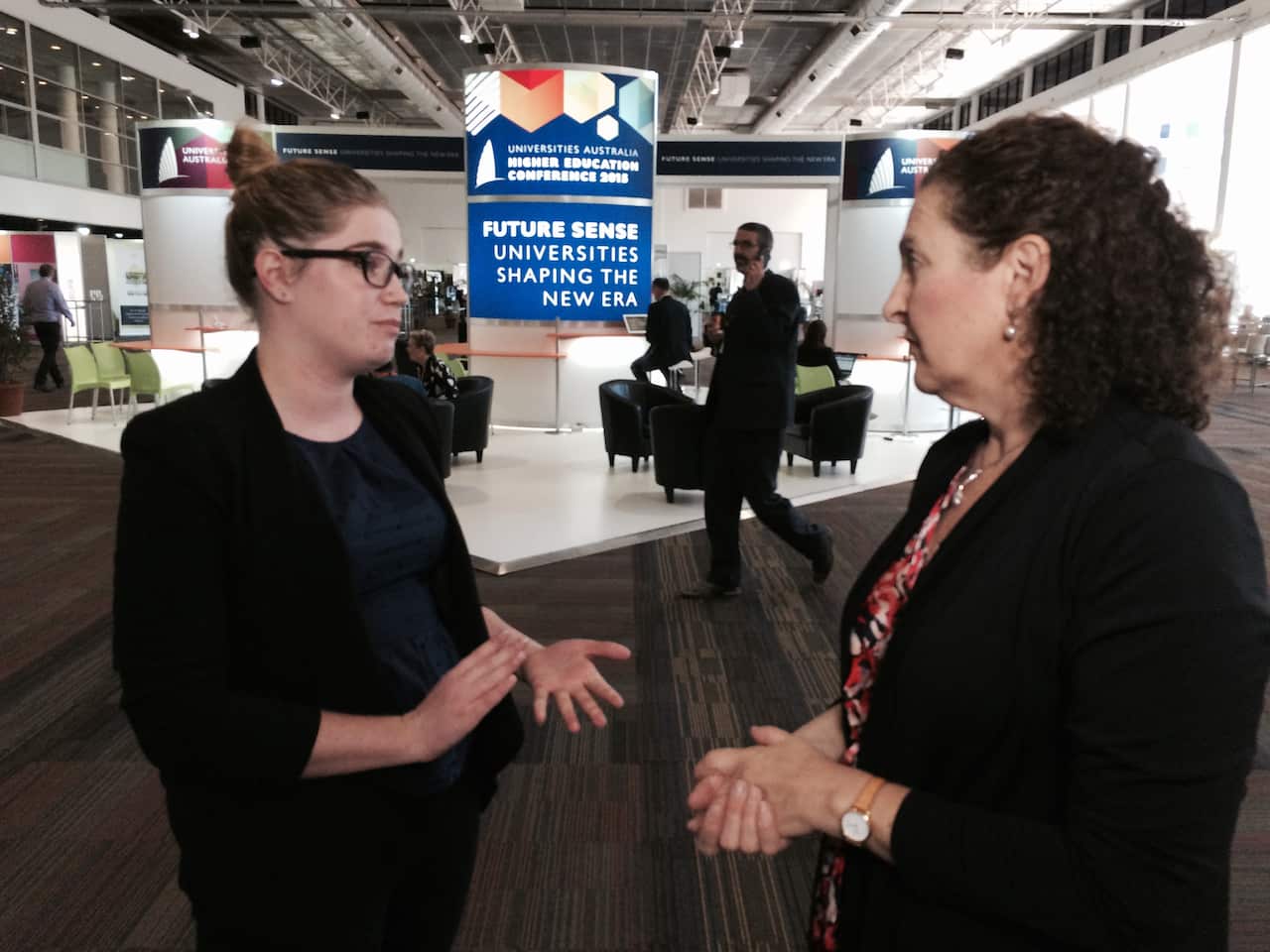 Education Minister Christopher Pyne is doing what he can to strike a deal with crossbench senators that would see the education bill pass, but senators are still undecided.
President of the National Union of Students Rose Steele speaks with Catherine McGrath (SBS)
Speaking in Brisbane, Mr Pyne said the government’s plans would free up universities and help support the sector through the future.
“Under the Coalition, we're going to create more opportunity, see more revenue flowing to universities that will strengthen the quality of our universities, improve our research and our teaching,” he said.
“Under Labor, there will be more cuts, lower revenue, fewer students getting the opportunity for transformative higher education and the potential for campuses and institutions to close.”
The university sector has been meeting in Canberra for their 2015 conference.
'Students are very aware and very concerned'
Universities are full of good people trying to keep an important system running, but it is also true that much of the debate about the university sector has taken place between the big research universities known as the Group of Eight.
Students and the rest of the community outside this peak body haven’t had their say on this important policy area.
This lack of broad conversation was noted by Belinda Robinson Chief Executive of Universities Australia in her address to the National Press Club.
Ms Robinson said the sector needs to bring people along with it as it moves forward on the issues of deregulation.
‘For a variety of reasons, primarily associated with the speed at which everything now operates, compounded by the insatiable and voracious appetite for new angles, if not new stories, publicly informed policy making is more difficult today than it has ever been,” she said.
“But we must keep trying and inject some fresh thinking into how we go about.
“We will keep calling for a political consensus that can only emerge out of strong engagement, broad consultation and a commitment to a higher education and research system that measures up as one of the best in the world, and one that all of us - including those who have never have set foot in a university - can celebrate and be proud of.”
Share


