

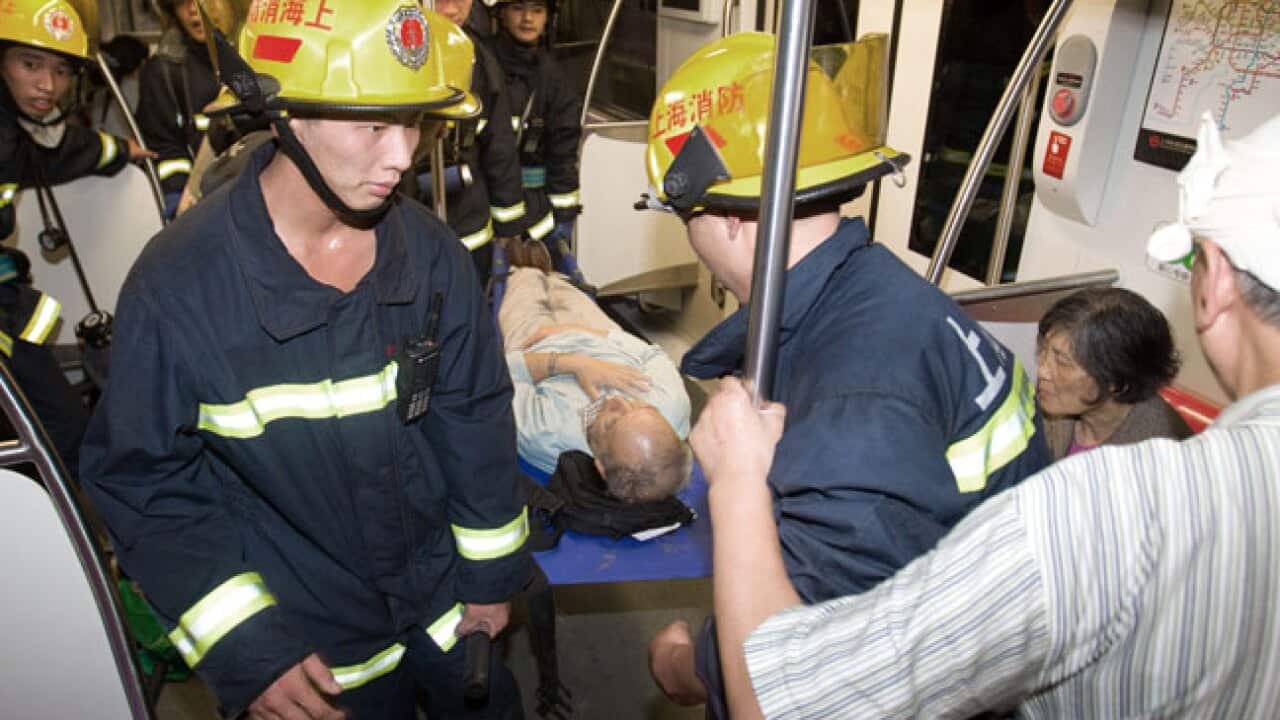
A metro crash in China's commercial capital Shanghai prompted fresh accusations Wednesday that safety has been compromised in the country's rush to develop its vast transport network.
State media urged the government to "be more cautious" after the collision of two metro trains on Tuesday injured 284 people, just months after a deadly high-speed rail crash in the eastern city of Wenzhou killed at least 40.
Operator Shanghai Metro Company Wednesday admitted for the first time that human error played a role, though it also blamed equipment failure.
A loss of power caused the signalling system to fail, forcing the trains to be operated manually, according to a company statement.
"Personnel didn't strictly carry out relevant management rules, leading to the accident," it said, but gave no details.
'GUIDED BY PHONE'
State media said metro employees were guiding the drivers of the trains by phone at the time of the accident.
Most of the injuries were mild, but the accident occurred on one of Shanghai's newest metro lines and is a blow to city authorities after an ambitious expansion programme for the World Expo.
Last year's six-month Expo attracted more than 70 million visitors from around the world and was viewed as a major success for the city as it develops into a global commercial capital.
The Global Times, an English-language daily, said China had no choice but to develop modern transport systems for major cities such as Beijing and Shanghai, but that it could not afford safety failures.
"China should be more cautious and concentrated in avoiding risks," the paper said in an editorial. "Although this is hard to do the tragedies in Wenzhou and Shanghai keep reminding people that China cannot afford failure."
Shanghai has set up a 15 person team, consisting mainly of city officials, to further investigate the cause, the government said.
ONLINE DISSENT
But web users set little store by the probe, using China's hugely popular social networking sites to criticise repeated safety failures.
"An investigation team has been set up again. Who will trust it again? Should the same mistake not be corrected before it is repeated 100 times with the blood of ordinary people?" Tang Feng posted on Sina's Weibo, China's biggest microblog service.
Much of the public anger focused on Chinese-French joint venture CASCO Signal, which provided the signalling equipment involved in the Shanghai metro accident, according to the city's metro operator.
CASCO is a venture between French transport and power giant Alstom and state-owned China Railway Signal & Communication Corp.
Chinese state media have reported that the signalling system implicated in the Wenzhou train crash was also supplied by the same company, but Dominique Pouliquen, president of Alstom China, denied this.
"CASCO has never made signalling systems for high-speed trains in China," he told AFP, adding that CASCO was "participating in the ongoing (metro) investigation" without commenting further.
Shanghai's metro operator said it would reduce the speed of trains on the line where the accident occurred and use two people instead of one for key positions, such as driving the trains.
China's rail sector has been plagued by allegations of widespread, high-level corruption, with fears that safety has been compromised as a result, particularly in the wake of the Wenzhou crash.
Railways minister Liu Zhijun was sacked in February over graft charges, after he allegedly took more than 800 million yuan ($125 million) in kickbacks over several years on contracts linked to the high-speed network.
Zhang Mi, a member of the Ministry of Housing and Urban-Rural Development's urban rail transport safety and quality committee, told AFP the emphasis has been rapid construction, sometimes by unqualified firms.
"Construction firms that have never conducted any subway construction are building subways. Overall, there are not enough technical staff and undue emphasis has been placed on speed (of construction)," he said.
China's listed rail companies fell in trading Tuesday, due to worries the accident would have on growth of the sector, dealers said.
Metro line builder Shanghai Tunnel Engineering lost 2.6 percent, while train maker China South Locomotive and Rolling Stock Corp lost 1.7 percent.