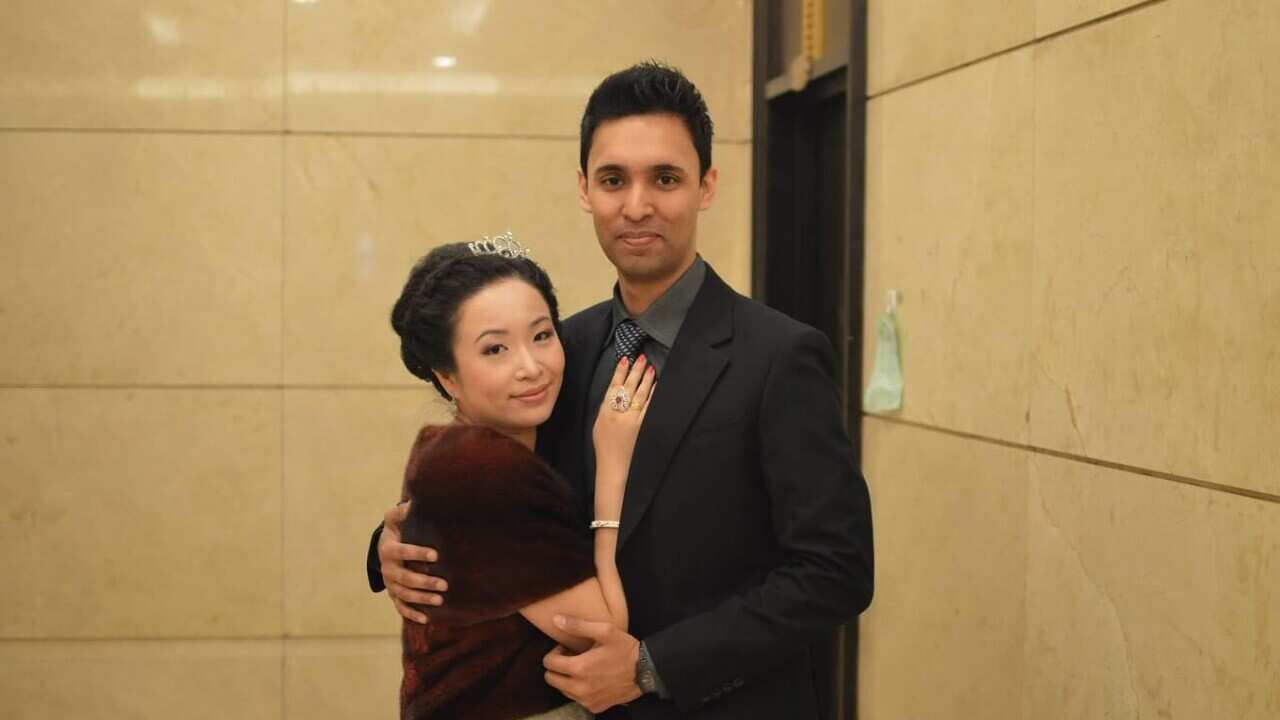
When Angie Cui married her husband Tom, they had not one, but three weddings.
Angie is from China's icy Harbin region and Tom (who did not want his surname revealed) is from Bangladesh. They met and fell in love as international students in Melbourne.
"There's always someone who asks me, 'You got married three times? So, you married three different people?' I’m like, 'No, no, no. One person three times,'" she said.

Their first wedding, in Melbourne in 2011, was an intimate ceremony surrounded by close friends.
News that makes sense
Your trusted source for staying up-to-date with the world around you. Get free daily news updates and analysis, straight to your inbox.
"I think I invited maybe eight or nine people ... It was tiny, and my dress wasn't that expensive. The total wedding cost was around less than $2,000," Angie said.
They celebrated their second wedding — which Angie was told would also be a small event — with her husband's family in Bangladesh.
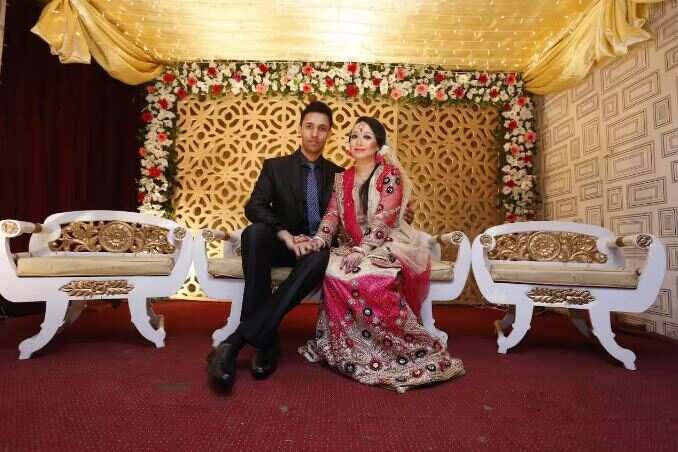
"But then on the wedding day, I actually noticed 600 people were there … And half of them, my husband told me he didn't even know who they are," she said.
By the time the third wedding rolled around in China in 2013, Angie was less enthused with marking the occasion.
"The hairdresser was doing my hairpiece and she was asking me, 'Aren't you excited you're getting married today?' And, I was like, 'Yeah, a third time,'" she said.
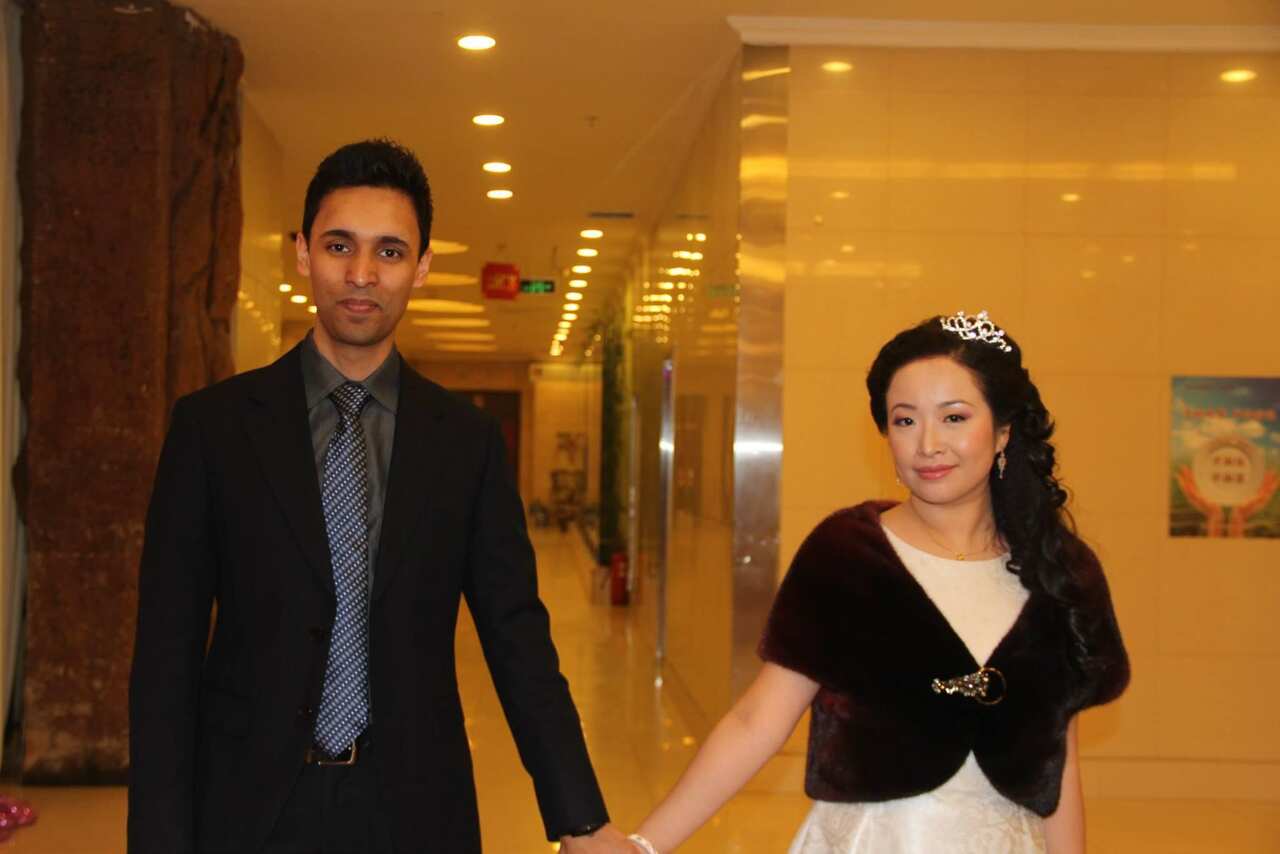
Angie said that, while she wouldn't repeat the experience again, sharing cultures with her husband has been wonderful and eye-opening.
But it's not without its challenges.
Intercultural marriage and social cohesion
About a third of all registered marriages in Australia are intercultural.
According to senior researcher Trish Prentice of the Scanlon Foundation Research Institute — an independent, not-for-profit institute conducting research into multiculturalism — such marriages play a broader role in Australia's social cohesion.
"When two people from different cultural groups, or different racial groups, come together and join in that kind of intimate partnership, it certainly suggests a level of acceptance and intimacy that's special and unique," she said.

"Love is love, honestly. And I think you will really miss out if I had closed my eyes to the fact that, 'Oh, he's of a different race', I would not be able to enjoy eight amazing years of being with my soulmate." — Stella Adlike.
Stella Adlike moved from Kenya to Perth to study accounting in 2015.
Two months later she met Oleg, a Russian-born man who would later become her husband.
"We started by going for breakfast, meeting in uni corridors. And then one day, he asked me out for dinner," she said.
"And he was just so lovely. When I was at work, he was taking my family out for lunch, for dinner, bringing groceries for them. So, I thought, 'Oh, he's really invested. If he likes my family, then there's something to it.' So, we started dating from there."

Stella said she’s found it surprising when people have questioned their relationship.
"I once met a lady at the shopping mall … We were walking with my partner, and she looks at me, she's like, 'Wow, you did well, congratulations.' And I'm like, 'Wait, excuse me?'" she said.
"So, she explained to me 'Oh, at least you chose a white partner' … My jaw dropped; I was so, so shocked," she said.
"But I think to my partner, because he's never experienced anything like that, to him it was funny. So, he was laughing about it.
"But later on, I was like, 'No.' You know, I had to explain to him."

Stella said while her husband is supportive, he's sometimes struggled to realise when she's being subject to racism, especially the more subtle microaggressions that can occur in everyday interactions.
"For people who are not affected by race, it's really hard for them to get it," she said.
"So sometimes I really have to do a lot of education towards my partner.
"And sometimes you meet people who give you such beautiful compliments as well … We're quite fortunate to be in Australia. As much as some people can be ignorant, most of the time it's good."
The history of interracial marriage in Australia
Interracial marriage was once frowned upon and restricted by the state.
Until the middle of the 20th century, Indigenous women in Australia required permission to marry a non-Indigenous man.
"So, we see, especially [for] Indigenous women, [their] female sexuality — being very restricted, being very much regulated by the state, as a way to, in a de facto sense, restrict the amount of interracial marriage that happened throughout the Australian colonies," Australian Catholic University research fellow Rachel Stevens said.

The restriction also extended to relationships between Chinese men and Anglo women during the Gold Rush, where there’s evidence of around 2,000 such marriages in southern NSW.
But within a couple of decades, this number had reduced to around 100 marriages.
"There was so much social pressure to restrict the marriage between Chinese men and white women ... And if they did, it was [a] credit to them because they risked being disinherited from their family or social ostracisation," Stevens said.
These restrictions also extended to the segregation of African American troops, to prevent them from interacting with white Australian women, when they arrived in Australia during World War Two, Stevens said.
The provisions were far-reaching; up until 1962, if a Catholic wanted to marry a Protestant they would have been excommunicated from the church.
Not always positive: interracial dating and internalised racism
Nowadays, intercultural relationships have become increasingly commonplace.
But not everyone's experience with them is positive.
Growing up, Helen Nguyen was urged by her Vietnamese mother not to date outside of her race.
"I felt a very strong pressure from everyone around me that I was expected to only date another Asian man or be friends with only Asian people," she said.

As one of the only Asian people at her predominantly white school, Helen said she did everything in her power to defy stereotypes.
"I would only date white boys. I tried to be fit and active and show that I wasn't a stereotypical awkward Asian girl …The rebellion manifested in a lot of different aspects, and my dating choices were one part of that," she said.
But those dating choices weren't always embraced by her parents.
"My mum always said the same thing: 'White people won't treat us the same. They'll never see us as equal. They don't care about us the way the Asian community would,'" Helen said.

"And I know they meant well and wanted to protect me. But that only in turn deepened my internalised racism."
In some of her relationships with white people, Helen said she felt pressure to fulfil certain roles.
"I think there is a big expectation in society, or at least an expectation that I felt as a young Asian woman, to satisfy this submissive, docile stereotype [by] being very agreeable, quiet, willing to do everything, but on the other hand, also to be hypersexual beings," she said.
"It's a stereotype that I felt hit me hard when I was dating different white people. I've had a few experiences intimately where I felt like I was shoved into this box."

Helen, who is currently in her first relationship with a Vietnamese man, said she's since worked through a lot of internalised racism.
"I thought it meant I've finally proven myself as Australian and as belonging in Australia, if I had white approval, if I had this community around me — white friends, and a white boyfriend to validate my existence," she said.
"But it made me realise that it wasn't all that I thought it was meant to be. And that there's inherent power imbalances in these kinds of dynamics.
"It's been a long work in progress, coming to terms with my ethnic identity, and the parts of it I used to be so ashamed of, and I am now learning to love."







