(Transcript from World News Australia Radio):
Almost 30 years ago, Aboriginal teenager John Pat died in police custody.
The 16 year-old was caught up in a drunken brawl with police in 1983 outside a hotel in Roebourne, a predominantly Aboriginal town in Western Australia's Pilbara region.
Four years after his death, a Royal Commission began into Aboriginal deaths in custody: John Pat's case cited as one of the major factors.
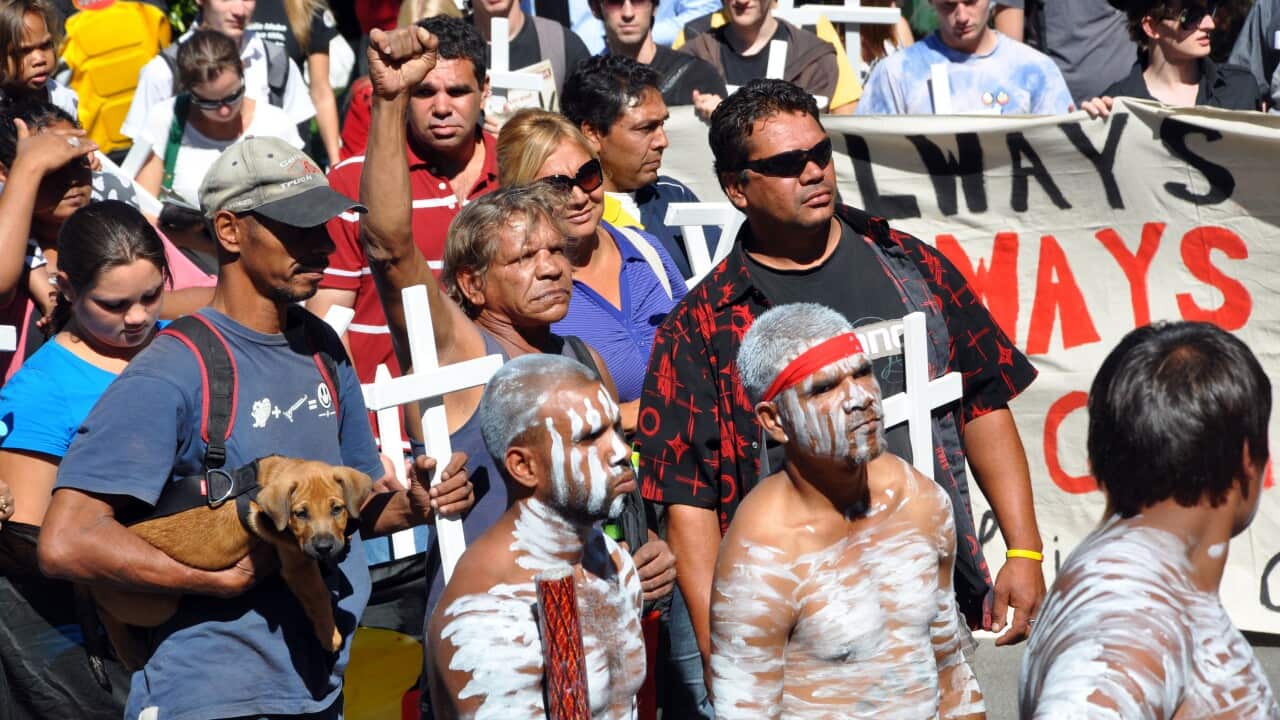
In the coming days, there will be national rallies to commemorate the passing of John Pat and to question what's changed since the Royal Commission.
News that makes sense
Your trusted source for staying up-to-date with the world around you. Get free daily news updates and analysis, straight to your inbox.
Ryan Emery reports.
It was a fight that went international - gathering the support of Amnesty International and the Anti-Slavery Society.
It ended after four years, in 1987, when a Royal Commission began into Aboriginal deaths in custody.
The push for the commission was led in part by Noongar woman Helen Corbett.
She was shocked into action when, as the Director of Studies at Tranby Aboriginal College in Sydney, she read about the manslaughter trial of five police officers.
They were accused of causing the injuries that led to the death of Aboriginal teenager John Pat who had a fractured skull and torn aorta.
The 16-year-old died an hour after he was taken into police custody following a drunken brawl outside the Victoria Hotel in Roebourne, in north western Australia.
A coronial inquest led to the officers involved being charged with manslaughter.
But they would be found not guilty of causing John Pat's death.
Helen Corbett says action was needed.
"And I was quite horrified about what I was reading and I said to another colleague, who was also from Western Australia, we need to do something about this. So we cut out the newspaper clipping, photocopied it and then we faxed it to a number of Aboriginal organisations and West Australian people we knew who were living in Sydney and said let's have a meeting and talk about what we should do because it's quite an horrific situation and we need to do something to give support to the families and all our mob back in WA."
The Committee to Defend Black Rights was formed and the push for a Royal Commission began in 1984.
In the meantime, more Aboriginal deaths in custody began to emerge.
But Helen says the wider community didn't connect the dots and they appeared to be isolated cases.
The committee started a listening tour around the country in 1986.
"And as we went around to each spot, more people were coming up to us and telling us their situations and so at the end of the tour, which ended in Perth, and Mavis Pat, the mother of the young boy, joined us in the final leg of the trip, we had something like 100 deaths that we'd collected from this tour."
Armed with the facts, they began to build a prima facie case with 12 thousand dollars from the federal Labor government led by Prime Minister Bob Hawke.
But the committee also took the cause overseas.
Helen Corbett describes walking into Amnesty International's London office.
"I brought a second-hand old suitcase full of all our information and dragged it into the office and they said look, they showed me an empty filing cabinet of Oceania and said 'look we have no complaints about human rights violations in Oceania, which includes Australia' and I said 'well, here's a suitcase full' and left it there with them."
Helen Corbett also spoke to a United Nations delegation in Geneva, Switzerland in 1986.
"People were very interested to hear what was going on and within four days of delivering the speech the Hawke Labor government, well Hawke himself got on TV and was crying and said we need to hold a Royal Commission into deaths in custody. There was a lot of international pressure. There was a lot of waking up of Australian people themselves, Aboriginal and non-Aboriginal people, about what was really happening about our people dying in custody."
The Royal Commission became a reality.
Hearings started in 1988 and covered the deaths of 99 Aboriginal people in custody, including John Pat's.
A report in 1991 made 339 recommendations including arresting people only when there was no other way to deal with a problem and imprisoning someone as the last resort.
Rallies are being held in Western Australia, New South Wales and Victoria marking the 30th anniversary of John Pat's death.
The protesters will be questioning how well Australian authorities have implemented the recommendations of the Royal Commission.
There will also be calls for an apology for John Pat's death.







