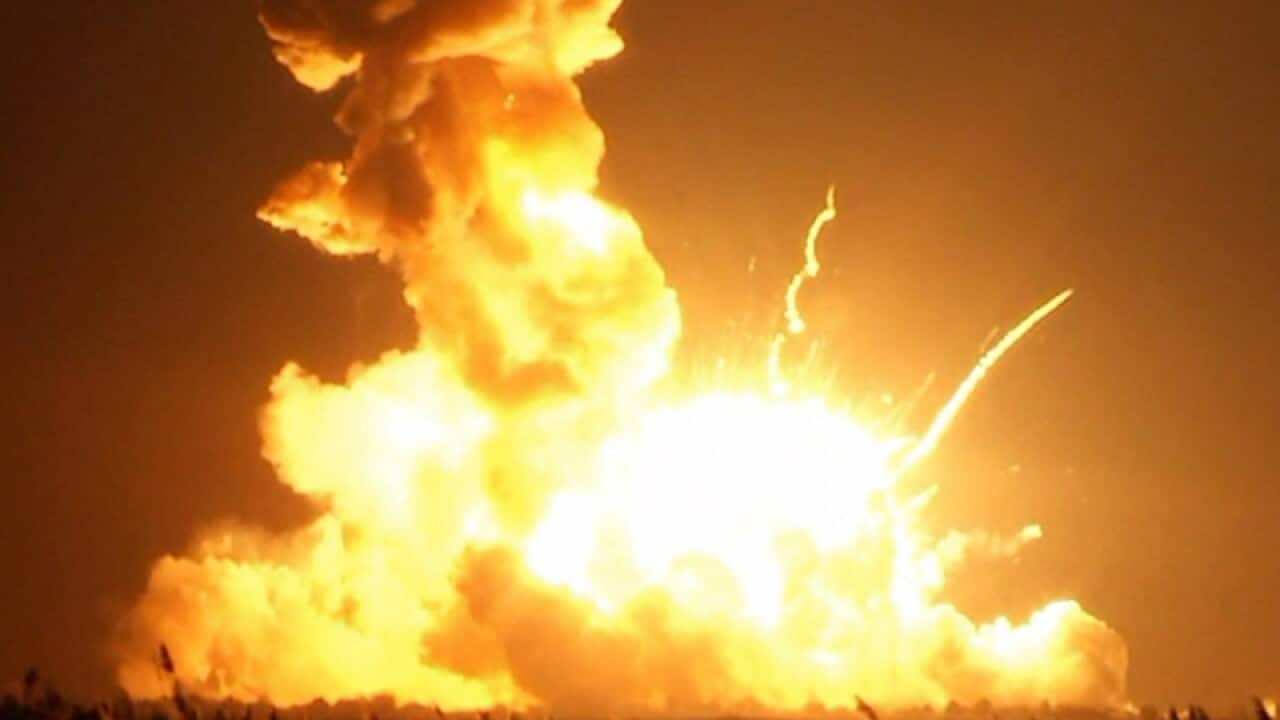
An unmanned rocket owned by Orbital Sciences Corporation exploded in a giant fireball and plummeted back to earth just seconds after launch on what was to be a resupply mission to the International Space Station.
"The Antares rocket suffered an accident shortly after lift-off," NASA mission control in Houston said on Tuesday, describing the event as a "catastrophic anomaly".
After the countdown, the base of the tall, white rocket ignited on cue, then rose a short distance into the air before it suddenly exploded in a fiery blast six seconds later.
Enveloped in flames, the rocket collapsed to the ground, as a cloud of dark grey smoke rose from the wreckage.
Investigators swiftly secured the perimeter of the area and forbade any outside interviews of witnesses or staff, citing classified equipment that had been aboard the spacecraft.
News that makes sense
Your trusted source for staying up-to-date with the world around you. Get free daily news updates and analysis, straight to your inbox.
As night fell, fires were seen burning at the coastal launch pad at Wallops Island, Virginia.
It was unclear what caused the explosion, which occurred at 6.22pm (0922 AEDT Wednesday).
"At this point it appears that the damage is limited to the facility," a commentator on NASA television said.
All personnel in the area were accounted for, and there were no injuries, the US space agency said.
There was, however significant property damage.
NASA mission control said the accident occurred just after Orbital's unmanned Cygnus cargo ship blasted off toward ISS carrying 5000 pounds (2200kg) of supplies for the six astronauts living at the research outpost.
It was the first night-time launch of an Antares rocket, Orbital said.
Engineers said the countdown had gone smoothly, and there were no issues apparent with the machinery.
The mission, known as CRS-3, was to be Orbital's fourth trip to the ISS, including an initial demonstration.
Orbital has a $US1.9 billion ($A2.06 billion) contract with NASA for a total of eight supply missions.
The Cygnus craft, which is shaped like a massive beer keg, was to have remained berthed at the ISS for about five weeks.
After the US space shuttle program ended in 2011, leaving no government program to send humans to the space station, private companies raced to restore US access.
SpaceX's Dragon was the first commercial spacecraft to make a supply journey there in 2010.







