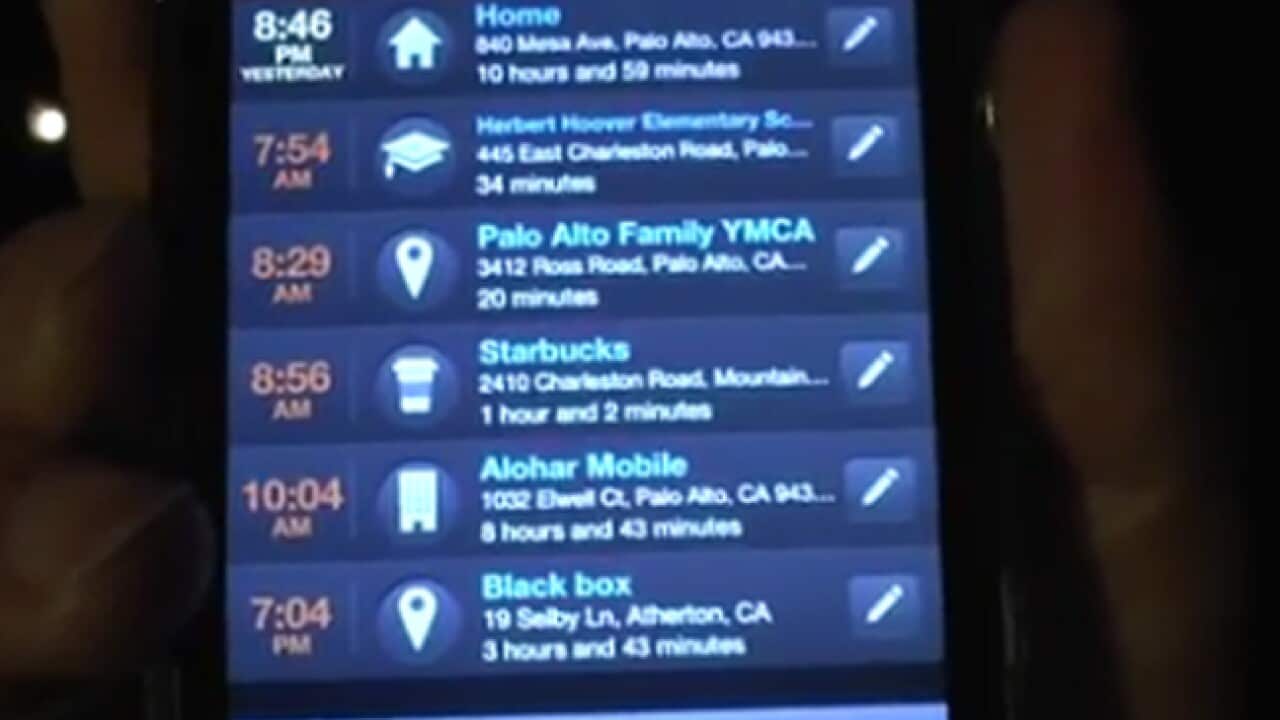
A new app created by a former Google employee uses GPS, heat and light sensors and WiFi to record everywhere the user goes - and more.
The app, called 'PlaceMe', is available for Apple and Android smartphones, and is free to download.
Since its launch last week it has attracted several thousand users in the United States and a few hundred in Australia, developer Sam Liang told SBS.
PlaceMe requires users to create an account, but after that, it records everything automatically.
Mr Liang says the app's greatest strength is that it doesn't demand that users 'check in' to locations they visit as do other location apps like Foursquare and Facebook's 'Nearby'.
News that makes sense
Your trusted source for staying up-to-date with the world around you. Get free daily news updates and analysis, straight to your inbox.
It compiles a profile based on your habits with the aim of acting as a personal assistant, Mr Liang says.
"We envision that once the phone understands you, it can become the ultimate butler for you, remind you to do more exercises if it detects that you've been lazy recently, remind you to pick up milk when you drive by a grocery store, tell you where you parked your car if you forget.... " Mr Liang told SBS in an email.
PRIVACY
PlaceMe continues recording information, running 'in the background' even when it is closed and other apps are in use. It can only be switched off manually from inside the app.
Such a comprehensive journal of an individual's habits would surely be of enormous interest to retailers of all kinds, but Mr Liang says his company has vowed never to sell users' information.
Asked how much a corporation would have to offer him to change his mind, he responded:
"We can't sell that information. Once we promise not to sell that information, we can't sell it."
His company, Alohar Mobile's website reiterates that vow.
"We take your privacy interests very seriously, and appreciate that you may consider data about your present and past locations to be very personal. We therefore do not share, rent or sell personally-identifiable information about you except as described in this Policy," it says.
However, Alohar does share information with third parties in order to facilitate better service to users, its privacy policy states. In addition, the company used 'cookies' and allowed third parties to plant invisible 'web bugs' via its services.
"We may use Web beacons on our site or other sites and may permit third parties to place them on our site to monitor the effectiveness of advertising or for other legitimate purposes such as analyzing the effectiveness of our web pages and content," the website says.
"A Web beacon, also known as a "Web bug," is a small, graphic image on a Web page, Web-based document or in an e-mail message that is designed to allow the site owner or a third party to monitor who is visiting a site," the Alohar site explains.
"Web beacons are often invisible to the user because they are typically very small (only 1-by-1 pixel) and the same color as the background of the Web page, document or e-mail message," it says.
HEALTH BENEFITS
Mr Liang says his company has already been approached by a number of hospitals in California that are interested in using the app to help patients monitor their own lifestyles.
It could track their food choices by noting whether they visited fast food outlets or healthy food chains, count the steps they walk each day and record how many times they visited the gym.
Heat and movement sensors could theoroetically record how hard they worked out there.
There had also been interest in using the app to help with the management of Alzheimer's Disease patients, Mr Liang said.
Mr Liang holds a doctorate from the prestigious Stanford University and helped build Google's location server.
'STRIP CLUB' DATA
At the moment, PlaceMe offers nothing more than a record of places you have visited during the day, but Alohar plans to add many more features on its 'persistent sensing platform'.
"It studies all the sensors in your phone. Temperature. Compass. Gyroscope. Wifi and bluetooth antennas. Accelerometer. It collects all that data and uploads it to his servers," blogged high-profile reviewer Robert Scoble.
PlaceMe quickly learns where you live and work, and what routes you take to get there, Mr Scoble noted on his GooglePlus blog.
It notes which petrol stations you use and calculates your car's fuel mileage based on how often you stop there.
It can even calculate how excited you are when visiting a strip club, he added.
Mr Liang has confirmed that that is possible - using the same sensors the app relies upon to ascertain whether you are sitting, walking, driving or dancing.







