It's an early start for SBS Radio's Arabic program with the team broadcasting at 6am, seven days a week.
Their beat is one of the world's most complex and they've been covering it for SBS since 1975.
Marie Myssy, the program's executive producer, started her career reporting on the civil war in Lebanon.
Since then she's covered many stories including the Arab spring, conflicts in Iraq and Syria and the impact of terrorism laws on the community.
"When I first started, I was covering the Lebanese war and everyday I was counting the dead. And you know Lebanon is such a small country. Nearly we all know each other and we know the areas. It was so close to home."
Since then, Marie Myssy said covering local issues affecting the community had been one the team's biggest jobs.
"Lately the challenge for us was covering terrorism and home-grown terrorism," she said.
She said many of the program's listeners felt targeted by anti-terrorism laws.
"The Arabic community would feel that it's affected by this and they feel that they always have to justify that they are not like that. So it's a challenge for us covering the anti-terrorism laws."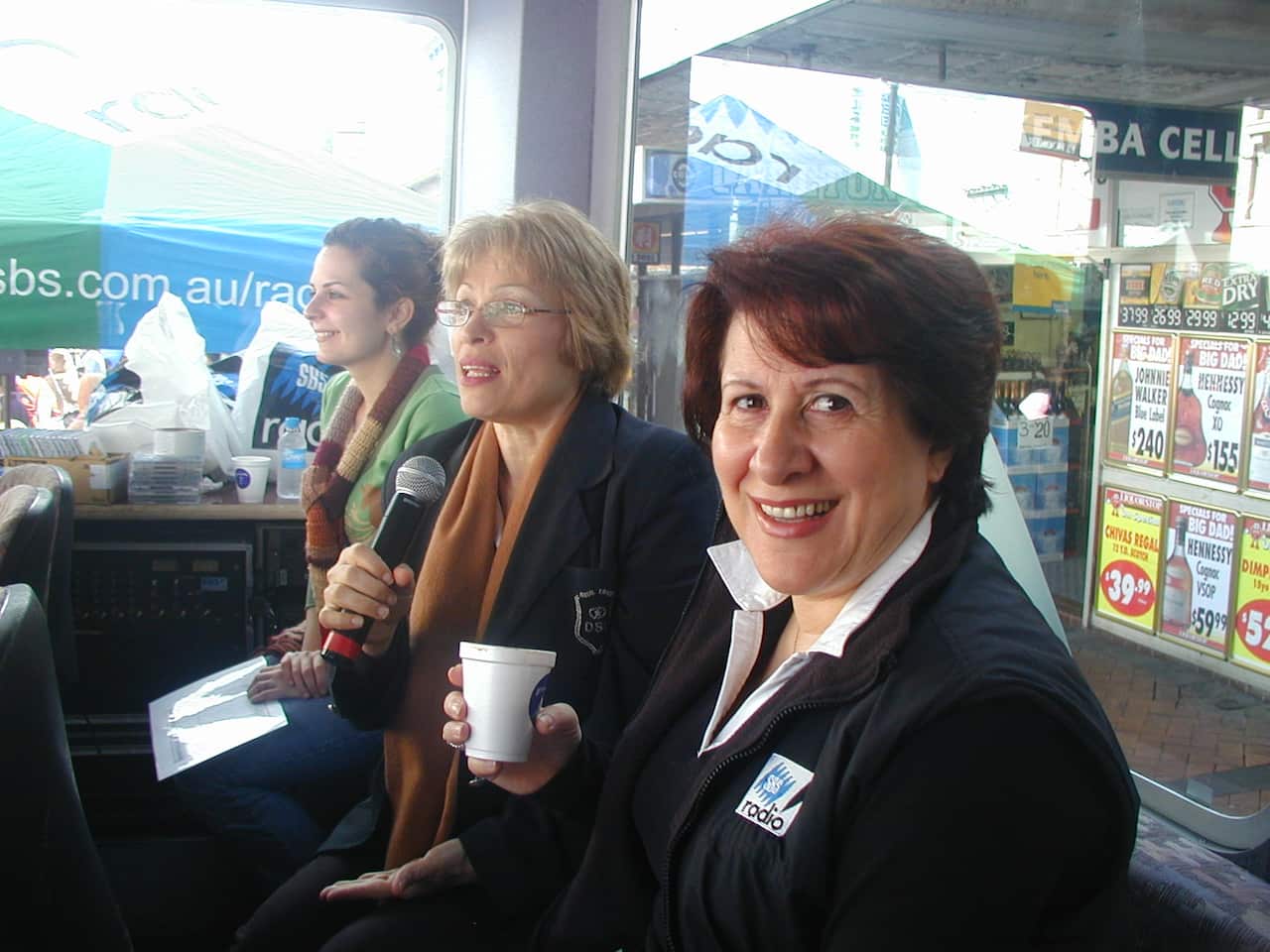 Another big challenge for the program is covering stories from 22 diverse countries where Arabic is the official language.
Eddie Abd, Majida Abboud, and Marie Myssy at the Haldon Street Festival. (AAP)
2011 census data revealed that there are nearly 300,000 (287,000) Arabic speakers in Australia.
Around 40 per cent were born here, followed by those born in Lebanon, Egypt and Iraq.
There are also smaller communities from many other Arabic-speaking countries including Sudan and Syria.
Marie Myssy points out the community is much more diverse - spiritually, culturally and ethnically - than many people think.
"People sometimes they have this perception that Arabs are Muslims. That is not the case. Of course most of the Arabic speaking people are Muslims. But you have a sizeable population of Christians. We have Arab Jews too."
Beyond that there are many misconceptions about Arabs,for example, what they look like.
"People sometimes they have this perception that Arabs are Muslims. That is not the case. Of course most of the Arabic speaking people are Muslims. But you have a sizeable population of Christians. We have Arab Jews too."
"Arabs are not a race. You have for example people who have blue eyes, red hair, some people are dark-skinned and others are in between. So there is no standard Arab. "
Randa Kattan is from the Arab Council of Australia.
She's seen the community grow and thrive over the last few decades, but she's also seen negative public perceptions overshadow its achievements.
"I think when you want to bring out the strength, the negative far outweighs it sometimes in the public domain."
Randa Kattan would like to see more about the contribution Arab-Australians have made to the Australian community.
"They don't come to the attention of the media. Unfortunately the media has been targeting bad elements thousands of miles away and bringing it to our shores and that's the attention the Arab community gets these days."
Listen to the full story here:
Hachem El-Haddad writes and presents the news for the program.
He said he approached the future of the Arabic-speaking world with cautious optimism.
"When the violence subsides in the Middle East, if it does, we are going to see a different Middle East. The Middle East as we know it will cease to exist. But what will come out of it I think is something spectacular - and scary, to say the least."
Share


