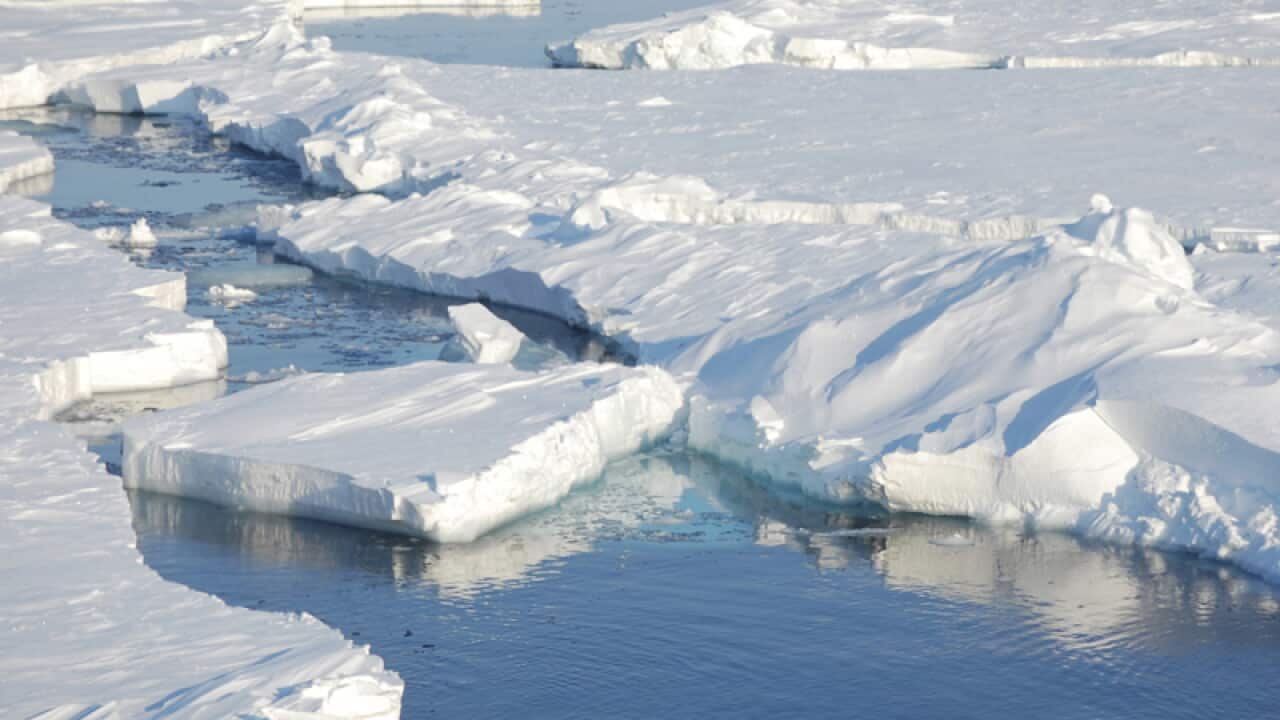
The Arctic's quickening melt could cost the world economy trillions of dollars this century, an international study has found.
The region's warmer and wetter shift is melting permafrost under buildings from Siberia to Alaska, raising world sea levels and disrupting temperature patterns further south, the report said.
Some 90 scientists contributed to the study commissioned by the Arctic Council, which groups the United States, Russia, Canada, Sweden, Denmark, Norway, Finland and Iceland.
They have urged governments with interests in the Arctic to cut greenhouse gas emissions.
"The Arctic is warming faster than any other region on Earth, and rapidly becoming a warmer, wetter and more variable environment," the report said.
News that makes sense
Your trusted source for staying up-to-date with the world around you. Get free daily news updates and analysis, straight to your inbox.
"Increasing greenhouse gas emissions from human activities are the primary underlying cause."
Walt Meier, a NASA scientist who was among the authors, said there was new evidence since 2011 that the thickest Arctic sea ice, which survives multiple summers, was breaking up.
"Multi-year ice used to be a big consolidated pack," he told Reuters.
"It's almost like a big thick ice cube versus a bunch of crushed ice. When you warm the water, the crushed ice melts a lot quicker."
Arctic warming could have a cumulative net cost of between $US7 ($A9.3) trillion and $US90 trillion from 2010-2100, with harm exceeding benefits such as easier access to oil and gas exploration and shipping, the report said.
Sea ice on the Arctic Ocean, which shrank to a record low in 2012, could disappear in summers by the 2030s, quicker than many earlier projections, it continued.
The period from 2011-2015 was the warmest since records began in 1900.
Rare warmth and spring floods closed the highway to Alaska's North Slope oilfields for three weeks in 2015.
The Arctic is warming at an accelerated rate as disappearing ice gets replaced by darker-coloured sea water which in turn absorbs more of the sun's heat.
The report urges Arctic states to lead global efforts to reach an early, ambitious and full implementation of the 2015 Paris Agreement.







