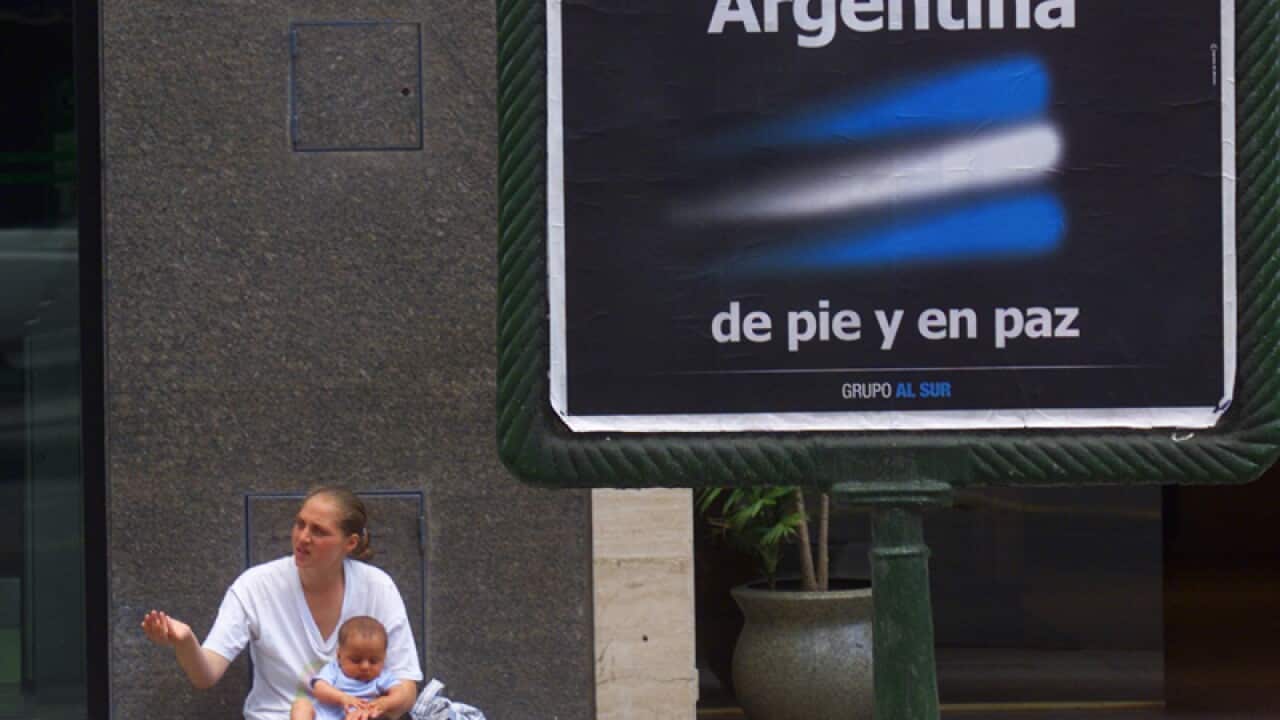
Last-ditch talks between Argentina and the US hedge funds it has branded "vultures" failed to reach agreement, effectively pushing the country into default.
Ratings agency Standard and Poor's had already placed Argentina in "selective default" when Economy Minister Axel Kicillof emerged from the New York talks on Wednesday to confirm that no deal had been reached.
This left it inevitable that Latin America's third-largest economy would be unable to meet its repayment obligations by midnight, placing the country in default for the second time in 13 years.
"Unfortunately, no agreement was reached and the Republic of Argentina will imminently be in default," said Daniel Pollack, the lawyer appointed by a US court to oversee the talks.
Kicillof complained that the creditors, US hedge funds that bought defaulted Argentine debt at knockdown rates, then went to court to demand full payment, had refused to compromise.
"They were trying to impose on us something illegal," he declared, confirming that he was heading back to Buenos Aires without a deal.
Kicillof slammed S&P's downgrade, arguing that Argentina could not be regarded as being in default since the money for the repayment was in a US bank account ready to be paid but frozen by court order.
"That money is there. Obviously, if there were a default, the money would not be there," he stressed, blaming a ruling by US District Judge Thomas Griesa that has prevented its transfer.
"Argentina paid. It has money. It is going to continue to pay. The one who is responsible for this situation is Judge Griesa," he said.
"We are going to pay those who hold bonds that have been defaulted on, but on reasonable terms, not on terms that amount to extortion, created under pressure, under a threat," he said.
Wednesday marked the deadline for Argentina to make a $US539 million ($A583.18 million) payment on debt it had restructured with co-operative "exchange creditors" after its previous 2001 default.
Argentina had deposited the sum - for payment to those bond holders who had accepted a write-down in deals reached in 2005 and 2010 - in a bank account when it was due at the end of June.
But Griesa blocked the bank from forwarding the payment unless Argentina also paid two US hedge funds - the "holdout creditors" - the full value of their bonds, $US1.3 billion, at the same time.
Argentina and these funds - NML Capital and Aurelius Capital Management - have spent the past two days locked in talks in New York with a US court-appointed mediator to try a set a deal.
"What we offered them in terms of profit was 300 per cent. It was not accepted, because they want more, and they want it now," Kicillof said, insisting the funds were being unreasonably greedy.
"Default is not a mere 'technical' condition, but rather a real and painful event that will hurt real people," Pollack warned, while not assigning blame for the failure of the talks.
There was no immediate reaction from the hedge funds.
Share


