
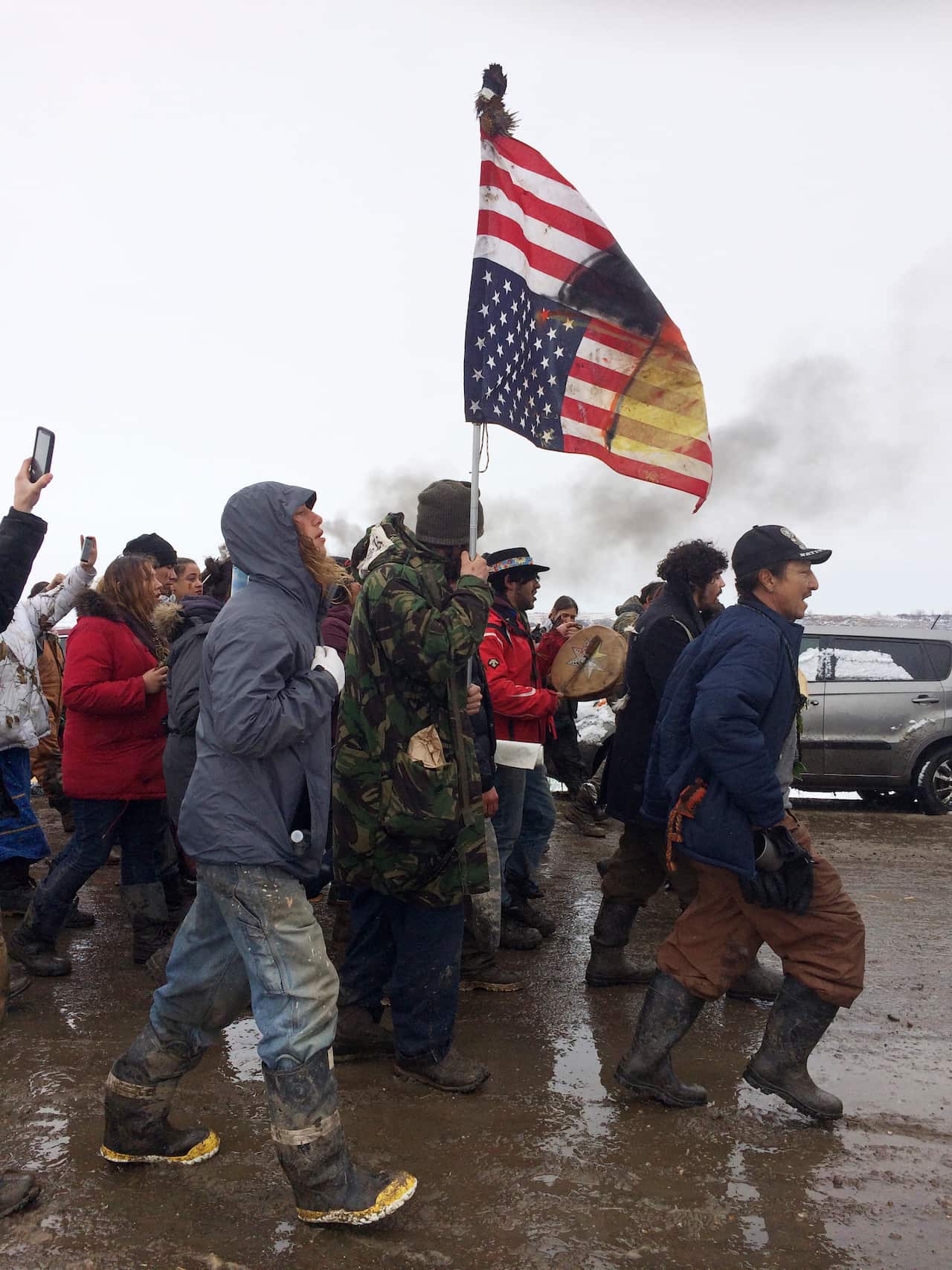
Burning the structures was part of a leaving ceremony, according to protesters.
Many of them planned to go peacefully, but authorities were prepared to arrest others who said they would defy the deadline in a final show of dissent.
Some 10 activists who had remained after the 2pm deadline passed were arrested, according to the North Dakota Joint Information Center.
About 150 people marched arm-in-arm out of the camp, singing and playing drums as they walked down a highway. It was not clear where they were headed. One man carried an American flag hung upside-down.
Others departed the soggy camp earlier in the day. Authorities sent buses to take protesters to Bismarck, where they were offered fresh clothing, bus fare home and food and hotel vouchers.
News that makes sense
Your trusted source for staying up-to-date with the world around you. Get free daily news updates and analysis, straight to your inbox.
The U.S. Army Corps of Engineers set a 2 p.m. Wednesday deadline for the camp to be cleared, citing the threat of spring flooding.
At the height of the protests, the site known as Oceti Sakowin hosted thousands of people, though its population dwindled to just a couple of hundred as the pipeline battle moved into the courts.
The camp is on federal land in North Dakota between the Standing Rock Sioux
Reservation and the pipeline route that is being finished by Dallas-based Energy Transfer Partners. When complete, the pipeline will carry oil through the Dakotas and Iowa to a shipping point in Illinois.
Some of the remaining protesters were focused on moving off federal land and away from the flood plain into other camps, said Phyllis Young, one of the camp leaders.
"The camps will continue," she said. "Freedom is in our DNA, and we have no choice but to continue the struggle."
New camps are popping up on private land, including one the Cheyenne River Sioux set up about a mile from the main camp.
"A lot of our people want to be here and pray for our future," tribal Chairman Harold Frazier said.
Others, including Dom Cross, an Oglala Sioux from Pine Ridge, South Dakota, said he planned to return home after living at the camp since September.
"There's a lot of sadness right now. We have to leave our second home," he said.
Law enforcement officers and first-responders were on hand from several states.
Charles Whalen, 50, an alcohol and drug counselor from Mille Lacs, Minnesota, said he and a group of about 20 people were not going to leave on their own and were willing to get arrested to prove their point.
"Passive resistance," Whalen said. "We are not going to do anything negative. It's about prayer."
Levi Bachmeier, policy adviser for Gov. Doug Burgum, said authorities would rather not apprehend people, but they would enforce the deadline.
The state "remains committed to ensuring the safety of everyone here," Bachmeier said. "The last thing we want is to see anyone harmed."
Some campers said they were leaving with mixed feelings, both energized by the long protest effort and saddened to leave new friends. Some people set off fireworks.
Matthew Bishop, of Ketchikan, Alaska, has been in North Dakota since October. He planned to move to another camp.
"People have been surviving here for hundreds and hundreds of years ... so if I back down, what would I look like?" Bishop said as he tied his possessions to the top of his car.
Craig Stevens, spokesman for the MAIN Coalition of agriculture, business and labour interests, said the group understands "the passions that individuals on all sides of the pipeline discussion feel" and hopes that protesters' voices "will continue to be heard through other peaceful channels and in court."
A massive effort to clean up the camp has been underway for weeks, first by protesters themselves and now with help from the Army Corps in removing debris.
Some vehicles and pedestrians were having trouble getting through the muck created by recent rain and snow, and cleanup efforts were suspended in part because camp officials did not want heavy equipment making the conditions worse.
Native Americans and others began protesting at the camp starting last April, in opposition to the 1,172-mile (1,886-kilometer) oil pipeline. Its route runs under land the Standing Rock Sioux consider sacred and under the Missouri River, which is the source of drinking water for the tribe's reservation.
The tribe filed a motion in federal court last week asking that pipeline construction be halted until a full environmental impact review is completed.







