(Transcript from World News Australia)
A project to encourage indigenous prisoners in Victoria to produce artwork while serving their sentences is being credited with helping to ensure many don't re-offend.
As Santilla Chingaipe reports, the sixth annual exhibition of works from the project has just opened in Melbourne featuring artwork produced by current and former Indigenous prisoners.
(Click on audio tab to listen to this item)
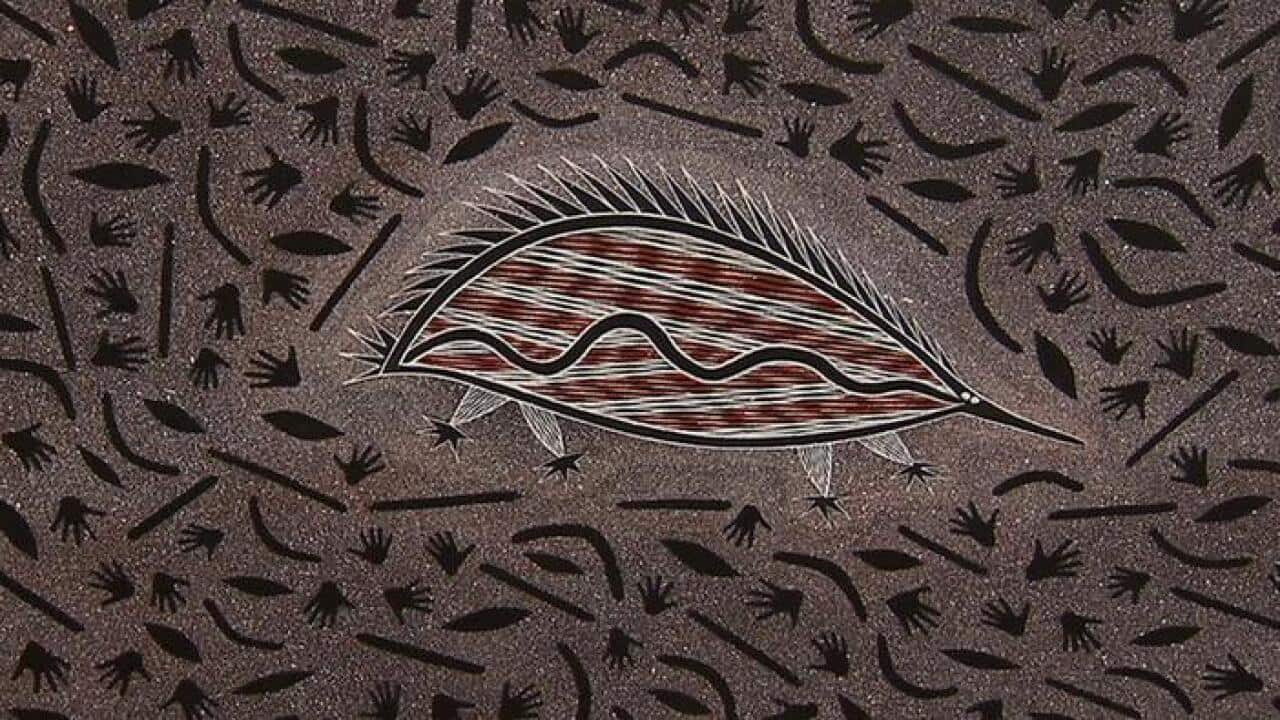
The 'Confined' exhibition is part of what's called the Indigenous Arts in Prisons and Community Program.
Curator Kent Morris says this year's exhibition features more than 100 pieces of artwork.
"Each tells a unique story and I like to look at them that each painting is a person and that person is part of a family, part of a community. And the paintings represent their journey and wanting to find connection back to their family and back to their comminity."
Kent Morris says the program helps prisoners reconnect with their communities.
"And that's a really important connection. To find a way back to connect to family. And through that to connect to the community. Find a role. Some fellas are now teaching art to the Koori kids coming up through their community. Some are running men's groups, providing that support. Others are just keeping going with their art, selling it, finding a legitimate self generated income and just keeping on the straight and narrow."
Mr Morris believes the program has helped to reduce rates of re-offending.
"I've seen fellas apply for jobs for the first time through the confidence they feel and to apply for jobs for the first time and find jobs and start working in areas of supporting other members of the community or just finding a gainful place. Other fellas ring me and say 'you know, I've been painting since I got out. I've been painting for 3 years since I got out and I've just finished that painting and it's kept me strong and kept me on track and I've finished it now I don't know what to do' and I say to them 'Just start another one brother, start another one'."
Ray Young says the program has changed his life
"I was messed up on drugs. My life at that point in time was heading down hill. I think when I was arrested and all that, it really woke me up. I had to really take a look at my life. My brother Richard came to visit me in jail and he said something that really changed my whole perspective of jail. he said to me, he said 'Ray, you're doing time. But have the time serve you' and once he said that the penny just dropped. And from then on, I said I'm going to make the most of this time I have here."
Ray Young says participation in the program has opened up possibilities he never imagined.
In his case, he's gone on to create art work that's been picked up by the National Gallery of Victoria.
"It's vital actually, having those programs in there for the boys to do that. The art is fantastic considering the conditions that they're under. It's not a nice place. Being able to express and able to have a connection to country, because there's a lot of people, a lot of lads in there from different parts of Australia and just seeing what they're putting down and how their connection it spurs on the others around you and really lifts the spirits for the boys - that's their connection to country."
Dennis Thorpe came out of prison four years ago and has been involved with the program ever since.
"When I was in prison, there was no program - no sort of connection to country. You were just part of the system when you were in there so you couldn't actually wait to get out. But in saying that, when you got out of prison, there was actually nothing to do when you got out anyone. Even if there was something to do in prison, there was nothing to do after prison."
Dennis Thorpe says more cultural services should be made available to Indigenous inmates.
"At the moment, there's nothing like culture wise, or any programs. Unless you're an alcoholic or a drug addict. That's not an option. That's just following a program until you get out. When need to get a program before they get out - to follow through with the program until they get if they want to get out."
The exhibition runs at St Kilda Town Hall until February 18.
Share


