
The Indigenous Arts in Prisons and Community Program in Melbourne is helping past and present inmates rehabilitate and break the path to prison.
Forty-eight-year-old Raymond Young spent almost three years in prison.
“I was messed up,” he said. “My life was heading downhill.”
But rather than continue that spiral, he took it as a wake-up call, and started to re-evaluate his choices.
A visit from his brother helped him along.
“He said, ‘Ray, you’re doing time, but let the time serve you’, and from then on I decided I’m going to make the most of the time I have in here and how I can engage the young fellas that are in there to programs.”
“Culture is like a jigsaw puzzle, you got to put it all together.”
So he turned to art and it became his therapy.
“It takes you out of prison so to speak, you're there in a body form of course, but spiritually, you have that connection with your ancestors.”
That connection wouldn’t have been possible if it wasn’t for the Indigenous Arts in Prisons and Community Program, run by The Torch Project’ Kent Morris.
The program gives inmates and parolees the opportunity to create new pathways, through art.
“The paintings represent their journey, and wanting to find connection back to the community and back to their family,” said Kent.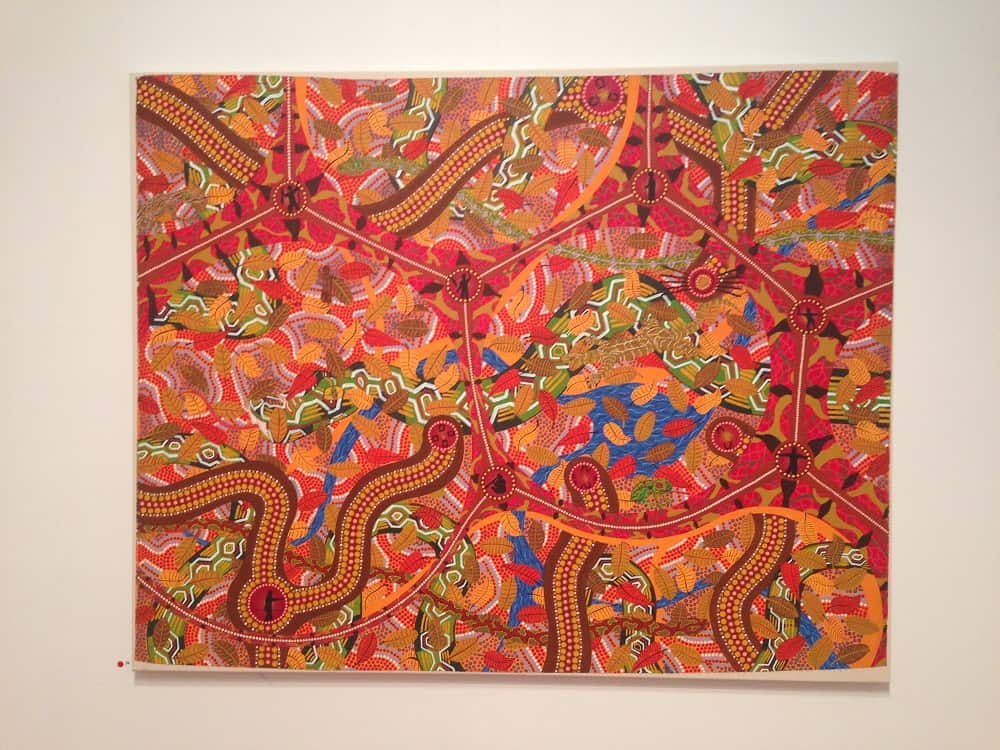 “And that's where the cultural strengthening and cultural focus of the program comes into play.”
One of the paintings from the Confined Exhibition.
By taking them on a path of cultural discovery, the program aims to reduce the over-representation of Indigenous people in the prison system.
Something Raymond Young saw first hand.
“It's quite sad, a lot of the lads have gone out - been released. And within a couple of weeks or so, they're back in. With this program, I believe it's going to be a good stepping stone for them.”
More than 100 works from 88 participants make up the Confined Exhibition - each painting representing an individual story. Fifty-one-year-old Dennis Thorpe learned of the program on parole after three years behind bars.
One of the paintings from the Confined Exhibition.
“One of the main reasons I wanted to get involved in it was to find my connection, where I come from, because, culture is like a jigsaw puzzle, you got to put it all together.”
To find the missing pieces, he put brush to canvas.
“It's a representation for myself,” Dennis said. “To find my identity, and a representation for other people to ask me about my tribe or where I come from.”
Raymond Young is the ultimate success story - the National Gallery of Victoria now plans to add his art to their exhibition.
“It's been one hell of a ride and here I am today.”
Share


