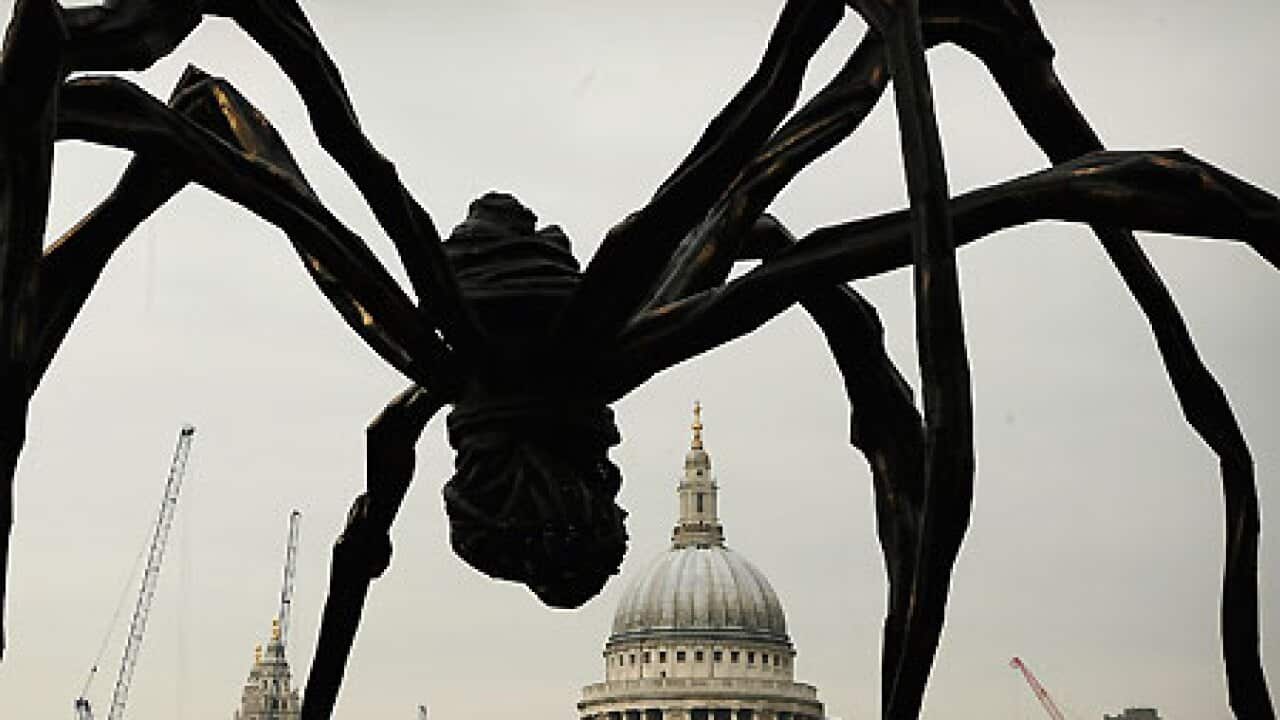
A foundation which had been preparing an exhibition of her work announced Bourgeois' death, hailing her as "one of the most important and significant figures of the artistic panorama of our era".
The Emilio and Annabianca Vedova Foundation's show, featuring works in cloth as well as sketches from between 2002 and 2008, had been due to open in Venice on Friday.
News that makes sense
Your trusted source for staying up-to-date with the world around you. Get free daily news updates and analysis, straight to your inbox.
Foundation president Alfredo Bianchini said Bourgeois had been actively involved in preparations for the exhibition until two days ago.
The artist would "continue to live through her work", Bianchini said, paying homage to her "great energy" and creative capacity.
Some of Bourgeois' works have fetched over a million dollars at auctions in recent years.
Giant spider sculptures
Born in Paris on December 25, 1911, Bourgeois moved to the United States in 1938 where she produced the bulk of her emotionally powerful and provocative art which explored the traumas of her childhood and sexuality.
Among her most famous pieces are a series of giant spiders presented as symbols of the mother, and entitled "Maman", with one standing more than nine metres high outside the National Gallery of Canada.
"The Destruction of the father", a 1974 installation, depicts her traumatic relationship with her father.
Bourgeois, inspired at the beginning of her career by Max Ernst and Constantin Brancusi, has never classed herself into a particular artistic grouping, preferring instead to pursue her own personal brand of art.
"All my inspiration comes from my childhood, from my education, from France at a certain moment in my life," the artist once said.
Her parents owned a studio that restored tapestries. She had a troubled relationship with her father, never forgiving him for his infidelity to her mother.
Bourgeois studied art in Paris and in 1938 married American art historian Robert Goldwater and left for New York.
She became a US citizen in 1951 and had three children before being widowed in 1973.







