(Transcript from World News Radio)
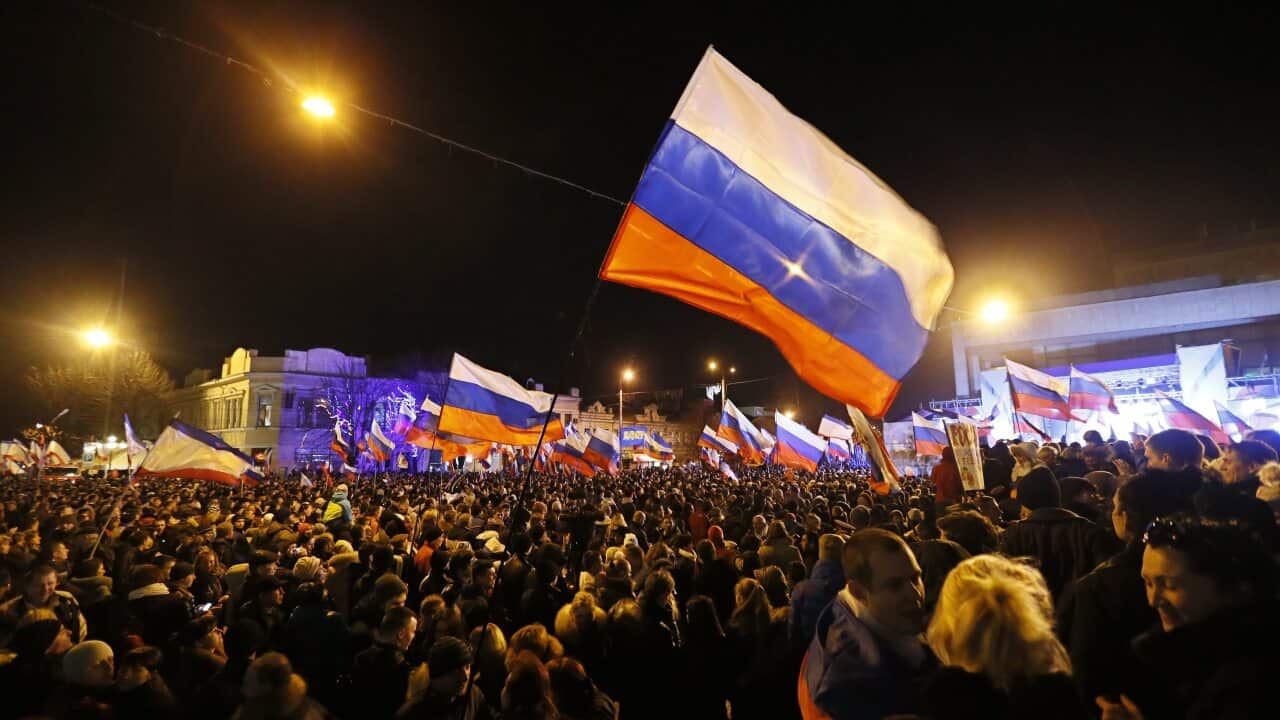
There have been street celebrations in Crimea, following the announcement of results from a referendum showing an overwhelming majority in favour of the Ukrainian region re-uniting with Russia.
But the reaction from much of the rest of the world has not been so jubilant.
European Union foreign ministers say they are finalising plans to impose sanctions on Russia because of its support for the referendum, which came after months of unrest in Ukraine and the ousting of pro-Russian President Viktor Yanukovych.
The referendum has also been criticised by a Ukrainian-Australian community group, which argues it could exacerbate tensions between Russia and Ukraine.
News that makes sense
Your trusted source for staying up-to-date with the world around you. Get free daily news updates and analysis, straight to your inbox.
Michael Kenny reports.
(Music)Russia's national anthem played out across Lenin Square in the Crimean capital Simferopol as voters welcomed the referendum result which was announced two hours after polling stations closed.
Election officials praised the voter turn-out of 83 percent, although some minority groups boycotted the referendum, including the Tartars and the region's Muslim community.
A voter who rallied in Lenin Square told Al Jazeera, he believes the referendum is a great step forward for Crimea.
"The new Ukrainian government calls itself legitimate, but do you think this is illegitimate? We are going home to Russia."
However, the referendum has been denounced by the interim Ukrainian government in Kiev.
Ukraine's Interim Prime Minister Arseniy Yatsenyuk has promised to take strong action against those who promoted the referendum.
"Let there be no doubt. The Ukrainian state will find all ringleaders of separatism and division now shielded by the Russian troops who are attempting to destroy Ukrainian independence- we will find them all. If it takes a year or two years- we will bring them to justice and we will try them through Ukrainian and international courts. The earth will burn beneath their feet."
At a meeting in Brussels, European Union Foreign Ministers discussed plans to impose travel bans and asset freezes on over 100 senior Russian officials over their actions in Crimea.
The President of the Socialist and Democrats Group at the European Parliament, Austrian MP Hannes Swoboda says targeted sanctions may offer the best approach to resolving the crisis.
"It could be therefore that one has to be, let us say moderate. Targeted sanctions 'Yes'. But make it clear not to start a new economic war because that could be disastrous and our citizens at the end of the day would not blame the Russians, but us in the European Union."
However a spokesman for the Australian Federation of Ukrainian Organisations, Professor Marko Pavlyshyn believes targeted sanctions are likely to have a limited impact on Russia.
Professor Pavlyshyn, who lectures in Ukrainian studies at Monash University in Melbourne, believes the international community instead needs to look towards tougher sanctions covering the Russian economy as a whole.
"It is an instance of a major power ignoring obligations that itself has signed and invading a neighbour and unilaterally acquiring territory and proclaiming that territory to be a part of itself. The question of to what extent the Russian Federation leadership will be sufficiently impacted by direct personal sanctions to alter their thinking on their international stance (on Crimea) remains to be seen."
Professor Pavlyshyn believes that although the referendum result will not gain any international recognition, it will nevertheless allow Crimea to become a de-facto part of the Russian Federation.
He believes pressure will now be applied through government-run institutions like universities in Crimea for Russian rather than Ukrainian to be the region's first language.
Professor Pavlyshyn says Australia could now play a pivotal role through bodies like the G20 and the United Nations Security Council to pressure Russia into changing its position on Crimea.
"Australia at the moment has a place on the Security Council and it is for the moment, Chair of the G20. That gives Australia a platform from which it can join the international chorus of condemnation of Russia's actions."