(Transcript from SBS World News Radio)
The body count from the New South Wales Independent Commission Against Corruption has risen to almost a dozen state Liberals and several high level Labor politicians.
The developments at the ICAC hearings in Sydney have again galvanised calls for establishing a federal anti-corruption body.
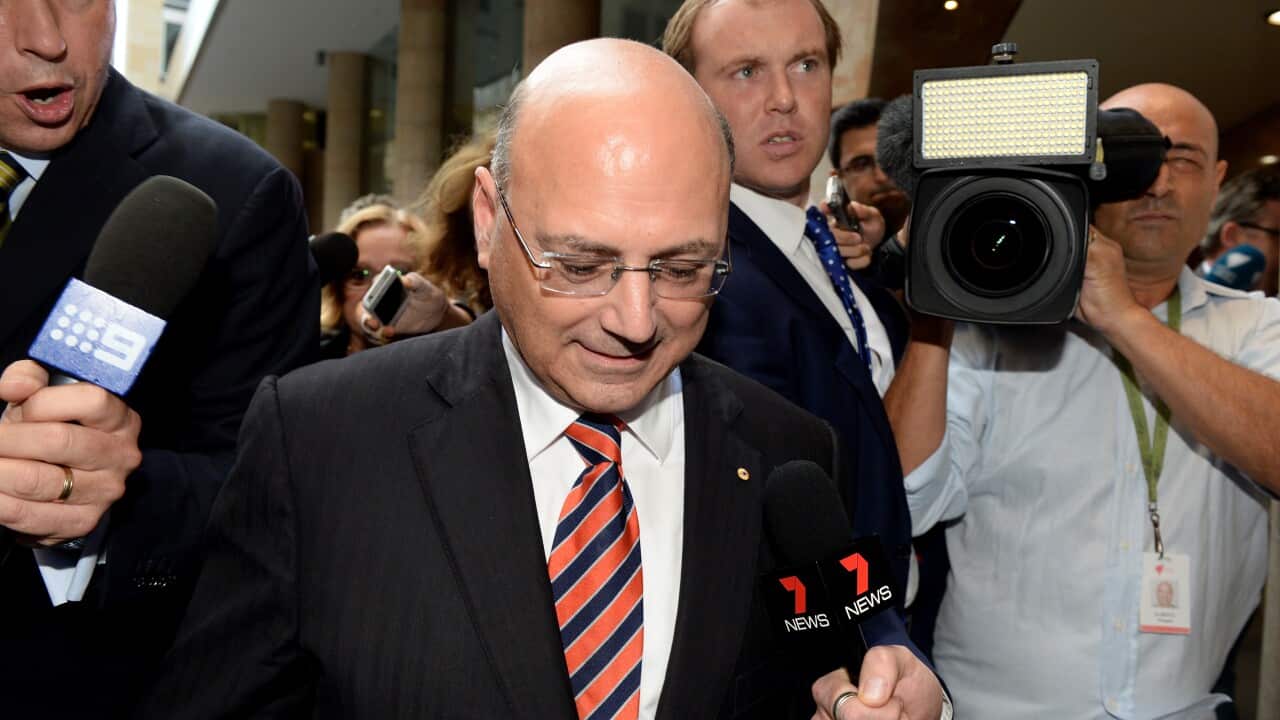
ICAC has heard claims former deputy federal Treasurer Arthur Sinodinos was present when the Liberal Party's chief fundraiser suggested a way to launder donations.
The idea allegedly was to have a federal front organisation launder the donations from the state's property developers.
Amanda Cavill reports.
(Click on the audio tab above to hear the full report)
The chief Liberal Party fundraiser has told ICAC he suggested using the Free Enterprise Foundation at a party finance committee meeting chaired by Senator Arthur Sinodinos.
Paul Nicolaou says the move was designed to get around a ban in New South Wales on political donations from property developers.
Mr Nicolaou, once head of the state's Ethnic Communities' Council, says he assumed the party would seek legal advice to make sure his idea did not violate the rules.
It has been suggested money was paid to the Free Enterprise Foundation, then went straight back to the state Liberal Party or individual candidates' campaign accounts.
The matter has grown further complicated after a chain of emails were revealed, showing the level of access Mr Nicolaou had to powerful federal party figures.
The emails between Prime Minister Tony Abbott's chief of staff, Peta Credlin, and Mr Nicolaou became public after ICAC overturned a suppression order over their release.
Counsel Assisting the Commission Geoffrey Watson has told the hearings there are questions around whether state party members used the Canberra-based foundation to disguise banned donations ahead of the 2011 state election.
"There is evidence that the use of the Free Enterprise Foundation in this fashion was known at high levels in the Liberal Party. It seems that the federal party was willing to allow itself to be used in that way."
The New South Wales Government established ICAC in 1989 in response to growing community concern about the integrity of public administration in New South Wales.
There have been recent calls to establish a similar national body whose reach would extend right to the top of the federal political and administrative structure.
Former Victorian Supreme Court judge Stephen Charles, a member of the Accountability Roundtable, has told the ABC a federal body like ICAC is needed.
He says claims that such a body is unnecessary because the problem is just state laws are wrong.
"The trouble is that, when you look at Canberra and you look at its history, there are any number of examples of corruption by individual officials, in Customs, in Defence, places like that -- even in Treasury. Anywhere where people are in a position to dispense money and influence and power, there will be others seeking to obtain them. And Canberra is where most of these things are to be found."
Elected just a year ago, the Abbott Government has already faced corruption allegations over parliamentarians' travel expenses and charging lobbyists and business for access to ministers.
The former Labor government was tarnished by the corrupt actions of Peter Slipper and Craig Thomson, MPs whose support was vital to maintain a shaky minority government.
A former head of ICAC, David Ipp, says, while he believes there is a need for a national body, there is sure to be resistance to the idea.
He says ICAC is the only state corruption watchdog in Australia which has been allowed the necessary power to be effective.
"Most politicians do not like to be subject to a body such as ICAC, and you can see that in all the new, similar bodies that have been created in South Australia, Victoria and Tasmania. They really do not have the (same) powers of investigation as ICAC, and that is because politicians don't want that."
The feature that gives ICAC its power is that it is comprehensive, investigating the actions of both politicians and public servants across all areas of the public sector.
It also has all the powers of a judicial commission of inquiry, including the right to acquire evidence and hold public hearings, but it cannot conduct criminal prosecutions.
It can and does, however, recommend criminal proceedings go forward.
The former head of the Australian Institute of Criminology, Professor Adam Graycar, says there are other mechanisms available to deal with corruption allegations at a federal level.
A professor of public policy with the Australian National University, he says, if such a body were established, there would need to be clear direction on how it would function.
"It depends what you want that body to do. It's a complex issue, because the federal jurisdiction, if it's to look at federal politicians and federal public servants, there are other mechanisms that can deal with that. There is a difference in a federal system between the nature of corruption at the national level and at local levels. It's not automatic that we should have a national body like ICAC."
The former Labor government had drafted a National Anti-Corruption Plan, but the plan excluded politicians, involved no new agencies and was never acted upon.
The Coalition has said the Federal Government will develop new anti-corruption measures, but nothing more has been heard of that plan either.
Share


