
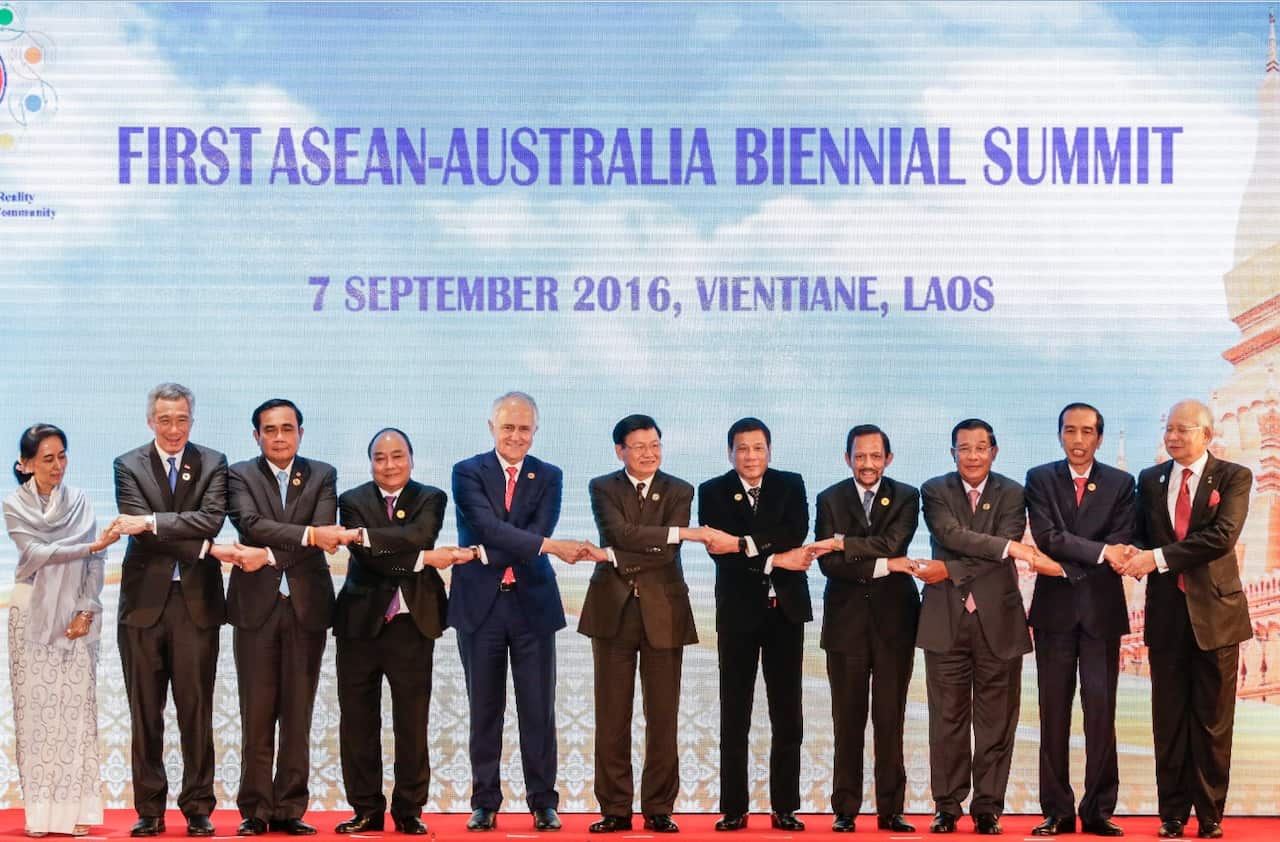
Mr Turnbull issued the invitation during a special address at the ASEAN summit in Laos - where the South China Sea dispute and concerns over regional security - continue to dominate.
The Philippines, which won a case against China in the International Court of Arbitration in July, has released new images from the South China Sea, which it claimed shows China preparing to possibly reclaim more land, as well as building infrastructure on another disputed territory.
China denies it has any such intention.
Mr Turnbull told ASEAN leaders that all parties in the South China Sea dispute must exercise restraint.
"Differences should be settled peacefully accordance to international law. And until they are, we will draw side to act with restraint and avoid any steps which will create or add tensions," he said.
News that makes sense
Your trusted source for staying up-to-date with the world around you. Get free daily news updates and analysis, straight to your inbox.
"We know that ISIL wants to expand its presence in south-east Asia and this is of concern to us all."
Mr Turnbull made those comments as he sat down for the first ASEAN-Australia dialogue, which gives Australia a direct audience with the ten nations in the region.
After issuing the invitation for the 2018 summit, he said it would draw regional partners closer together to tackle issues such as the South China Sea dispute.
"A special summit in Australia would deepen our economic partnership through closer links between ASEAN and Australian businesses in the private sector and bolster our strategic partnership," Mr Turnbull said.
Another issue at the forefront of the summit and sideline meetings has been regional security and terrorism.
Mr Turnbull said that as Islamic State - also known as ISIL - continued to lose ground in Syria and Iraq, it would turn a sharp eye to south-east Asia.
He has called for greater cooperation on intelligence sharing to be better across the recruitment and movement of terrorists.
"We know that ISIL wants to expand its presence in south-east Asia and this is of concern to us all,” he said.
“The latest ISIL propaganda is further evidence that as it faces increased pressure in Syria and Iraq, it will attempt to seed fear and division in our communities. Our updated joint declaration is a significant signal of collective political will to share our expertise and stay ahead of this evolving threat."
ASEAN leaders joined other partners for individual meetings like the one hosted by Malcolm Turnbull, before moving into the east-Asia summit.
That included ASEAN's north-Asian nations China, South Korea and Japan, and dialogue partners Australia, the US, New Zealand.
Duterte finally meets Obama
The leaders attended a gala dinner to mark the start of the east-Asia summit.
At the dinner, the Philippines confirmed its president, Rodrigo Duterte, had finally met with US President Barack Obama.
The men were initially scheduled to meet on Tuesday, but the US president cancelled after Duterte called him a "son of a whore" and threatened to swear at him if he brought up certain domestic issues.
But Philippine foreign secretary, Perfecto Yasay, told reporters the pair finally crossed paths for a brief chat - but would not disclose the details of the conversation.
"Yes, I will confirm that they met. They met in the holding room and they were the last persons to leave the holding room,” Mr Yasay said.
“I would not be able to say at this time how long they met and talked but I am informed very reliably that the meeting was very cordial, and I guess the implications of this would be that the relationship between the Philippines and the United States is firm."
Another leader on the attack came in the form of New Zealand Prime Minister John Key, who has hit out at North Korean dictator Kim Jong-un.
After meeting with Malcolm Turnbull for talks, Mr Key said the threat from North Korea was one of the biggest issues on the agenda.
"All of us are concerned by the actions that we see from a leader which is highly unpredictable, and is building greater capability and undertaking more tests and from what we can see, those tests are becoming more successful, the range is further, and that's challenging for regional security in a way we haven't really seen in other areas,” Mr Key said.
“We sit back with a guy that we just don't know what he's going to do next. His behaviour and the way he's treated people, if you believe the media reporting of that, not only is it abhorrent but it's also, well, it's barbaric."
Also in attendance at ASEAN was the United Nations Secretary-General, Ban Ki-Moon.
He urged leaders to ratify the Paris Agreement on climate change.
Last December, nearly 200 countries agreed on a binding global compact to keep global temperature increases to "well below" two degrees Celsius.
Ban Ki-Moon said that although 180 countries have since signed the agreement, 55 nations need to formally ratify the treaty to put it into legal effect.
"Twenty-seven countries as of now have ratified the agreement, accounting for some 39, a little over 39 per cent of greenhouse gas emission,” he said.
“We need that 28 more countries ratify, and accounting for a further 16 per cent of greenhouse gas emission to bring this agreement into force."
With Reuters, APTN and AAP







