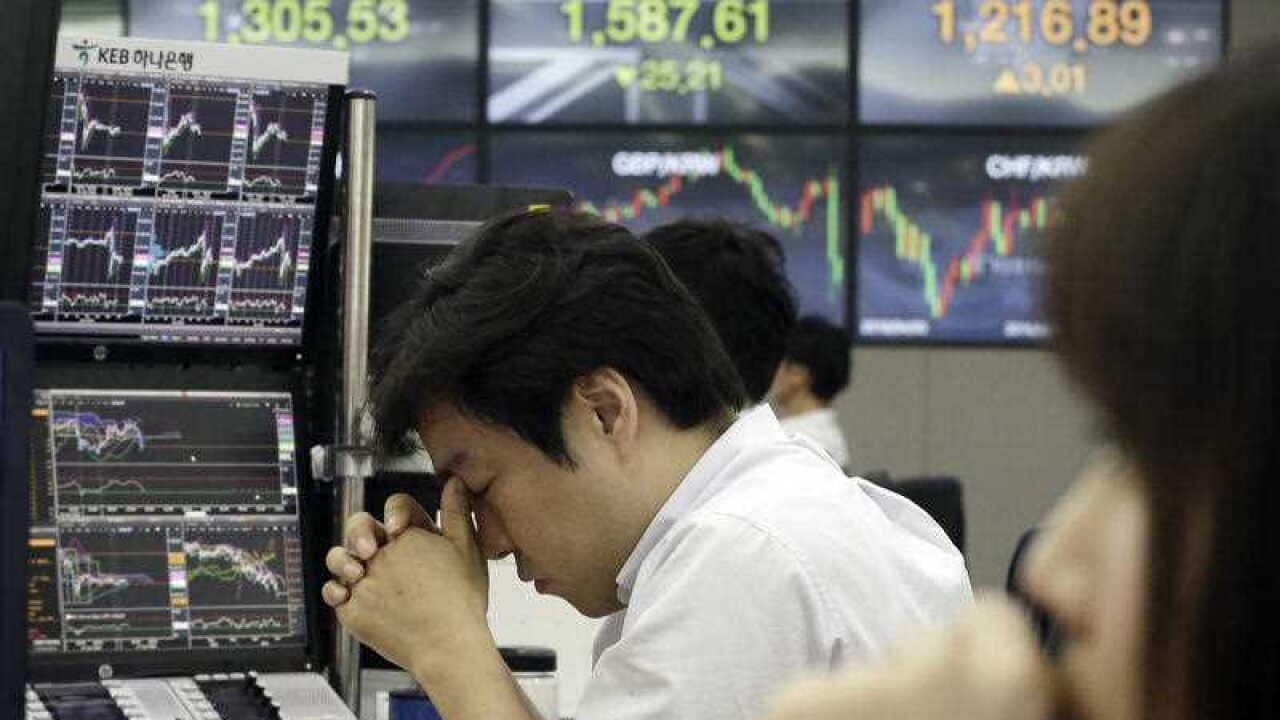
Asian stocks have fallen and the British pound has tumbled more than two per cent as markets struggle to shake off deep uncertainty sparked by Britain's decision to leave the European Union.
Sentiment remained weak and trading was volatile on Monday, even if the worst of the turmoil seen on Friday, when global stock markets suffered their biggest decline in nearly five years, had eased.
"Things are so uncertain that investors still do not have a clear idea how much risk assets they need to sell," said Hiroko Iwaki, senior foreign bond strategist at Mizuho Securities.
"But it is safe to assume investors are not yet with done all the selling they need to. I wouldn't be surprised to see another 10 per cent fall in share prices," she added.
Among many questions the British exit, or Brexit, has triggered are just how much UK and European economies will slow, how they will negotiate their new relationship and how European leaders will try to boost the crumbling European Union.
News that makes sense
Your trusted source for staying up-to-date with the world around you. Get free daily news updates and analysis, straight to your inbox.
US S&P mini futures, the world's most traded stock futures, fell 0.5 per cent to 2,009, edging near Friday's 3-1/2 month low of 1,999.
MSCI's broadest index of Asia-Pacific shares outside Japan dropped 0.9 per cent in volatile trade as companies with UK exposure in particular came under more pressure.
Financials led declines in Australia and Hong Kong with the sector seen among the worst hit by Brexit and the prospect of London losing its prized "EU passport".
"What we are witnessing is 'escape from freedom'. We are likely to see walls building up in many places. The sectors that had benefited the most from globalisation will now suffer," said a fund manager at a Japanese asset management firm.
Japan's Nikkei rose 1.4 per cent, a partial rebound after Friday's hefty 7.9 per cent fall, helped by stronger warnings from Japanese officials that they may intervene in currency markets to stabilise the yen.
Still, the dollar fell 0.4 per cent against the safe-haven yen, trading around 101.80 yen.
The British pound fell 2.4 per cent to $US1.3388, still some distance from the 31-year low of $US1.3228 touched during Friday's wild trade.
The euro also came under further pressure, falling almost 1 per cent against the dollar, as investors fret Brexit could stoke the anti-establishment mood in Europe and even talk of disintegration of the union.
"(There will be) sell-off in the euro as talk of other exit referenda builds," said Jerome Booth, chairman of New Sparta Asset Management in London.
"This sell-off will be more profound and long-lasting and will be not just against the dollar and yen but also against the pound. It will also raise fears of significant loss of values for holders of Euro-zone government bonds."
The euro fell to $US1.1008, edging closer to Friday's 3-1/2-month low of $US1.0912.
But in a sign Briton's shock decision to leave the European Union may be encouraging Europeans to seek the safety of the status quo, support for Spain's conservative People's Party (PP) surged in Sunday's general election.
The euro's weakness helped to push the Chinese yuan to its weakest level against the dollar since December 2010 on Monday.
Oil prices fell more than 1 per cent in early trade, with international benchmark Brent futures down 1.3 per cent to $US47.80 per barrel.
Demand for safe haven assets such as government debt and precious metals remained strong.
The 10-year US debt yield dropped almost 10 basis points to 1.480 per cent in early Asian trade. On Friday, it fell as low as 1.406 per cent, near its record low of 1.381 per cent marked in July 2012.
US interest rate futures have completely priced out chance of a rate hike by the Federal Reserve this year and pricing in less than 50 per cent chance of a rate hike even by the end of 2017.
Gold rose 0.9 per cent to $US1,327.2 per ounce.







