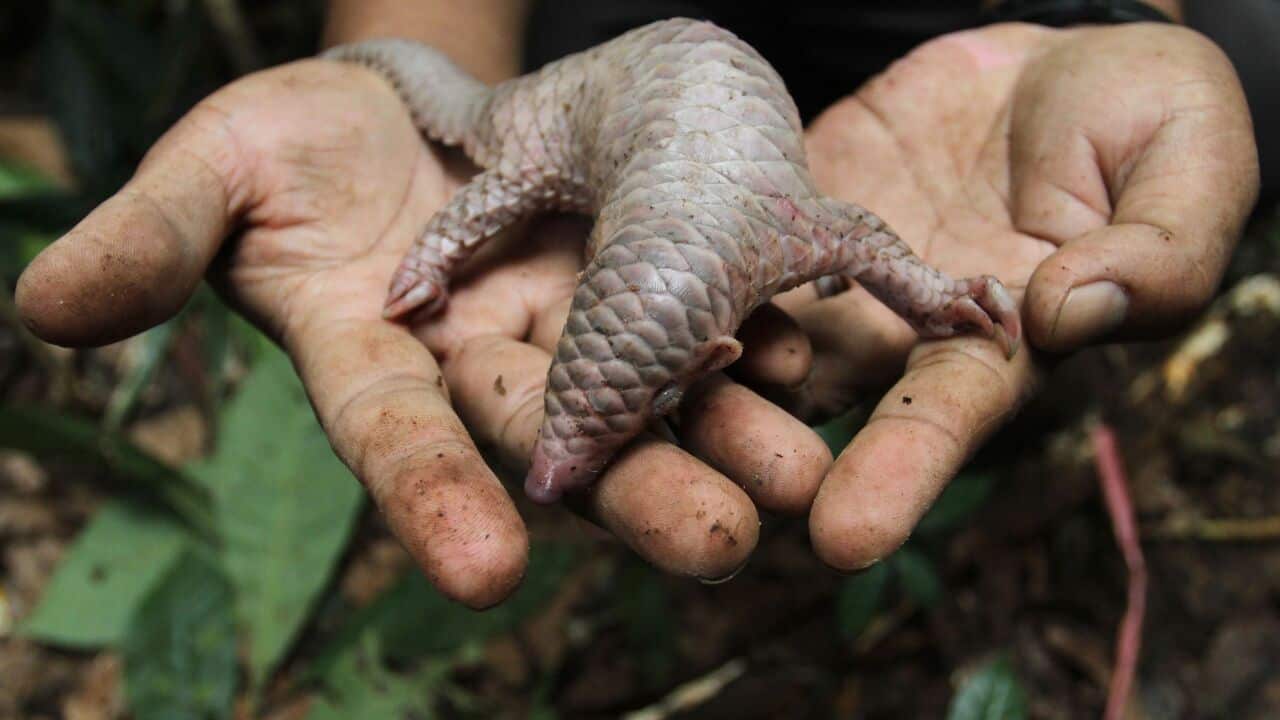
The mysterious mammal, also known as a pangolin, is the prey of poachers with more than one million believed to have been snatched from the wild in the past decade.
"In the 21st century we really should not be eating species to extinction -- there is simply no excuse for allowing this illegal trade to continue," said Jonathan Baillie, co-chair of the pangolin specialist group of the IUCN Species Survival Commission.
"All eight pangolin species are now listed as threatened with extinction, largely because they are being traded to China and Vietnam," he said in an statement from the International Union for Conservation of Nature.
The illegal trade is flourishing for, besides being a luxury food, pangolin scales are also used in Chinese medicine to treat conditions such as psoriasis and poor circulation.
In fact, this scaly anteater has become the world's most illegally traded mammal, which has led the IUCN to step up conservation efforts in Asia and also Africa where traders are turning to meet the growing demand.
"A first vital step is for the Chinese and Vietnamese governments to conduct an inventory of their pangolin scale stocks and make this publicly available to prove that wild-caught pangolins are no longer supplying the commercial trade," said Dan Challender, the other co-chair of the specialist group based at the Zoological Society of London.
Conservationists want to save the pangolin from the dinner table and the annals of extinction as they are highly evolutionarily distinct. Extinction would wipe out 80 million years of evolutionary history.
The name pangolin comes from the Malay word 'pengguling' which means something that rolls up, which is what they do when they feel threatened.
The pangolin, which lives on insects in the tropical forests, weighs between two to 35 kilogrammes (4.4 to 77 pounds) and measures between 30 to 80 centimetres (12 to 31.5 inches) long. The giant species is up to 1.5 metres long.
Pangolins were previously grouped with anteaters, sloths and armadillos, but now pangolins are known to be most closely related to carnivores.