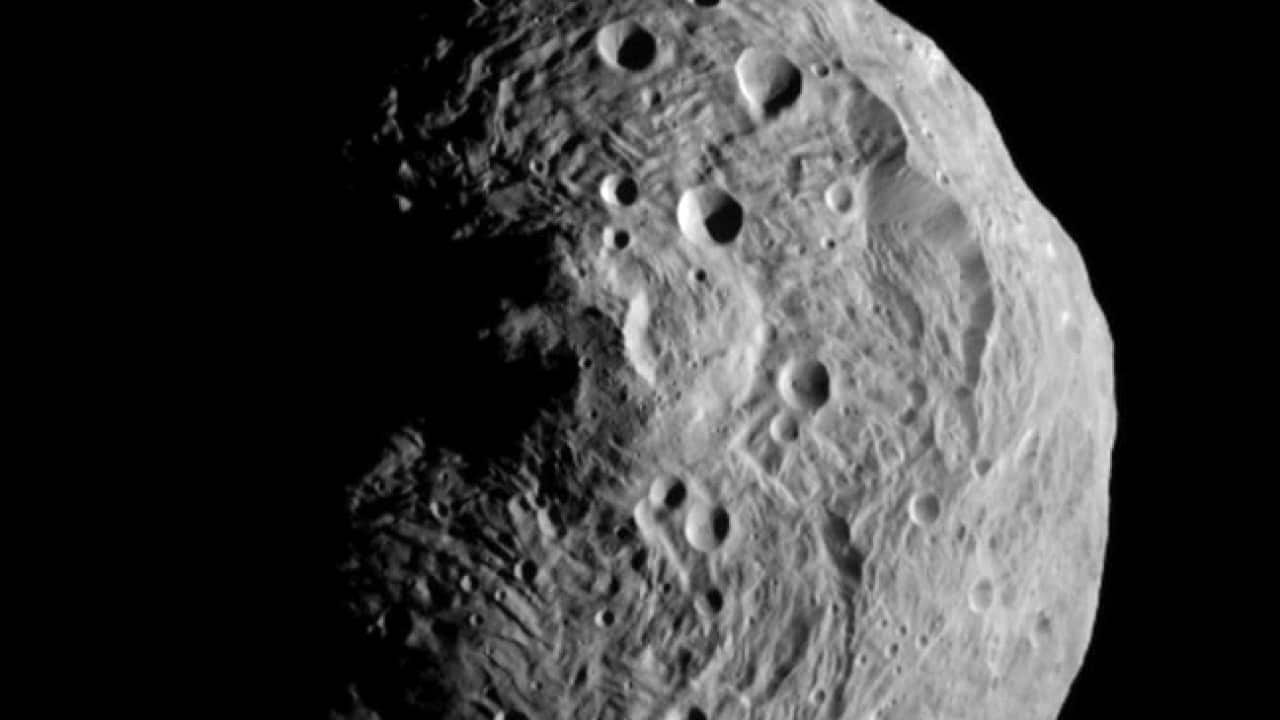
Nasa's Dawn mission has returned new images from orbit around the asteroid Vesta, revealing a diverse and dramatic landscape says David Shiga of New Scientist.
Dawn entered orbit around the giant asteroid Vesta on July 16. Vesta is the second-heaviest asteroid in the solar system and may offer new insights into the early stages of planet formation, since meteorites from Vesta suggest the giant asteroid formed before Earth and the other planets.
At a NASA press conference on Monday, the Dawn team showed off a new set of detailed images taken from Vesta orbit. The images show a varied and surprising landscape and reveal details as small as 500 metres across – less than one-thousandth Vesta's diameter.
"We're here today to say Earth, meet Vesta," said Dawn's chief engineer Marc Rayman of NASA's Jet Propulsion Laboratory in Pasadena, California.
The Dawn team had previously released a few images taken after Dawn entered orbit around Vesta. But this was the team's first press conference to explain what the images show. It also unveiled some new images that had not previously been released.
Dark streaks
Several of the images were combined to create a video of Vesta's rotation, as seen from about 5200 kilometres away.
Huge grooves are seen wrapping around Vesta's equator. They may have formed from the force of the tremendous impact that blasted an enormous crater at the asteroid's south pole long ago.
"The orientation of the grooves suggests it was associated with that early giant impact," said Dawn's chief scientist Chris Russell of the University of California in Los Angeles.
The interiors of some craters are decorated with very dark streaks of unknown origin. "I haven't seen anything like that before," said Russell. The more detailed views that Dawn will obtain as it spirals closer might help reveal their origin, he added.
Colour and brightness variations across the surface hint at differences in composition, though exactly what minerals account for them is not yet clear. "There are very dramatic differences in different regions," said Enrico Flamini, chief scientist at the Italian Space Agency in Rome, which provided Dawn's spectrometer.
Closer and closer
Dawn, currently about 3500 km away from Vesta, has been getting closer to the asteroid since it entered orbit around it at a distance of 16,000 km. It will officially begin the science-observing phase of its mission on 11 August at an altitude of 2700 kilometres, eventually dipping to just 200 kilometres above the asteroid.
In July 2012, it will depart Vesta en route to its second and final destination, Ceres, the biggest asteroid in the solar system.
Rayman credited an efficient technology that was once science fiction – but has been proven by several missions preceding Dawn – for allowing the spacecraft to visit both Vesta and eventually another asteroid, Ceres, in a single mission: ion propulsion.
Rather than simply burning fuel like conventional rockets, ion engines use electric or magnetic fields to accelerate charged particles to high speed, pushing the spacecraft in the opposite direction. "We take advantage of the tremendous capability of ion propulsion, which I first heard of in a Star Trek episode," Rayman said.
Share


