
Astronomers have found that a planet they thought was flying solo through space, has indeed been orbiting a star about one trillion kilometers away from it.
That is equivalent to 7,000 times the distance from the Earth to the Sun.
The planet, known as 2MASS J2126-8140, and its orbit around the red dwarf star - which has been named TYC 9486-927-1 - form the largest solar system known.
A team of astronomers from Australia, the US and the UK published the findings.
News that makes sense
Your trusted source for staying up-to-date with the world around you. Get free daily news updates and analysis, straight to your inbox.
The astronomers report the distance between the planet and the star is "extremely wide", at 0.1 light years, and the orbit 140 times wider than Pluto's.
"We were very surprised to find such a low-mass object so far from its parent star," said Dr Simon Murphy from the Australian National University’s Research School of Astronomy and Astrophysics, who was part of the study.
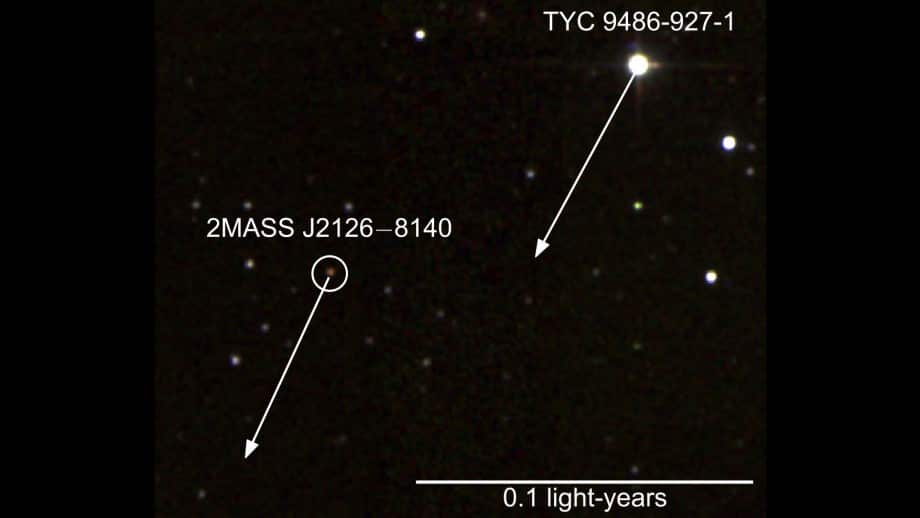
In fact, the astronomers estimate it would take the planet about one million earth years to circumnavigate the star, and the star’s light would take about one month to reach the planet.
Dr Murphy said the solar system likely formed in a different way to our solar system, "form[ing] a large disc of dust and gas" about 10 million to 45 million years ago.
"They must not have lived their lives in a very dense environment. They are so tenuously bound together that any nearby star would have disrupted their orbit completely."
Other scientists in the research collaboration include the lead astronomer, Dr Niall Deacon from University of Hertfordshire, and Dr Joshua Schlieder from the NASA Ames Research Center.
Dr Deacon said astronomers have plenty of questions that want answered in further research, including finding out how the solar system formed in the first place.
"How do you get something like this forming at this separation? We have models of binary stars that can form at this really wide separation. We have models of planets," he said. "Is this a planet that formed to be close in and got kicked out or something that formed really far out? We don’t know."







