(Transcript from World News Australia Radio)
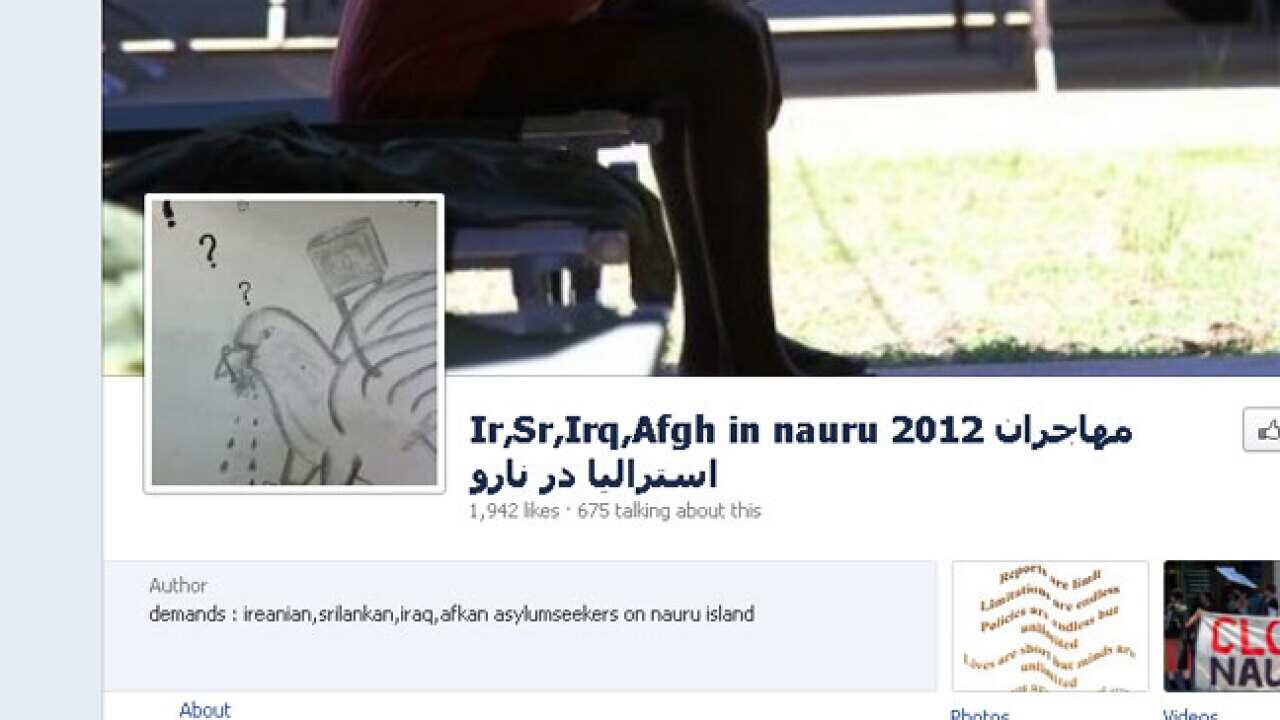
Anyone can now apparently make contact with detainees on Nauru via the Internet phone service Skype, and a group of them is believed to be behind at least one account on the social networking site Facebook.
News that makes sense
Your trusted source for staying up-to-date with the world around you. Get free daily news updates and analysis, straight to your inbox.
As asylum-seekers take to new media platforms to protest their detention on Nauru, Kristina Kukolja asks: is a social media presence helping or hindering their cause?
"Get over it. Our soldiers are doing it tougher fighting the war you were not brave enough to stay and fight for yourselves./ If people can look at what is happening on Nauru and NOT see genuine suffering: well they are beyond redemption./ My family and I want you to know that we want you in our country and we care about what happens to you. Not all Australians are against refugees./ If you destroy your papers and passports, why should we let you into our country? We DON'T know who you are. You could be very BAD people. So until we find out who you are, have a happy time relaxing in the tropics. Go fishing, grow some marijuana. HELP the army and contractors BUILD you better accommodation. Oh that's right MUSLIM men don't work do they? That's WHY you are NOT welcome in Australia. By the way has OMID died yet?" (Note: capitals inserted by comment authors)
Just some of the comments posted by visitors to a Facebook page believed to be maintained by asylum-seekers in Australia's overseas processing centre on Nauru.
Omid is understood to be a detainee of Iranian background recently airlifted to Australia for emergency medical treatment, after reportedly refusing food for more than 50 days while in detention.
Graphic descriptions of his deteriorating health are just one example of the content being posted by those behind what's claimed to be the asylum-seekers' own Facebook page.
Regular updates - detailing suicide attempts, hunger strikes, widepread mental anguish and repeated pleas for their claims to be processed in Australia - paint an even more disturbing picture of life on the island for the nearly 400 men being held there.
Refugee Action Coalition spokesman Ian Rintoul says, for the very first time, social media is giving Australians direct access to the reality of the asylum experience.
"It took months, if not longer in the situation when the Howard government set up the first Pacific Solution on Nauru for any of the reality of Nauru to get out. So, that's the most immediate thing. The other thing is that it's meant is that it's been able to push its way into the media and push its way onto the agenda of the government. The government would've been quite happy to keep churning out its press releases, saying: oh another successful transfer, simply out of the numbers. But the Facebook page has meant that people have been able to see the truth of what those transfers actually mean as they've had to address that. So, the hunger strike which they could have kept under wraps has meant that its pushed its way onto the government's agenda and the government has had to address it."
Information sciences lecturer at the University of Canberra Lubna Alum says the purported asylum-seeker Facebook page has attracted a following of mainly refugee advocates, human rights bodies and journalists -- in other words, those already sympathetic to their cause.
She says last month's visit to Nauru by advocacy group Amnesty International is a sign of positive attention born of their interaction on social media.
But Ms Alum expects it will only have a limited impact.
"This is nothing new. The messages we are getting from the detention centres are sort of not a suprise, but what it does -- because it's coming directly from the people -- it obviously has drawn our attention and I think it will serve to some purpose to improving the conditions in those centres, renewing the logistics and infrastructure issues and the medical treatments. However, I am doubtful if it would actually change the government policy because it is a much more complex and complicated process."
Melbourne-based social media expert Sam Mutimer agrees.
Ms Mutimer says while a Facebook page offering what appear to be fist-hand accounts of life in detention on Nauru has sparked online interest, it's not certain whether any meaningful public action will come as a result.
She also questions how long the interest can be sustained, and warns that, in time, imposter sites may emerge.
Ms Mutimer describes the maintenance of the Facebook page as very strategic which, she says, raises other questions.
"It's been really cleverly set up. I was just looking down at the other pages they've liked, so to potentially gain attention to themselves, like the Herald Sun, yourselves (SBS), The Australian and the like. So, whoever set up the page really knows what they are doing. They've pinned a post at the top of the Facebook page as well, which obviously will stay there for a while as well. So, first impressions lead me to the fact [ask]: how do we know if it's them or not? For one, is this someone that is really passionate about that and they're working on their behalf? Just [looking at] the way the posts have been set up, it's been done in a really professional manner."
As part of its so-called No-Advantage campaign, the government has taken to the video-sharing site Youtube with a message it hopes will dissuade others in the region from travelling to Australia by boat.
But Lubna Alum from the University of Canberra says content seen to be posted by the asylum-seekers themselves could, inadvertently, become more of a deterrent than the government's efforts.
"The negative personal testimonies, the vivid pictures that we are seeing of the conditions and the hourly updates we are getting does paint a picture that this is no heaven they are coming to and there is probably no advantage from coming by boat and taking other channels rather than the formal channels the government is trying to advocate, so yes, it could probabaly work in favour of the government."
But the Refugee Action Coalition's Ian Rintoul says material posted by asylum-seekers on Facebook -- however distressing -- will not deter others planning to make their way to Australia by boat.
"To understand the reason why people are going to come, in spite of what is happening to the people on Nauru, you only have to look at the experience in Quetta (Pakistan) or Sri Lanka. You've got white vans driving around under the auspices of the Rajapaksa (Sri Lanka's president) regime with daily disappearances in Sri Lanka. That's why people get on boats to come from Sri Lanka to Australia. That's why people come on boats from Indonesia, with Afghan, Pakistan, Iran. The circumstances at home are so bad, where their immediate personal freedom is at risk, what's happening on Nauru -- even if they think in the end they might spend three or five years on Nauru -- they will end up in Australia, somewhere where they will get some safety and security for the future."







