
A minor meteor shower will streak across the skies this week as Earth passes through debris left behind by a comet that takes about 2,000 years to orbit the sun.
The Aurigid meteor shower will remain active until 5 September, with activity expected to peak on the night of 31 August to 1 September.
According to experts, the Aurigids are not as prolific as better-known meteor showers such as the Perseids or Orionids, but are notable for the speed of their meteors — and their connection to the long-period comet C/1911 N1, known as Kiess.
For Australian stargazers, however, this year's shower will be a difficult one to spot.
What are the Aurigids?
News that makes sense
Your trusted source for staying up-to-date with the world around you. Get free daily news updates and analysis, straight to your inbox.
Meteor showers occur when Earth passes through streams of dust and debris left behind by comets or asteroids as they travel around the sun.
As a comet approaches the sun, heat causes material from its icy nucleus to escape, leaving dust and rocky particles along its orbit.
When Earth crosses one of these debris trails, the particles enter our atmosphere at high speed and burn up, producing the streaks of light we see as meteors.
Andrew Tomkins, a professor at the School of Earth, Atmosphere and Environment at Monash University, told SBS News: "You can think of it as dirty snowballs."
The Aurigids are associated with Kiess, a long-period comet whose orbit takes it far beyond the planets of our solar system, named after astronomer Carl Clarence Kiess, who discovered it.
There are two broad groups of comets: short-period comets which take fewer than 200 years to orbit the sun, and long-period comets which take more than 200 years.
Short-period comets are generally thought to originate in the Kuiper belt beyond Neptune, while long-period comets are associated with the distant Oort Cloud.
Tomkins described the Oort Cloud as a "giant spherical shell of objects".
He said the Oort Cloud is so distant that spacecraft such as the Voyager missions have not travelled through it. Scientists have inferred its existence from the behaviour and origins of long-period comets.
Kiess is one of those long-period comets, with an estimated orbital period of about 2,000 years. It was discovered in 1911 and is now billions of kilometres away.
How are Aurigids different from other meteor showers?
The Aurigids are a relatively minor meteor shower, with a typical peak rate of around six meteors per hour under ideal observing conditions.
What makes them stand out is their speed.
Tomkins said Aurigids enter Earth's atmosphere at about "66 or 67km per second".
"Imagine a meteor moving between Melbourne and Geelong in a second."
That makes them considerably faster than many meteors associated with shorter-period comets.
Tomkins said meteors from short-period comets move at about 15km per second, while pieces of rocket debris, which can sometimes be mistaken for meteors, travel at around 8km per second.
The Aurigids are also unusual because they have occasionally produced brief bursts of much greater activity. The shower has recorded outbursts in the past, although these are not an annual feature.
Will the Aurigid meteor shower be visible in Australia?
The Aurigids are best suited to observers in the Northern Hemisphere, where the shower's radiant — the point in the sky from which the meteors appear to originate — rises higher.
That makes viewing conditions less favourable in Australia, particularly in southern parts of the country.
This year's conditions will make things even more difficult, Tomkins said.
This year, the moon will be shining strongly during the peak, and its light is expected to wash out many of the fainter meteors.
Tomkins said the position of the Aurigid radiant also means "if you're in southern Australia, you're going to have a hard time" seeing the meteors.
When and how should you watch the Aurigids?
If you want to try your luck, Tomkins recommends finding a "dark sky site" away from city lights.
For Australian observers, he said the best chance will be from a location with as little light pollution and as clear a view of the sky as possible.
In Australia, the radiant will rise at about 3am AEST, leaving only a couple of hours before sunrise to spot them.
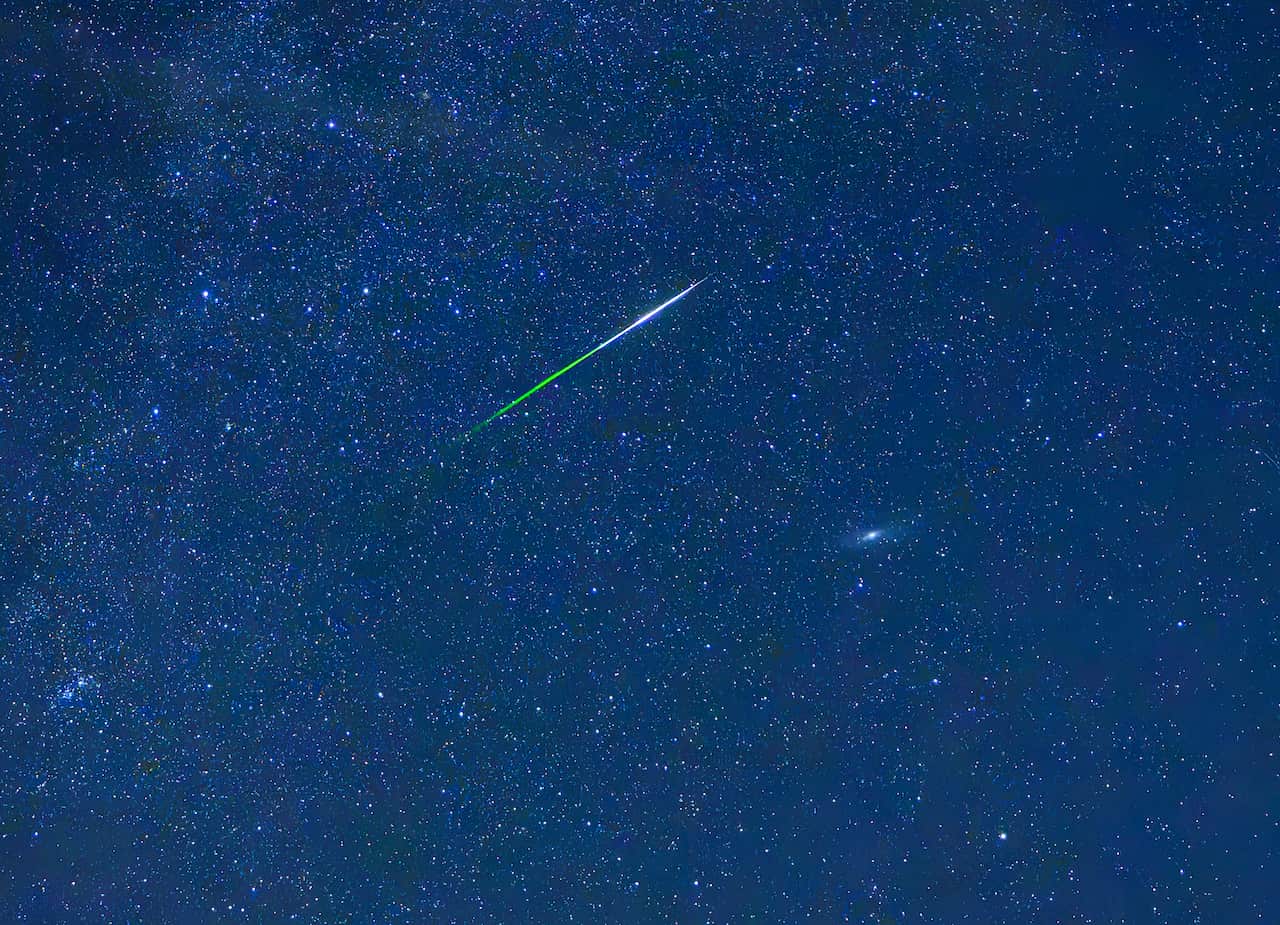
You do not need a telescope, binoculars, or any special equipment to see a meteor shower.
What else is happening in the night sky this year?
The September Epsilon Perseids become active around the same time, with activity extending into September, while the Orionid meteor shower offers a more substantial meteor-watching opportunity in October, followed by the Leonids in November and Geminids in December.
For the latest from SBS News, download our app and subscribe to our newsletter.







