
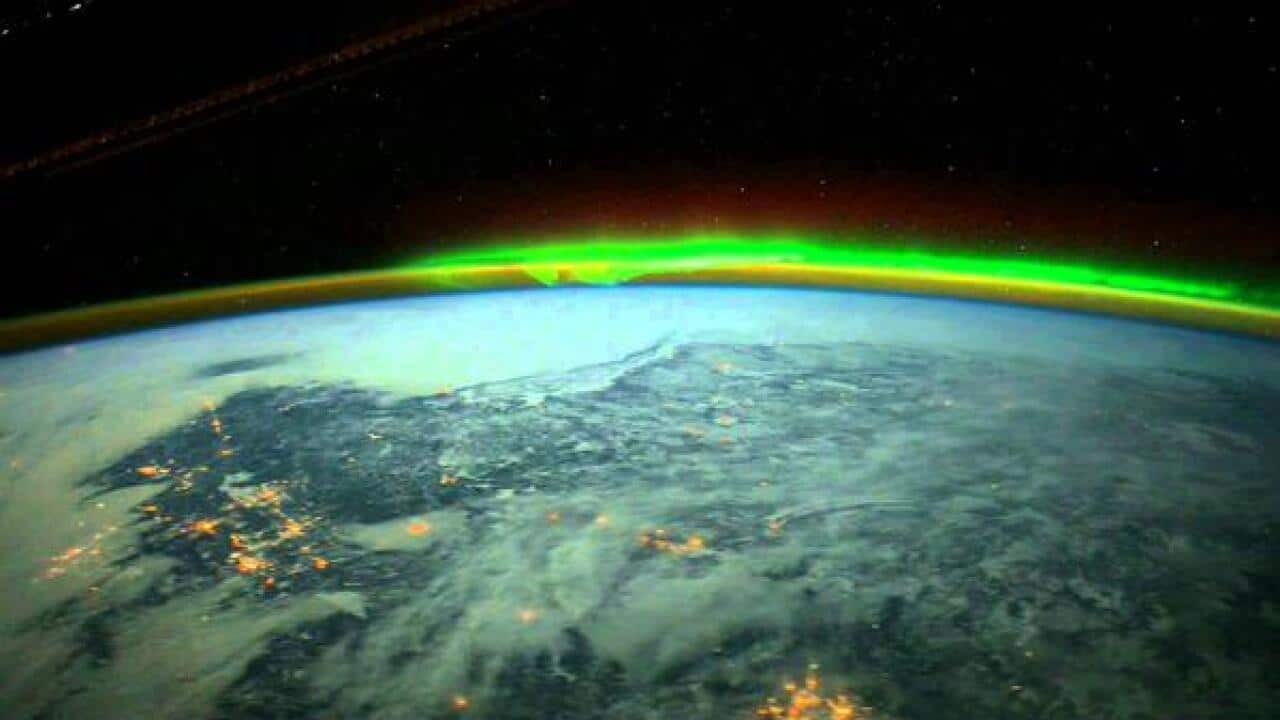
Forecasters say a severe solar storm smacked Earth with a surprisingly big geomagnetic jolt, potentially affecting power grids and satellite tracking systems.
The storm pushed the colourful northern lights farther south, making them visible to the United States. The sky also lit up in the southern hemisphere across Australia and New Zealand.
Auroras are known as 'australis' in the southern hemisphere, and 'borealis' in the northern hemisphere.
Thomas Berger, director of the Space Weather Prediction Centre said two blasts of magnetic plasma left the sun on Sunday, combined and arrived on Earth on Tuesday much earlier and stronger than expected.
This storm ranks a 4 on the National Oceanic and Atmospheric Administration's 1-to-5 scale for geomagnetic effects.
While it wasn't the "biggest" event recorded, Matthew Francis from Australia's Bureau of Meteorology said it was one of the best in the sun's current 11-year cycle of activity.
"We've probably had a dozen or so over the last few years that have been quite good shows for the Tasmanian aurora watchers, but this is definitely one of the best," a research and development scientist in the BoM's space weather services told AAP.
Mr Francis said part of the sun's outer later, the corona, was blown off during Sunday's explosion, producing an immense magnetised cloud.
It took two days for the high-energy particles emitted from the solar flare to reach earth, travelling at a speed of around 700km per second.
In a similar way to field lines on a magnet, energy from these particles were then deposited at the earth's north and south poles.
The fluorescent-type light we see is produced when the particles strike gas molecules in the upper atmosphere, at an altitude of 150-200km.
While flares are frequent on the sun, explosions as big are fewer.
"And then less often are these explosions directed towards the earth, so there's a few things that have to line up for us to get one of these events," he said.
"In this case, it was quite a strong event, so a lot of energy was deposited and further out from the poles.
"The further away that it's visible from the pole is indicative of a bigger and stronger event."
Why do those in the northern hemisphere see more green light, and those in the south more red?
"The red happens at a higher altitude - and if it's higher up, you can see it from further away," Mr Francis said.
"But if you're closer to it, you can see the green that happens at a lower altitude. And that tends to be a more a spectacular show."
Countries such as Finland and Norway, for example, are closer to the magnetic north pole than Tasmania is to the south pole.
Mr Francis said it was hard to predict whether the aurora would still be visible from Australia on Wednesday night, but didn't like the chances.
"These events don't typically last days and days and days, so I would suggest ... you've probably missed it."
What causes an aurora?
According to the Australian Bureau of Meteorology, auroras are caused when "electrically charged electrons and protons accelerate down the Earth’s magnetic field lines and collide with neutral atoms in the upper atmosphere – usually about 100 km above the Earth."
These cause neutral atoms to emit light at different wavelengths, the most common colours being red and green.
Social media feeds were lit up with colourful photos of the aurora.





