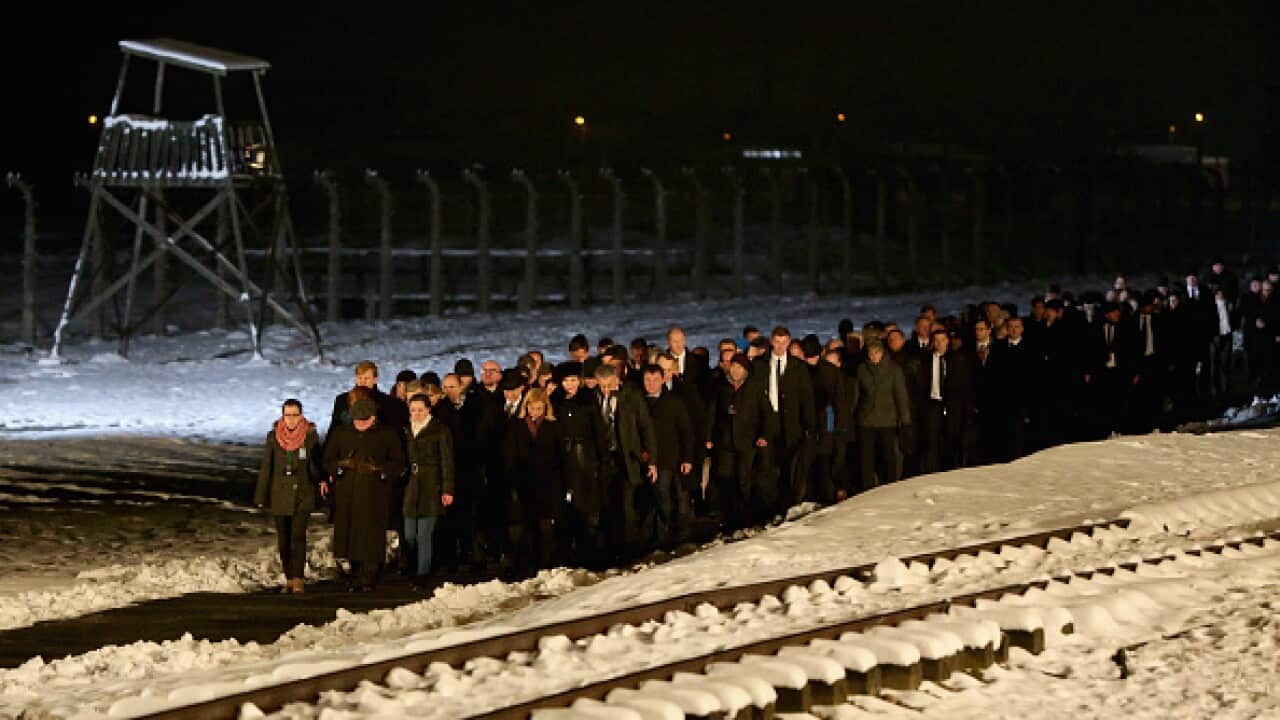
Elderly Holocaust survivors have returned to the infamous Auschwitz-Birkenau death camp, 70 years after it was liberated.
About 300 survivors, some of them wearing scarves in the blue-and-white stripes of their camp uniforms, joined world leaders on Tuesday for an emotional memorial at the epicentre of the Nazi genocide of European Jews.
Listen: SBS Europe Correspondent Brett Mason speaks to Greg Dyett about the ceremony.
The memorial at the austere camp, which was blanketed in snow, comes amidst growing concern over a resurgence in anti-Semitism in France, Germany and other parts of Europe.
"We do not want our past to be our children's future," survivor Roman Kent, 86, said.
"Witnessing the atrocities committed at the entrance gate of Auschwitz was enough to keep me awake until the end of time," Kent said.
"Even 70 years later the cruelty at the camp is indelibly etched in my mind...How can I ever forget the smell of burning flesh that permeated the air?"
"We are in a place where civilisation collapsed," Polish President Bronislaw Komorowski told those gathered as he paid respect to the Soviet Red Army troops who liberated the camps.
As night fell, dignitaries and survivors walked down the railway, in the shadows of the barbed-wire fence, to lay wreaths and candles at a memorial.
The grandson of the infamous Auschwitz commander Rudolf Hoess was among the attendees.
"I can't forgive my father or my grandfather. I'm completely different," Rainer Hoess, who is devoted to fighting anti-Semitism, told reporters as he visited Auschwitz.
Earlier on Tuesday, French President Francois Hollande and his Czech counterpart echoed warnings by a leading Jewish organisation, German Chancellor Angela Merkel and Hollywood mogul Steven Spielberg over violence against Jews in modern-day Europe.
The European Jewish Congress chief Moshe Kantor warned that Europe is "close to" a new exodus of Jews, saying "jihadism is very close to Nazism".
US President Barack Obama pledged in a statement Tuesday "never to forget" those murdered by the Nazi regime and voiced concerns over anti-Semitism.
German President Joachim Gauck and Ukraine President Petro Poroshenko and a host of other leaders attended Tuesday's memorial, but Russia, the United States and Israel sent lower-ranking representatives.
Part of Adolf Hitler's genocide plan against European Jews, dubbed the "Final Solution", Auschwitz-Birkenau operated in the occupied southern Polish town of Oswiecim between June 1940 and January 1945.
Of the more than 1.3 million people imprisoned there, some 1.1 million - mainly European Jews - perished, either in the gas chambers or by starvation or disease.
The Nazis killed six million of pre-war Europe's 11 million Jews.
Share


