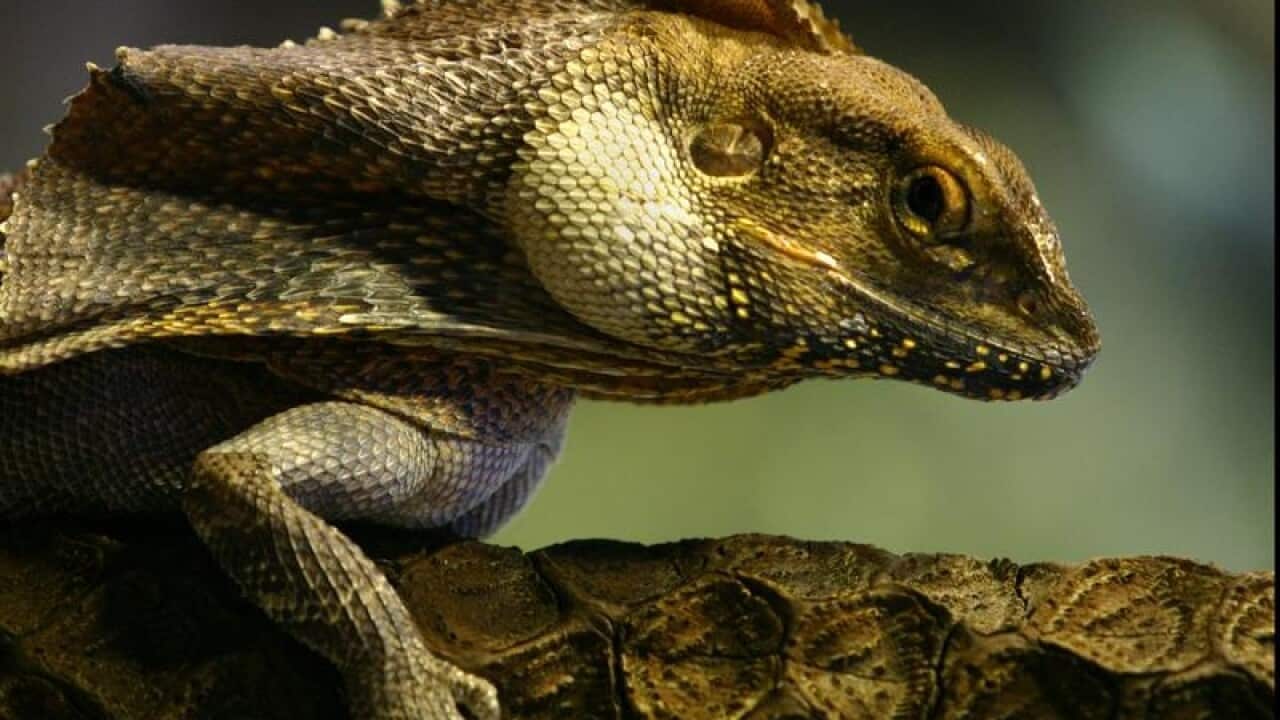
Australia's famous deadly snakes and its array of lizards may actually hail from Asia.
A new study suggests that ancestors of reptiles such as Australia's famous frill-necked lizard and venomous red-bellied black snake emigrated here about 30 million years ago, either by swimming across the sea or hitching a ride on drifting branches.
Their watery path could have been made possible after Australia broke away from Antarctica and drifted northwards towards Asia around the same time.
"If you came out to Australia 35 million years ago, there were probably no venomous snakes, there'd be no dragon lizards, frilled-necks, goannas, all these things we think of quintessentially Australian, they wouldn't have been here," the study's lead author, Dr Paul Oliver, of the Australian National University, told AAP.
Australia is home to about 11 per cent of the world's 6,300 reptile species, the highest proportion of snakes, lizards, crocodiles and turtles found in any country.
News that makes sense
Your trusted source for staying up-to-date with the world around you. Get free daily news updates and analysis, straight to your inbox.
In an attempt to understand more about the 1000 or so species of snakes and lizards here, Dr Oliver built a data set to work out how old they were and where they came from.
He estimates that 85 per cent are descended from ancestors that emigrated here, most likely from Asia and nearby islands, over millions of years.
Among that group are ancestors of the deadly elapid family of snakes, which includes the death adder, black tiger snake and red-bellied black snake.
Ancient relatives of Australia's frill-necked lizard and goannas also made the journey.
"Presumably they've been floating on bits of tree or vegetation," Dr Oliver said.
"Sometimes in tropical areas you actually get little bits of land which float out to sea in big floods and a lot of these animals are quite good at just hanging around on these little pieces of land.
"As far out as Fiji and way out in the Pacific Ocean there are things that have naturally dispersed floating around on little pieces of vegetation, on flotsam and jetsam. It's quite common."
Dr Oliver believes the influx of snakes and lizards was sparked by Australia's gradual separation from Antarctica, which was completed about 30 million years ago.
Once that happened, the deep seaway between Asia and Australia changed.
"Antarctica got closed off and the sea currents between Australia and Asia changed, opening up Australia to colonisation by many more lizards and snakes," Dr Oliver said.
The study was published on Thursday in the journal Nature Ecology & Evolution.







