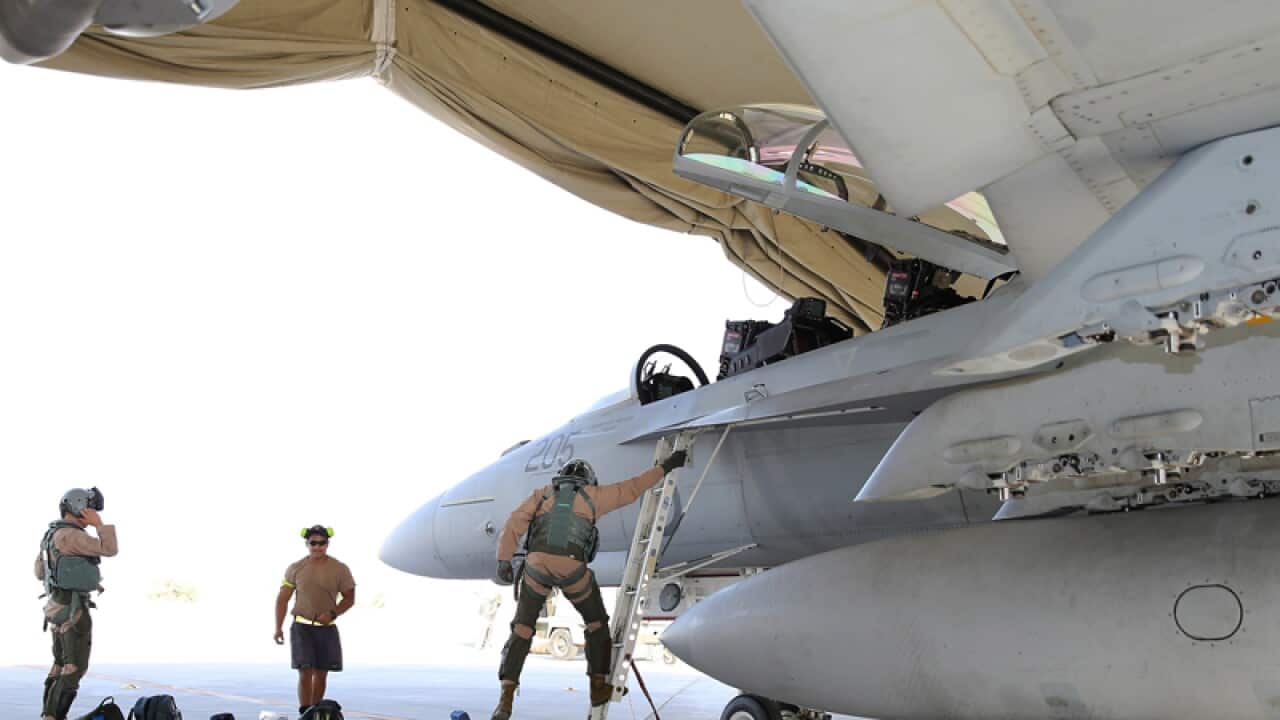
An Australian combat aircraft has targeted an Islamic State target but chose not to bomb because of the danger to Iraqi civilians.
In an update on combat activities over Iraq, Defence head Air Chief Marshal Mark Binskin said the Air Task Group's Super Hornets had flown combat missions on three days without releasing bombs.
They came close on the first sortie on Sunday, But the unspecified target - likely a vehicle - moved into an urban area, exceeding a threshold for potential collateral damage.
Consequently, the Australian aircrew and commander exercised the "red card" option, deciding against shooting to avoid breaching the rules around the engagement.
Air Chief Marshal Binskin said IS forces were increasingly seeking refuge from the escalating air campaign in urban areas.
News that makes sense
Your trusted source for staying up-to-date with the world around you. Get free daily news updates and analysis, straight to your inbox.
"Air stops forces like ISIL massing on the battlefield and taking ground and having freedom to manoeuvre," he told journalists in Canberra.
"They understand that if they start to move in groups in the open, they will die."
It was possible, although unlikely, that Australian aircraft would never drop bombs during what's now officially known as Operation Okra.
More nations are deploying aircraft to Iraq, including Canada which has decided to deploy up to six CF-18 Hornet aircraft.
Australia's next imminent move will be deploying 200 commandos and their support personnel into Iraq to advise and assist Iraqi forces on the ground.
Prime Minister Tony Abbott played down the prospect of more Australian combat troops on the ground but he did leave the door slightly open.
Only Iraqis could save their country from Islamic State extremists, he said.
"We'll be in a better position to judge what might be desirable down the track once we're in there," he said.
The Australian special forces will operate in small teams, advising and assisting the headquarters of Iraqi security force units down to battalion level.
So far just the US and Australia will provide this kind of assistance to Iraqi forces. Other nations are assisting Kurdish security forces.
Air Chief Marshal Binskin said it would take the Australians, drawn from the Sydney-based 2nd Commando Regiment, "outside the wire" to forward operating bases.
They would not be engaging in actual combat.
But their work could involve helping identify targets for air attack.
The commando teams comprise personnel with a range of specialist skills, including Joint Terminal Attack Controllers who are trained to call in air strikes.
"When they go forward (with) those headquarters, they are in a position, if the target's come up to be able to identify those targets," he said.
They could assess whether the target could be attacked from the air and then make a request through the targeting system.







