

(Transcript from World News Radio)
Prime Minister Tony Abbott has announced Australia will send around 300 more soldiers to Iraq to help train the Iraqi military.
It comes a week after New Zealand announced it would dispatch up to 143 soldiers as part of a joint 400-member training mission with Australia.
Mr Abbott says Australia's move follows requests from the governments of both Iraq and the United States.
Amanda Cavill reports.
(Click on audio tab to listen to this item)
The Australian troops will be based at Taji, about 30 kilometres north of Baghdad.
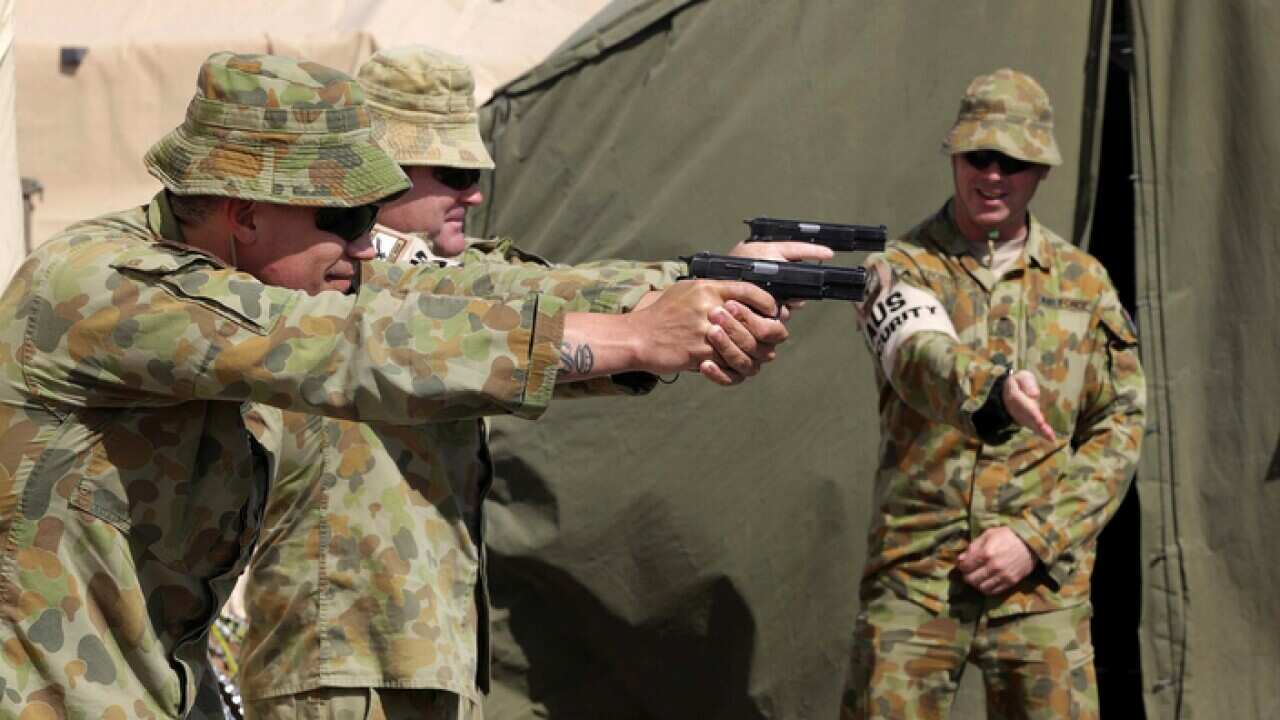
Their job will be to instruct Iraq's troops in basic weapons skills and individual and unit skills to prepare the country's security forces for combat.
The training will also include planning of operations and medical and logistics support.
Mr Abbott says Australian and New Zealand troops are needed to help train Iraqi soldiers trying to oust the self-proclaimed Islamic State, or I-S, forces from their country.
"This decision marks the next phase of Australia's contribution to the international coalition to disrupt, degrade and ultimately defeat the Daesh, or ISIL, death cult. We have slowed Daesh's advance, but Iraq's regular forces now require support to build their capacity to reclaim and to hold territory."
Mr Abbott says the United States, Spain, Italy, Germany, Denmark and the Netherlands are also sending trainers.
He says the mission is a two-year mission, to be reviewed after 12 months.
The Head of the Defence Force, Air Chief Marshall Mark Binskin, says Iraqi forces aided by coalition air power have halted the IS advance.
But he says, at some stage, a counteroffensive will start and Iraq needs to generate a force big enough to push IS out of Iraq.
Air Chief Marshal Binskin says many Iraqi troops will be needed and they will need to be trained.
"Now, more than ever, it's important for us to focus on the development of the Iraqi security forces to be able to take and hold their own ground, secure their borders and allow the restoration of governance in their own country. We'll be doing this in conjunction with our Kiwi counterparts, and I've been working very closely with the New Zealand Defence Force chief of defence force in developing the plan that we've put to government. The aim is to build the skills of the Iraqi army, and they're skills that are essential for the effective fighting that they need to do over the coming years to be able secure their borders."
Defence Minister Kevin Andrews says the decision has not been taken without consideration.
But Mr Andrews says Australia must do its part to help stamp out the IS advances, saying they threaten to impact every nation on earth.
"It's worth remembering why our forces are actually operating in Iraq. The depravity, the brutality which we've seen on our television screens and on YouTube and in the media, indicates that this is something that the world cannot ignore. The serious threat which Daesh (brings) to not only people in the Middle East, but to the entire world, calls for concerted international action."
But Independent MP Andrew Wilkie says Muslim countries, not Australia, should be committing soldiers on the ground in Iraq.
Mr Wilkie says Iraq needs to find its natural political order.
He says, instead, Australia should be encouraging Muslim countries in the Middle East and Asia to deploy soldiers.
"It is a bad decision. More Australian troops on the ground in Iraq will not solve the Iraq crisis. In fact, it has been the presence of Western troops in that country on and off for 12 years which has helped to create the resentment and the circumstances that have allowed the rise of Islamic State. If there are to be foreign boots on the ground in Iraq, then they must be soldiers from Muslim countries."
The Opposition is supporting the deployment, as long as four conditions are met.
It says the troops must be there at the request of Iraq's government, the mission must be confined to Iraq and Australian ground-combat units must not be deployed.
It also says, if the Iraqi security forces engage in unacceptable conduct or the Iraqi government adopts unacceptable policies, Australia should withdraw its support.
Mr Abbott says the approximately 170 special-forces soldiers currently operating in Iraq will begin returning home in September, with Australia's focus on training.