In Brief
- Home ownership rose in Queensland and WA between 2021 and 2025, while Sydney went backwards.
- Low rates, remote work and migration helped more Australians buy during the pandemic, KPMG says.
The COVID-19 pandemic became a turning point for Australians to become homeowners before the country's housing crisis escalated, according to new data from KPMG Australia.
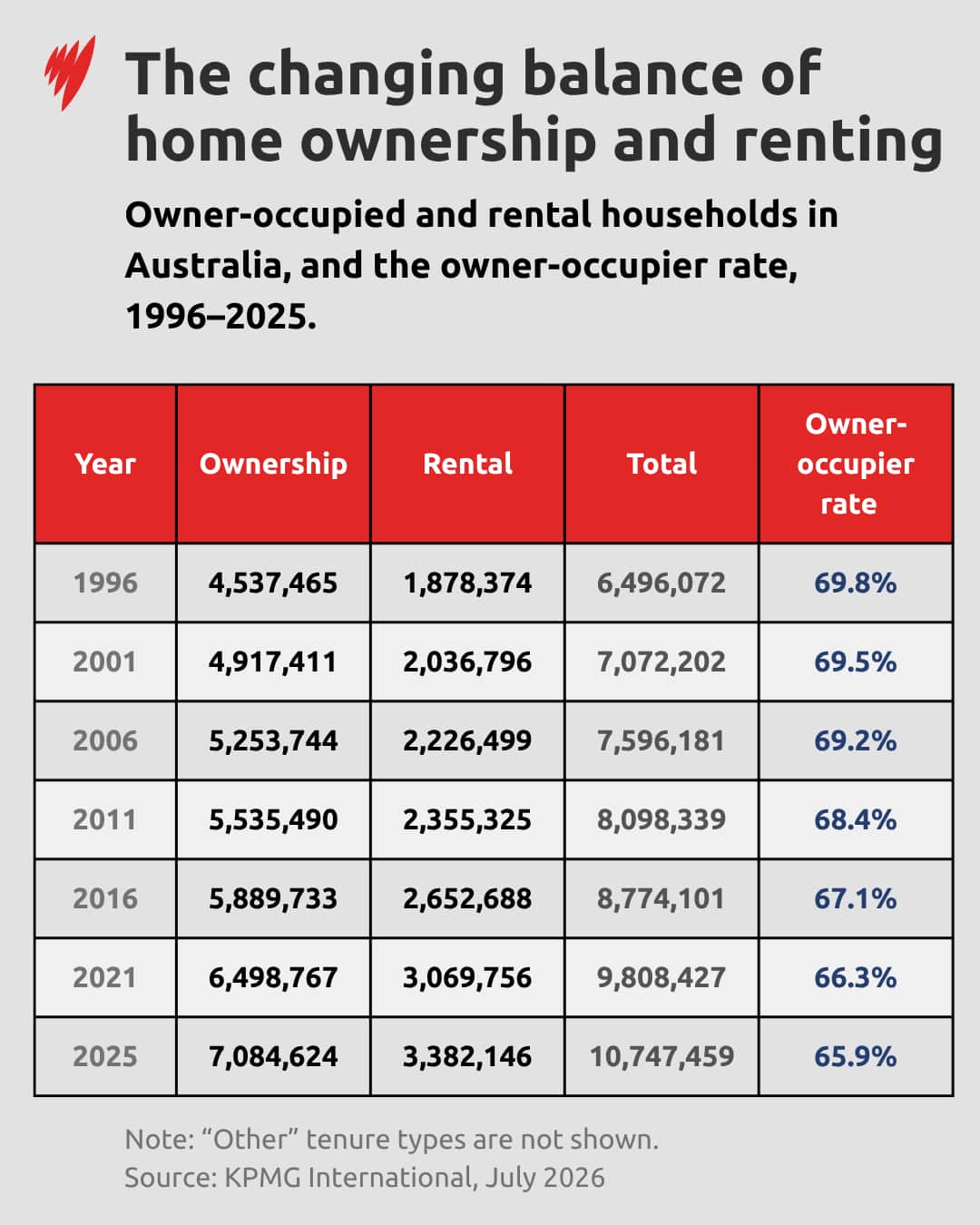
It estimates that from 2021 to 2025, nearly 600,000 Australian households became owner-occupiers, rising from around 490,000 over the 2016-2020 period.
While the overall rate of home ownership in Australia has decreased in the last 30 years, the number of homeowners has increased significantly in that time in line with population increases.
The KPMG analysis, based on Census data from the Australian Bureau of Statistics (ABS), found nationally the rate of owner-occupiers dropped from 66.3 per cent in 2021 to 65.9 per cent in 2025.
Queensland and Western Australia were the two states that saw the biggest leap in owner-occupiers from 2021 to 2025. Queensland recorded a 1 per cent increase in home ownership over the four-year period, and Western Australia recorded a 0.7 per cent rise.
News that makes sense
Your trusted source for staying up-to-date with the world around you. Get free daily news updates and analysis, straight to your inbox.
Terry Rawnsley, KPMG’s urban economist, told SBS News that the COVID-19 pandemic played a key role in the boost of home ownership in these two states.
"There was a period between 2020 and 2022 when there were really low interest rates, house prices hadn't really taken off much in those two states," Rawnsley said.
"We also had an inflow of people coming out of Melbourne and Sydney escaping COVID lockdown," he said, adding that the rise of remote working also facilitated the trend.
In Sydney — the country's most expensive city to buy property in — the analysis found a decrease in the rate of home ownership, dropping from 61.1 per cent in 2021 to 59.9 per cent in 2025.
Rawnsley said it was the first time since the late 1950s that Sydney recorded such a low home ownership rate. He said the drop could reflect the relocation of first home buyers to other states, as they found it challenging to afford a home in the city.
"If we look at the numbers back in 2011, Sydney was basically the same as the rest of the country," Rawnsley said.
"But in the last 15 years, that gap’s really opened up quite significantly, and that’s once again reflecting that Sydney's been really expensive, whereas other states are more relatively affordable."
Rawnsley also noted the importance of housing supply for home ownership, pointing out that Melbourne's home ownership rates have "held up pretty well" over the last decade compared with Sydney.
Do younger generations want to become homeowners?
In 1996 nearly 70 percent of Australians were owner-occupiers, but in the last 30 years this has fallen nearly 4 percentage points.
Rawnsley said it showed the current generation of first home buyers need continued support to secure home ownership.
The landmark Longitudinal Study of Australian Children study of 10,000 gen Z Australians found that in 2023 to 2024, seven out of 10 people aged 19 to 20 and 23 to 24 years were "quite a bit" or "very much" concerned about their own housing affordability.
Housing affordability has surpassed other issues such as climate change (41 per cent), global economy (42 per cent), employment (38 per cent) and future pandemics (25 per cent).
Recent ABS data also showed a 5 per cent increase in first home buyers committing to home loans in March 2026 compared to March 2025, following the federal government’s launch of the 5 per cent home loan scheme in October.
Rawnsley said the dream of owning a home in Australia was "far from dead".
"Australians are adapting, relocating and working hard to get into the market, and the combination of more housing supply and targeted support is creating a pathway to home ownership for more households."
For the latest from SBS News, download our app and subscribe to our newsletter.







