In brief:
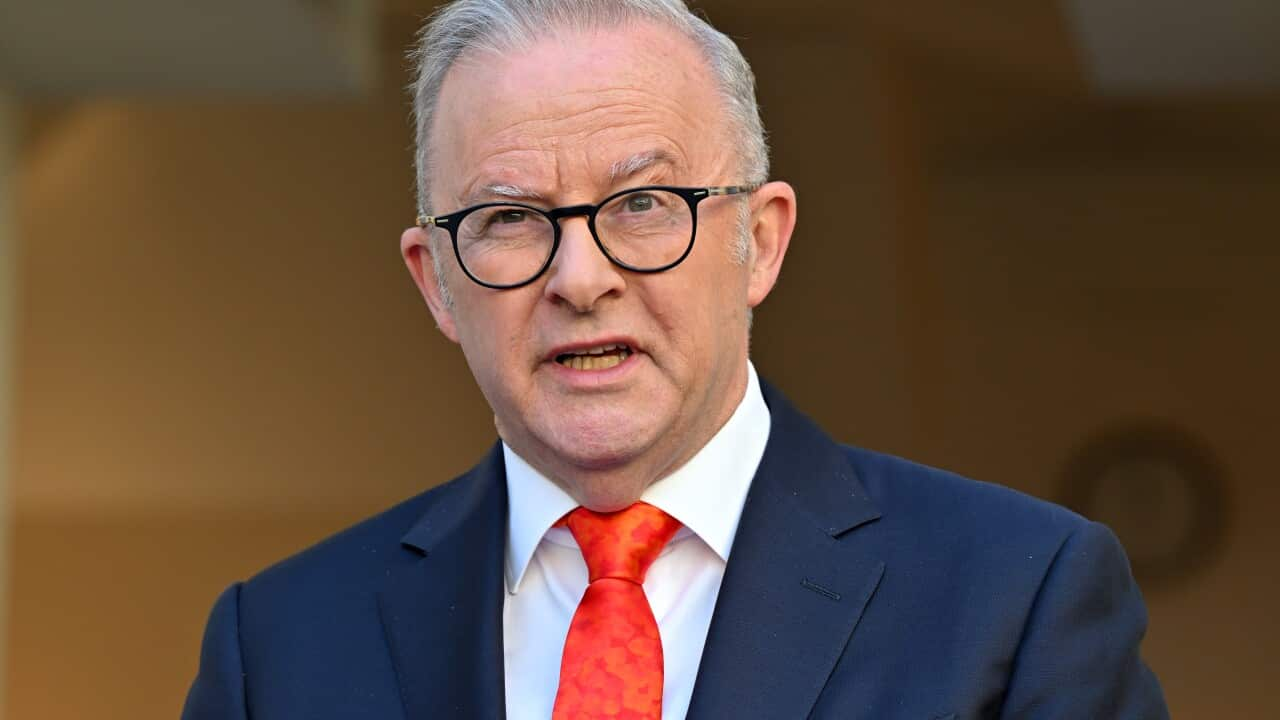
- Prime Minister Anthony Albanese attended a virtual summit of around 50 countries to discuss the permanent reopening of the Strait of Hormuz.
- The strait was confirmed as open to commercial vessels during the meeting, but only for as long as ceasefires hold.
Australia will join an international mission to ensure shipping from the Middle East continues as world leaders cautiously welcome the reopening of the Strait of Hormuz.
Anthony Albanese on Saturday acknowledged re-entry to the vital waterway was a "fragile arrangement" following an overnight summit of about 50 countries to support an ongoing ceasefire in the region.
The prime minister called for a full reopening "for all countries permanently" to ensure shipping resumes under the banner of the Strait of Hormuz Maritime Freedom of Navigation Initiative following the US-Israeli war with Iran.
"We want to see de-escalation, we want to see the Strait of Hormuz opened and we want to see no privatisation and no tolls," he told reporters in Sydney.
"We want to see this fragile arrangement confirmed, and we want to see those ships being able to pass."
News that makes sense
Your trusted source for staying up-to-date with the world around you. Get free daily news updates and analysis, straight to your inbox.
Albanese said Asia was feeling the impact of disruptions acutely, with the vast majority of oil that usually passes through the strait destined for the region.
"Freedom of navigation is essential for global trade," he said.
"It is how the world operates, not just in fuel but in other areas ... and the precedent that would be created if a country was allowed to close a navigation strait to international traffic, would change the very way the global economy operates."
Australia 'ready' to back Hormuz security efforts
Albanese also said that the nation formally backed coordinated international diplomacy to help resolve the Middle East conflict.
"Australia stands ready to support efforts to restore stability and security in the Strait of Hormuz," he said.
"We want to see this hold."
He also reiterated Australia's commitment to join a meeting of military planners in London next week as part of a bid to create an international mission to restore maritime security.
"In London, there will be discussion about what assets might be required," he said.
French President Emmanuel Macron and UK Prime Minister Keir Starmer said a meeting of military planners would take place in London next week as part of a bid to create an international mission to restore maritime security.
However, US President Donald Trump told the country's North Atlantic Treaty Organization (NATO) allies to "stay away".
"Now that the Hormuz Strait situation is over, I received a call from NATO asking if we would need some help," Trump posted on Truth Social.
"I TOLD THEM TO STAY AWAY, UNLESS THEY JUST WANT TO LOAD UP THEIR SHIPS WITH OIL."
Asked whether Australians would be prepared to offer defensive assets, Foreign Minister Penny Wong said a diplomatic approach was preferred.
Wong commented on the back of a visit to Singapore with Trade Minister Don Farrell on Friday.
The pair signed a supply agreement with Singaporean foreign minister Vivian Balakrishnan and energy minister Tan See Leeng designed to strengthen energy security in the region.
"The protocol reflects the priority we accord each other with respect to trade in essential supplies, including petroleum oils, such as diesel, and liquefied natural gas," the ministers said in a joint statement issued on Friday evening.
Fuel supply update
Energy Minister Chris Bowen said on Saturday that 61 fuel tankers were en route to Australia, up from 57 last weekend.
"Today Australia has 46 days' worth of petrol on hand in our stock holdings," he said.
"That's eight days more than the update last week."
However, Energy Economics and Financial Analysis spokesman Kevin Morrison said it could be some time before effects are felt at the bowser.
"They've declared the strait is open, but we've still got to work through the mechanics of what that actually means," he told ABC News.
"It's not like we can go back to full production as it was before the conflict started.
"There's estimates ... it's going to take about five, six weeks before we get 80 per cent of the oil that's been affected coming back online.
"I don't think we can expect cheaper oil prices in the foreseeable future."
For the latest from SBS News, download our app and subscribe to our newsletter.







