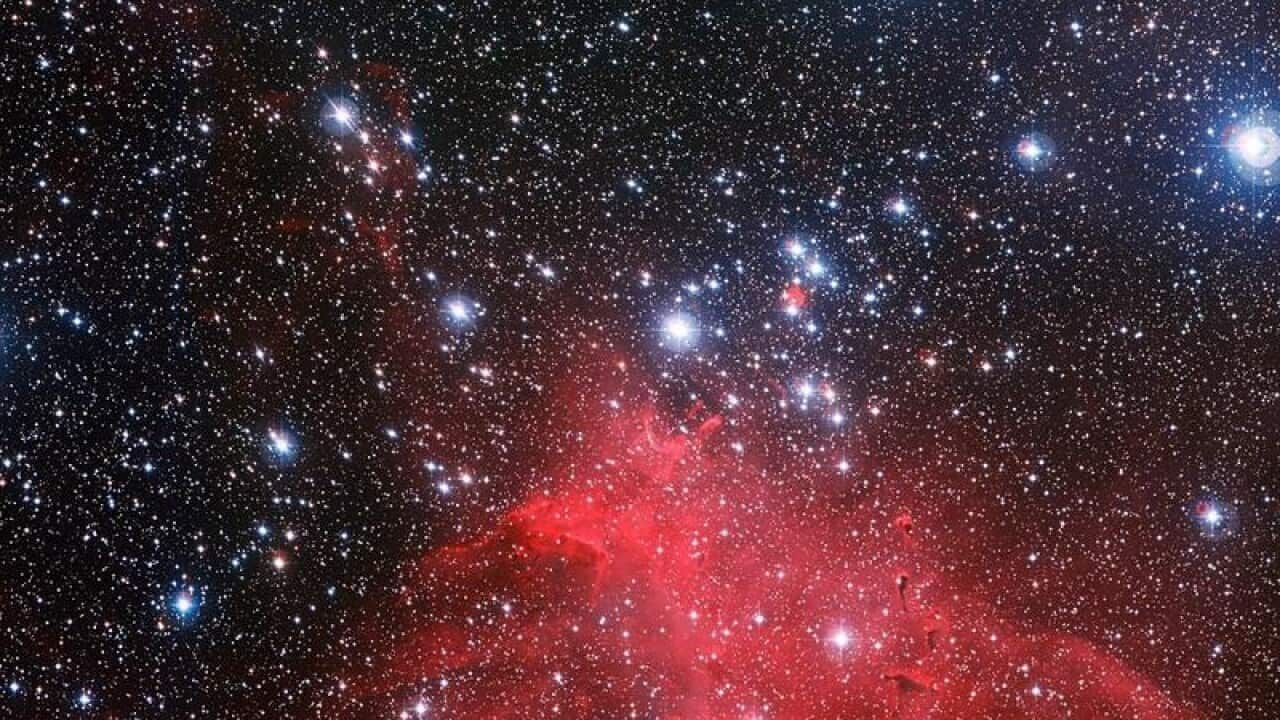
Australian scientists will spearhead the design of an ambitious $32 million telescopic optics system which will produce images of space three times sharper than the Hubble Space Telescope.
Scientists from the Australian National University and Macquarie University will lead the design phase of a new adaptive-optics system, called MAVIS, for one of the eight-metre telescopes at the ground-based Very Large Telescope facility in Chile.
Currently, bubbles of hot and cold air mixing in the atmosphere distort light waves and blur images captured from telescopes, producing a phenomenon exactly like "looking at the horizon through a desert," ANU Associate Professor Francois Rigaut, who is leading the international consortium, told AAP.
The new technology will counteract this and produce images 10 to 20 times clearer than images captured without the technology, and three times more detailed than images captured by the Hubble Space Telescope, Prof. Rigaut said.
This will allow scientists to identify individual stars in faraway galaxies allowing them to tell how old the stars are and to retrace the history of how galaxies form.
News that makes sense
Your trusted source for staying up-to-date with the world around you. Get free daily news updates and analysis, straight to your inbox.
Scientists will also be able to look for supermassive black holes in the centre of incredibly dense groups of old stars called globular clusters.
"Well for us it is a big honour to have the opportunity to lead (the design study) and also international recognition of our capabilities, our knowledge, our know-how and so it's quite important for us in that aspect," Prof. Rigaut said.
As Australian scientists have been chosen to lead the design study, there is a good chance they will also be granted the ability to build the actual technology, he said.
The 15-month design study will begin in February with the upgraded telescope expected to be completed by 2025.
As part of the agreement, the Australian astronomy community and project partners will be guaranteed 150 nights of observation access at the Very Large Telescope with MAVIS, equivalent in value to about $20 million.
The two universities, which are part of the international Australian Astronomical Optics consortium, will also work with the Italian National Institute for Astrophysics and the Laboratoire d'Astrophysique de Marseille and ONERA in France on the project.







