Australian museum curator Melanie Pitkin was looking forward to a stint in Egypt as a tour guide, but as she waited in Dubai for her connecting flight, reports of trouble in Cairo started flooding in.
“At that stage Australia hadn't upgraded its travel warnings," Ms Pitkin said in an interview with SBS. “But there were some tourists on the flight that decided not to go. They offloaded everyone's luggage. Mine went off as well…so I actually didn't have any luggage when I got to Cairo.”
News that makes sense
Your trusted source for staying up-to-date with the world around you. Get free daily news updates and analysis, straight to your inbox.
Ms Pitkin touched down in the Egyptian capital on the morning of Saturday, January 29 - four days after the protests began. She recalled that it was hard finding a car to reach her city-centre hotel.
“All the roads were blocked. Because the curfew was happening at that time,” she said. ”We had to turn around and go to Heliopolis…to an 'emergency' hotel…but there was no restaurant open, because the staff were not able to get to the hotel either.”
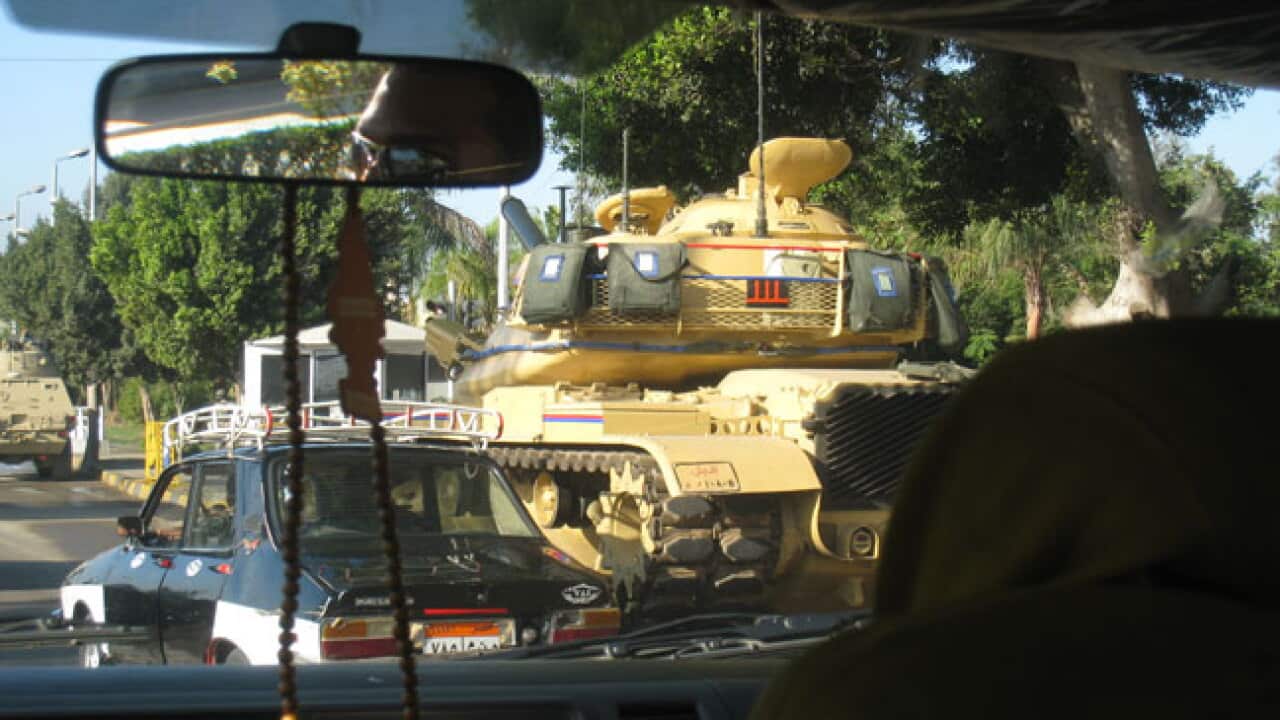
The next morning, Ms Pitkin's local guide again tried to get her to the centre of Cairo. As they were driving, they witnessed the picture of devastation from the night before - tanks and armed guards blocking the streets, burnt buildings and wrecked cars.
“Many shops were looted. It was like a war zone,” Ms Pitkin recalled.
Upon arrival at Semiramis International Hotel, situated next to Cairo's troubled Tahrir Square, she was warned not to go out.
“The warning signs said if you go out, it's your responsibility”, Ms Pitkin said.
Despite the warnings, Ms Pitkin couldn't resist paying a visit downstairs into Tahrir Square.
“I was in the middle of everything…I speak a bit of Arabic. So I was immersed like a local Egyptian, walking around, meeting people. They told me stories why they were there, what they think of government. Some people said to me 'don't I feel unsafe?'” she said..
Getting back into the hotel turned out to be a problem - it was boarded up during the overnight curfew, and Ms Pitkin was stranded on the street.
“There were 15 journalists all gathered outside. All the tourists had gone at this point. Reporters from the BBC, CNN, and the New York Times were all stuck out there together,” Ms Pitkin said.
“Finally the staff opened the doors and let the four of us, four females, in. But the rest of them were left outside.”
Later, Ms Pitkin's attempts to contact the Australian Embassy in Cairo failed. She wandered down to the embassy precinct, but discovered they were all shut down.
“I was very fortunate to work for a travel company…so they arranged the flight for me on the 2nd of February.”
She found the airport completely packed with people, and there was very little food. The Australian embassy provided a lunch box which lasted a couple of hours. After a cold and sleepless night, Ms Pitkin was able to board her homebound flight.
“The day after I left it broke out with the pro-Mubarak supporters coming in and exchanging Molotov cocktails, rocks and other sorts of ammunition. So I was glad that I was safe and sound,” said Melanie. “But I still wish I could have been there for a bit longer as well.”
Ms Pitkin is a design curator for the Powerhouse Museum in Sydney and a PhD scholar in Egyptology.







