Temperatures are soaring in parts of Australia, with the most intense heatwave in years blanketing the country's south-east.
Thermometers climbed past 40C across South Australia and Victoria on Wednesday, with NSW, the ACT and Tasmania set to swelter through oppressive temperatures into the weekend, according to the Bureau of Meteorology (BoM).
If you're feeling the heat, you might be wondering: Just how hot can it get?
Here's when and where Australia's record high temperatures were set
According to BoM data, drawn from observation sites across the country, towns in Western Australia and South Australia share the national heat record, with temperatures of 50.7 °C recorded at Oodnadatta in 1960 and Onslow in 2022.
The 876 residents of Onslow in WA faced the scorching heat on 13 January 2022, while those in the remote outback SA town of Oodnadatta experienced the same record temperature on 2 January 1960.
Wilcannia in north-west NSW reached 50.1C on 11 January 1939, while Birdsville in Queensland, on the border of NT, had a record 49.5C day Christmas Eve of 1972.
In the town of Hopetoun in Victoria's north-west, temperatures rose to 48.8 on 7 February 2009.
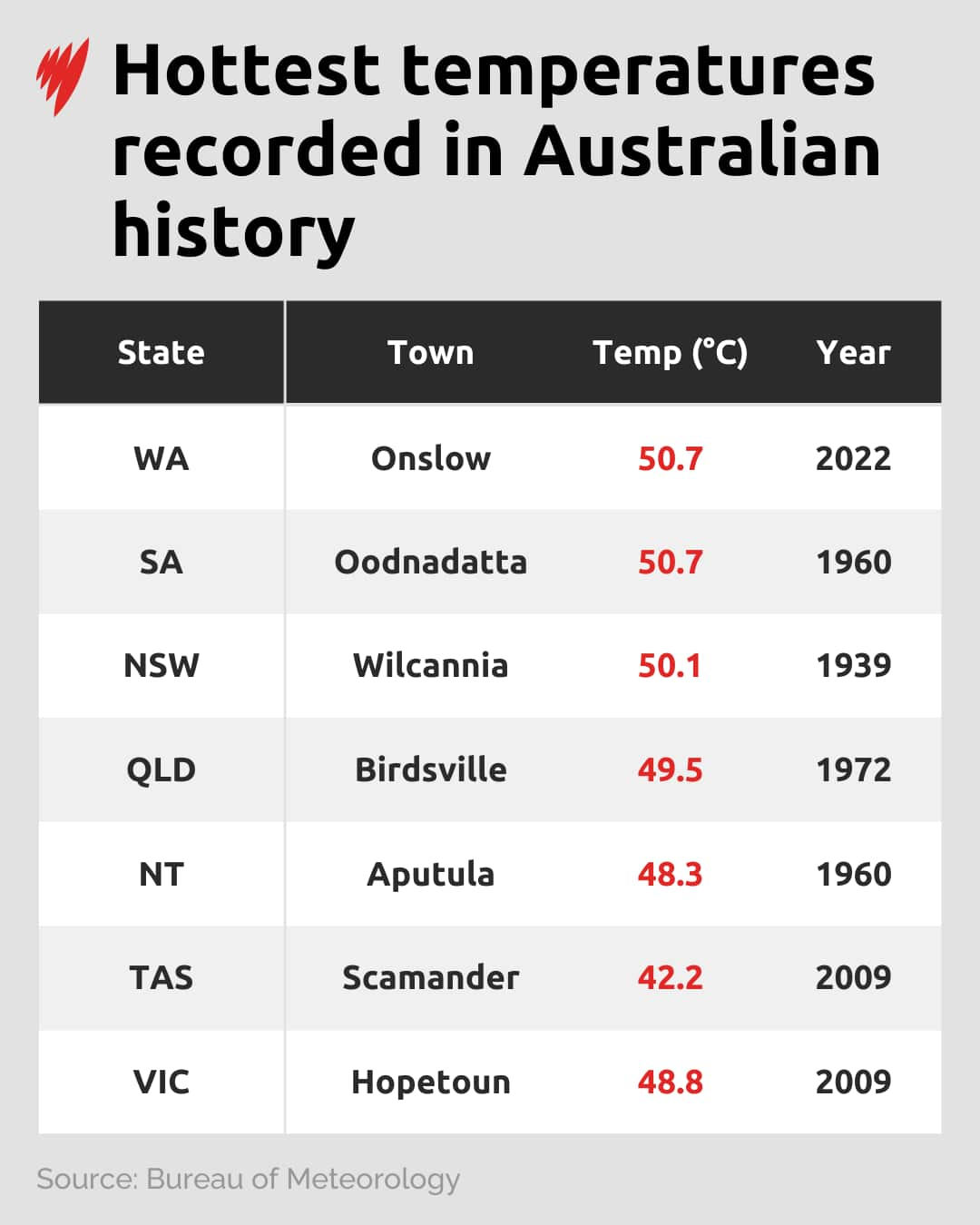
The ACT is not listed in this table because BoM groups it with NSW, and the highest temperature on record was recorded in the latter.
And in Tasmania, the temperature in the east coast town of Scamander hit 42.2C on 30 January 2009.
How about records in the capital cities?
Australia's capitals have also reached extremely hot temperatures over the years.
Perth reached 46.2C on 23 February 1991, according to BoM, while Adelaide hit 47.7C on 24 January 2019.
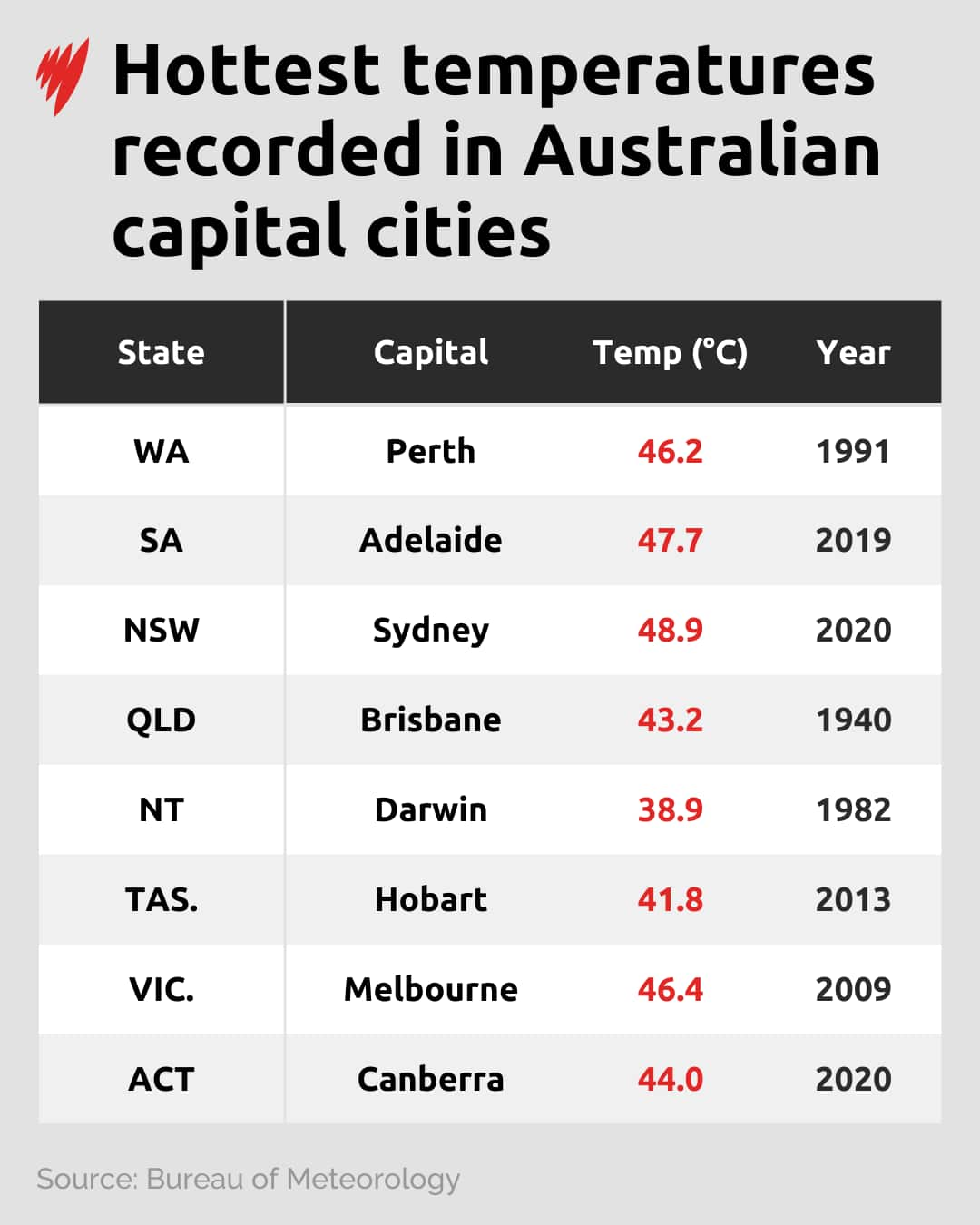
And in Sydney, temperatures peaked at 45.8C on 18 January 2013.
Hobart's record-high of 41.8C was reached on 4 January 2013, while Canberrans sweltered in 44C heat on January 2020.

Brisbane reached 43.2C back in 26 January 1940, while Darwin reached 38.9C on 18 October 1982.
BoM climatology specialist Nadine D'Argent said that Australia experienced its fourth-warmest year on record in 2025.
"This follows Australia's second-warmest year in 2024," D'Argent said.
The mean temperature that year was 1.46C above the 1961-1990 baseline average.
"Australia's warmest year was in 2019, when the national annual average temperature was 1.51C above average," she said.
Australia's third-warmest year was in 2013 — 1.35C above the average.
Share


