
In brief
- Devastating floods and landslides in Nepal have claimed hundreds of lives and left hundreds more missing.
- Prime Minister Anthony Albanese has confirmed 34 Australians are missing.
The Nepal Tourism Board says 35 Australians are missing after a massive flood and landslide disaster on the Nepal-Tibet border killed at least 273 people on Wednesday, with hundreds more unaccounted for.
That number had been 34 until the tourism board published an update Thursday afternoon.
Another 823 people, including 644 Nepali and foreign tourists, remained out of contact in Nepal, according to the country's disaster agency.
On Thursday afternoon, China's foreign minister said nearly 100 Chinese nationals were missing, revising down earlier reporting in Chinese state media that 558 people, including 260 foreigners, were missing in Gyirong Port, Tibet.
"At this point, there are 34 Australians who are missing," Albanese told a press conference on Thursday morning. "People would have seen some of the footage, which is a truly horrific event."
News that makes sense
Your trusted source for staying up-to-date with the world around you. Get free daily news updates and analysis, straight to your inbox.
Albanese said it was difficult to obtain information from Nepali authorities and appealed to anyone with information to come forward.
"At this point, Nepal is a developing country. It doesn't have the resources that an event like that would have in Australia, so information is difficult.
"Our thoughts are with all those who will be concerned about their loved ones today."
Defence minister Penny Wong echoed the Prime Minister's statements, noting that the Department of Foreign Affairs and Trade (DFAT) was working "urgently" to ascertain the welfare and location of the missing Australians.
"We are currently deploying further DFAT personnel, including crisis response experts to the region to ensure that we do provide the support needed to these posts, particularly our post in Nepal," Wong in a press conference on Thursday.
"At this stage, access and information are very limited given the scale of disaster. We will do our best, to ascertain whatever information we can."
A US-based tour company Himalayan Glacier Adventures told ABC News that 15 Australians, part of a group of 47 people, were on a hiking tour in the Lantang Valley at the time of the landslides.
The group of Australians was comprised of nine men and six women. Two of those Australians were reportedly boys aged 11 and 14, and a woman aged 64.
Australia's Nepali community in mourning
Tilak Pokharel, president of the Australian Nepalese Multicultural Centre, said there were "a lot" of people in Melbourne waiting anxiously to hear from loved ones.
"There are a lot of people affected by the flood. There are many people from that area living in Melbourne," Pokharel said.
"But several of them lost their property. I was just talking to someone who is from that area and they lost their houses, they lost their property and they have nothing left at the moment.
"I was talking to someone who was saying people went to see the flooding and they lost their life."
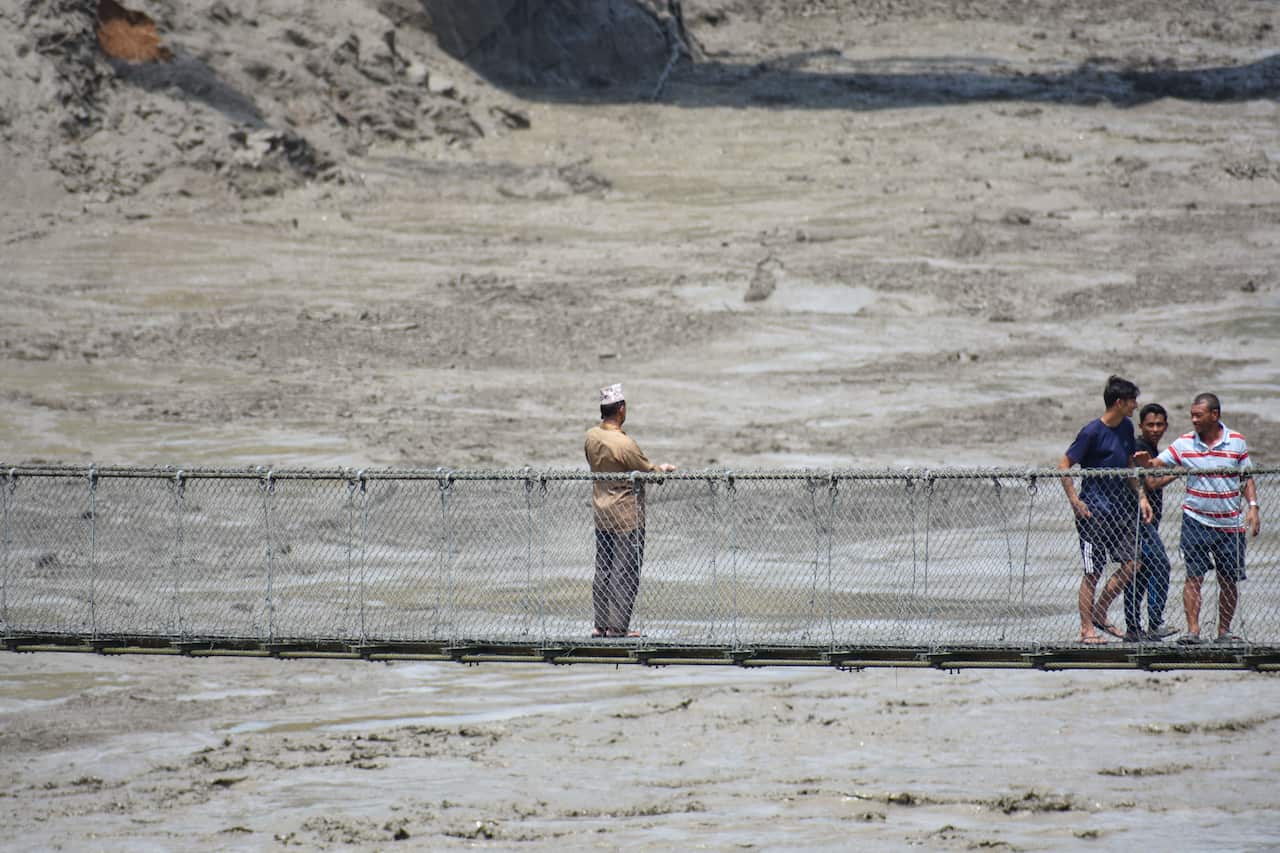
Pokharel said he had spoken to a friend back home who had lost everything and was now living in an emergency shelter with his children.
Another contact in Melbourne had cried to him on Wednesday night after learning her family had lost all their property.
Still, he said his community had been comparatively fortunate.
"Thankfully, none of them have lost relatives," he said.
A vigil and prayer will be held at the community centre on Thursday evening, with members also set to discuss how to support people back home as they make sense of the news.
"It's festive season in the country and there are a lot of festivals and celebrations planned this weekend," Pokharel said. "Some of them are cancelled and they're now focusing on supporting affected people, their relatives in Melbourne, or on the ground.
"It's very sad. This is not expected."
Government 'urgently working' to confirm welfare of Australians
Foreign Minister Penny Wong said that DFAT was still working to confirm how many Australians have been affected and said the loss of life is "devastating".
Albanese said his government was ready to provide consular assistance.
"We extend our deepest sympathies to those affected by the significant flooding in Nepal and Tibet, China," he said in a statement.
Australia's ambassador to Nepal, Simon Ernst, released a statement together with the embassies of the United Kingdom, France, Finland, Norway and Switzerland.
"Our thoughts are with all those affected by this disaster. We express our solidarity with the people of Nepal during this difficult time," they said.
"We encourage all those in affected areas to follow the guidance of local authorities and official safety advisories as the situation continues to evolve."
Toll rises
Nepali police said late on Wednesday that 165 bodies had been recovered so far.
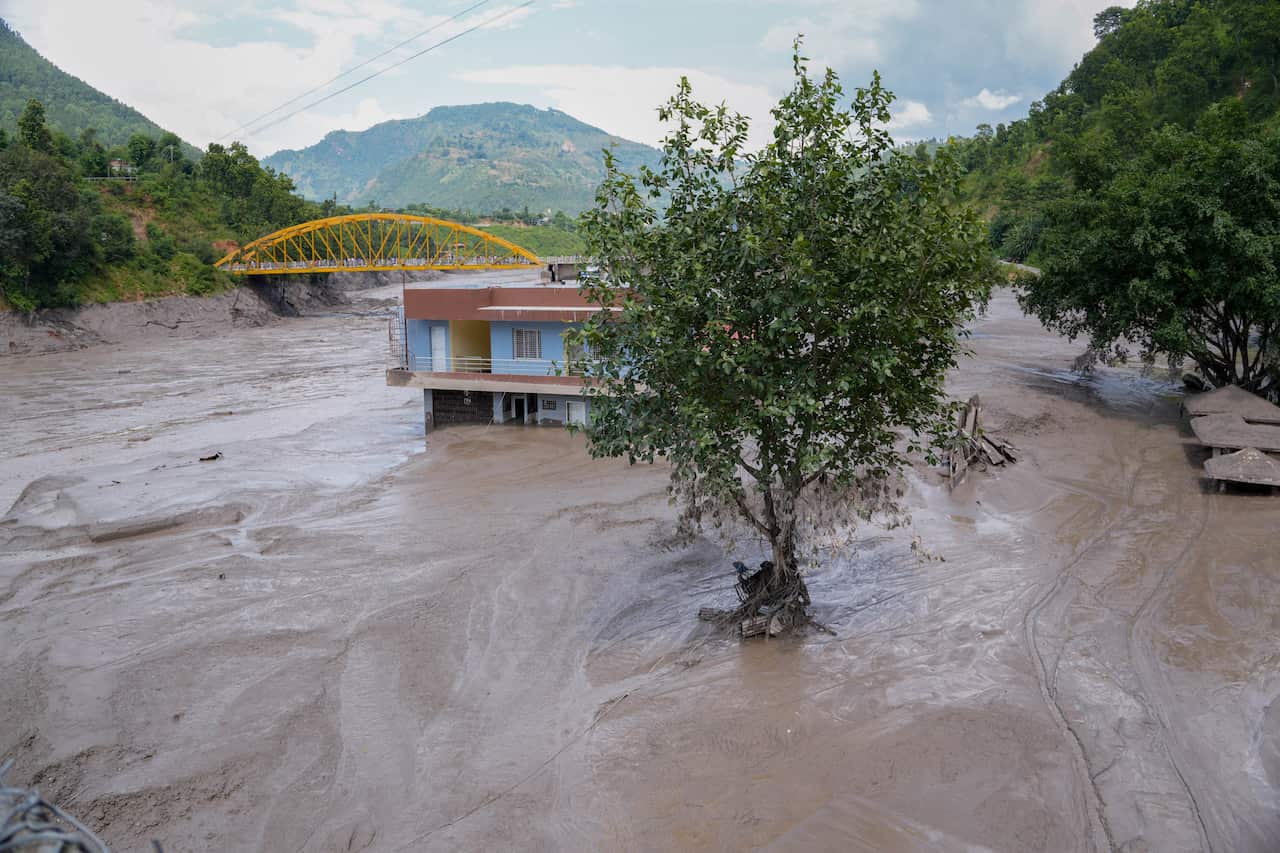
Rescuers waded through mud and sludge to look for survivors after floodwaters buried the lower floors of multi-storey buildings.
Records from Nepali trekking and travel companies have identified 644 people unaccounted for in the hours after the disaster struck, according to Nepal's tourism ministry.
The missing foreigners included 142 Indians, and others from Australia, Britain, Malaysia, the Netherlands, Portugal, South Africa, South Korea and the United States.
"Entire villages and market areas have been wiped out," David Fisher, the Nepal head of the International Federation of Red Cross and Red Crescent Societies (IFRC), said.
The organisation has dispatched emergency supplies including blankets, first aid kits, stretchers and body bags.
Locals were traumatised, while experts cautioned that a lingering blockage in a river could produce an additional flood.
"I got a call from (my brother-in-law) this morning, and they were crying and said their entire house had been swept away. Three family members were rescued, but his brother is still missing," 56-year-old local Raju Bhadel said.
Glacier collapse to blame
Experts have told Reuters the flood may have been triggered when the lower part of a glacier broke off and crashed on to the valley floor hundreds of metres below, citing satellite imagery from Planet Labs.
The cause of the disaster was not immediately clear, but the US Geological Survey said it was a glacial collapse that caused seismic activity and the "catastrophic" downstream impacts in Nepal and Tibet.
Before-and-after satellite imagery of the region from Planet Labs, reviewed by Reuters, showed lush green mountainside now buried under brown debris and sediment.
"It’s confirmed that a substantial portion of that glacier snout collapsed to initiate the event - probably including or entraining a fair amount of rock and sediment," said Vikram Gupta, who specialises in engineering geology and teaches at India's Sikkim University.
Earth scientist Dan Shugar, an associate professor at the University of Calgary, said the imagery seemed to show that a large amount of snow had melted in the 24 hours prior to the disaster.
"Some of the glaciers in the valley were covered in snow yesterday and today they are mostly bare ice. So in other words (and I haven't seen any weather station data yet), it was probably warm," he said.
Nepal's snow-capped mountains had lost close to one-third of their ice in just over 30 years due to global warming, the United Nations said in 2023. The agency added that year that glaciers in Nepal, wedged between two major carbon emitters - India and China, melted 65% faster in the last decade than in the previous one.
"What I can see in this morning's satellite imagery from Planet Labs, the lower part of a glacier broke off at about 5,200 metres and crashed onto the valley floor about 1,200 metres below," Shugar said.
He said construction could be a factor too and "whether climate change played a role is something we will no doubt be looking into in the near future".
Unlike anything seen before
In an interview with ABC News, Kiran Thapa — who has family in the badly affected Nuwakot district — said his relatives, including two young granddaughters aged five and seven, were safe after being trapped for a time on the other side of a river with communications cut.
He said there was almost no warning to evacuate with limited infrastructure.
"Where I come from, we got a 15 to 30 minute window," Thapa said.
"We, of course, don't have the proper pre-warning channel — we just get the phone call from the people upstream."
"My own family members had to rush up to the higher level. We had like 30 minutes."
He said the scale of flooding was unlike anything locals had seen.
"When I grew up, we never saw this flood in our lives."
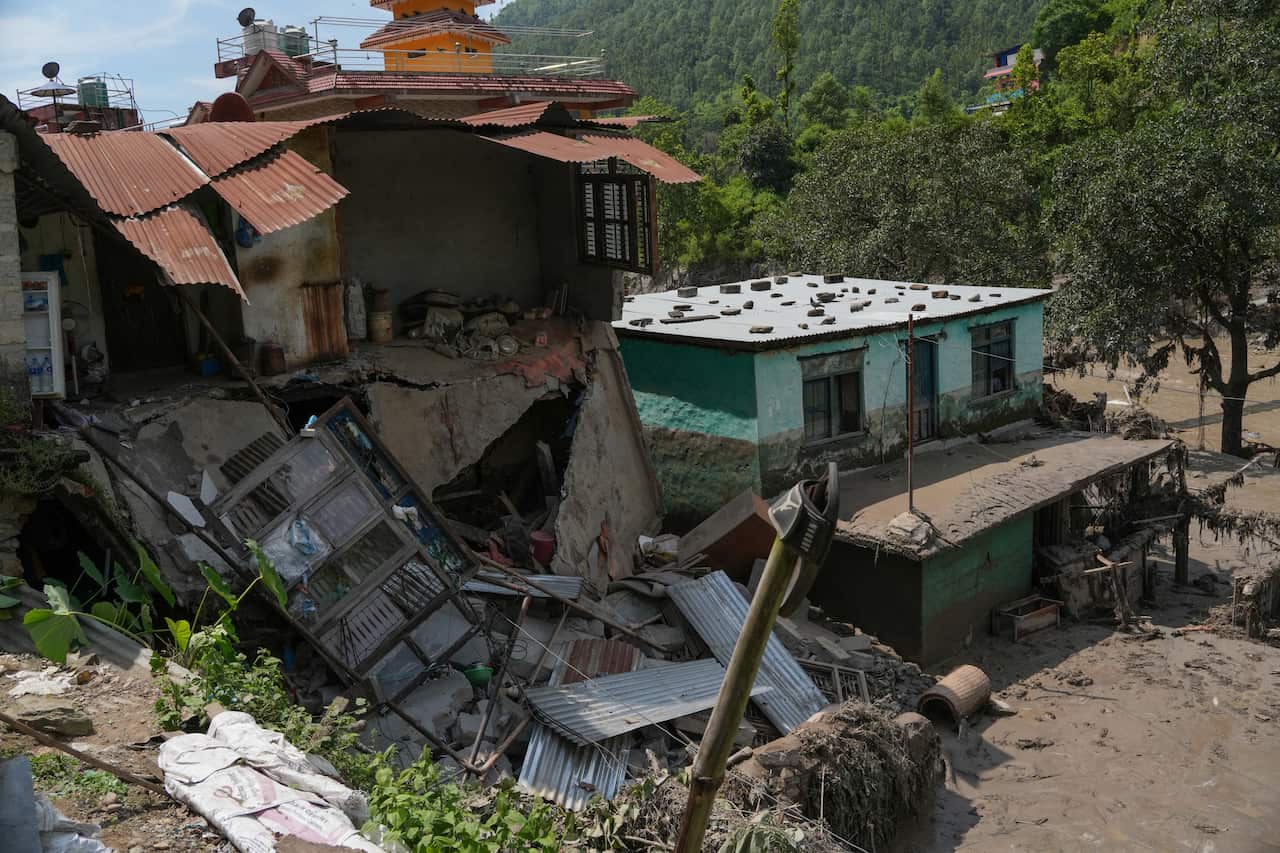
The long stretch of area bordering Nepal and Tibet is hilly, with a large river running through it.
The area most affected sits about 25km to the north-west of Nepal's capital, Kathmandu.
By the time the water had reached close to the capital, the water had slowed down, giving people time to evacuate, Pokharel said.
But those in the hills — including workers at hydro power plants which dot the area — didn't have much time.
"Some of the people working in those areas in are missing or unaccounted for at the moment," he said.
"There are a lot of security people, police, army, they're working on those areas are missing."
"There is a lot of tourist activity in that area and several tourists are not accounted for at the moment."
Nepal's Prime Minister Balendra Shah vowed an all-out response.
"The pain and loss you have suffered is not small," he said in a statement on social media. "But I want to assure you that you are not alone in this difficult time — the state is with you with all its means and resources."
— With additional reporting by Agence France-Presse and Reuters news agency.
For the latest from SBS News, download our app and subscribe to our newsletter.







