Key Points
- The 2025 General Social Survey asked thousands of Australians how they feel about their lives and about others.
- The results showed declines in many areas of Australian life, including trust and social inclusion.
Australians are less trusting of each other than they were five years ago, according to new data that also reveals shifting attitudes towards cultural diversity.
Residents aged 15 and over across 13,302 households were polled for the Australian Bureau of Statistics' (ABS) 2025 General Social Survey, which also found that almost one in 10 Australians are reporting "very high mental distress".
The survey results, collected between May and June of last year, showed declines in many areas of Australian life.
In 2025, Australians feel less healthy, less satisfied, less open and more stressed than they did five years earlier, according to the survey.
Young people are especially feeling the pinch.
News that makes sense
Your trusted source for staying up-to-date with the world around you. Get free daily news updates and analysis, straight to your inbox.
The greatest drop in overall life satisfaction was recorded in people aged 25-34.
Young women aged 15-24 recorded the highest rates of mental distress (17 per cent).
Dr Kate Lycett from Deakin University said while many of these results were "alarming", she was thrilled to see the government investing in this kind of data collection because it gave a much fuller view of society than GDP, hospital admissions data, or the unemployment rate.
"If we don't invest in tracking it, we don't know how people are feeling about their lives, which is what really matters," she said.
Very high levels of mental distress were also recorded in people with a mental health condition (31 per cent), people with a disability (18 per cent) and people who identified as gay, lesbian and bisexual (18 per cent).
She said these results showed where funding was needed most.
In Australians we trust?
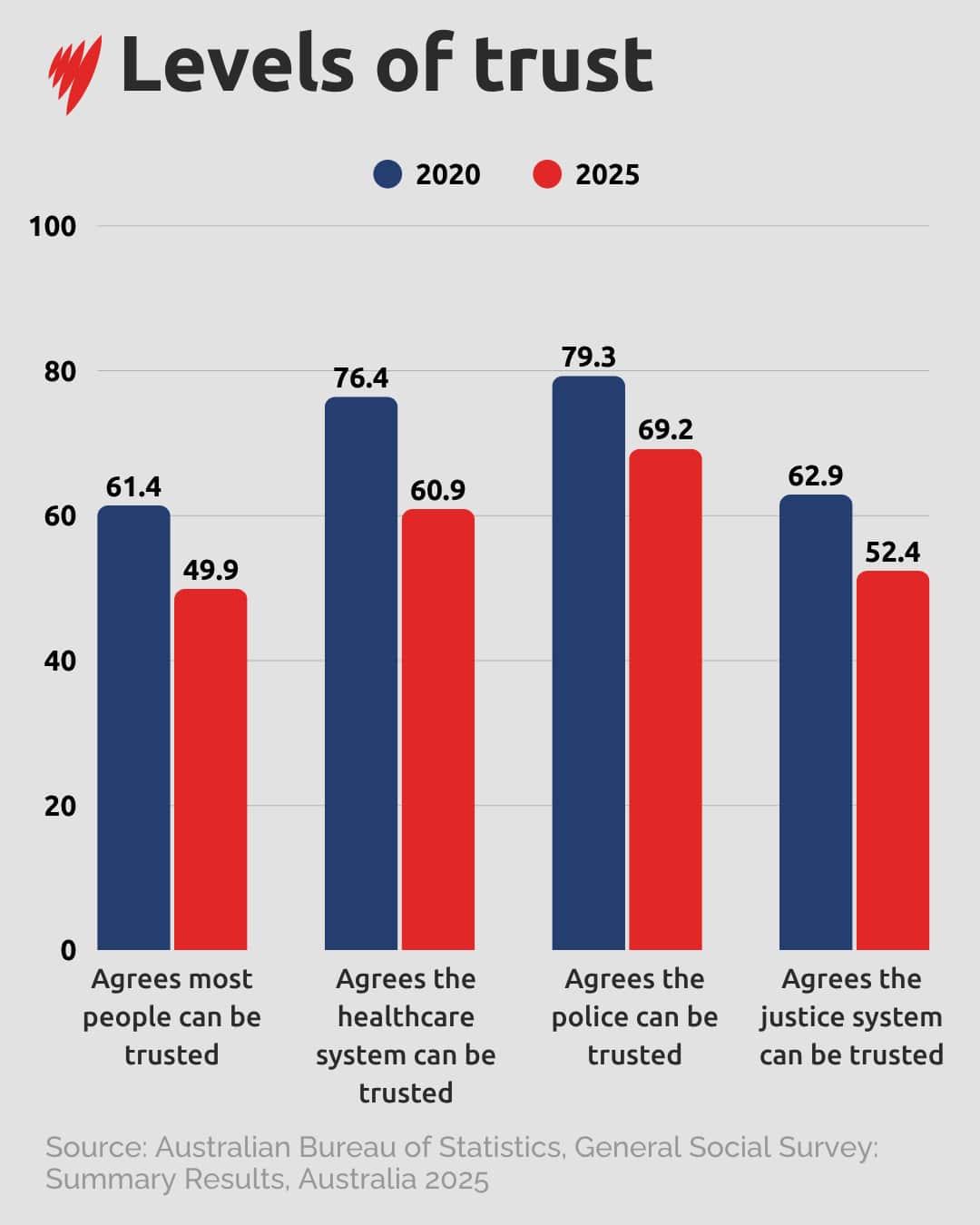
Trust declined in every area measured by the survey.
Only half of Australians feel like most people can be trusted, down from 61 per cent in 2020.
The greatest drop-off was seen in Australians' trust in the country's healthcare system, but people have also lost trust in the police and justice system.
Lycett said people feel they are being let down by the "social contract".
"Healthcare is a public good, but right now people can't access it, or can't access it equally, because it has been privatised."
She said these findings indicated that people are feeling let down by governments.
"The things that we invest in our choices, and the data is showing us where people want investment," she said.
"There's no reason why we can't be investing more in hospitals. You know, these are choices that we're making."
The findings follow a report last year that found national belonging had slumped to its lowest levels since 2007, driven by a widening gap in life satisfaction between younger and older people.
Support for multiculturalism is declining
While it is still generally accepted that multiculturalism is good for society — 75 per cent of people agree — that number has declined by 10 per cent since 2020.
Seventy-nine per cent of women agreed with that statement, compared to 73 per cent of men.
People who lived in cities were also more likely to agree with that statement (78 per cent) than those in regional Australia (69 per cent) and remote Australia (73 per cent).
The survey also found that 18 per cent of Australians reported experiencing discrimination in the previous 12 months.
Of those who experienced discrimination, 46 per cent felt that their ethnic or cultural background or appearance was the reason for their most recent incident.
Gay, lesbian or bisexual Australians also reported disproportionate rates of discrimination, with 36 per cent reporting an incident in the previous year.
Lycett said these results were in line with findings from the ABS's social cohesion survey that came out last year, and reflected growing segregation in society.
She hoped this data would encourage governments to invest in community cohesion.
"What can we be doing as a society to ensure that people are more trusting and have more openness to multiculturalism? This data shows us that this is an area we need to invest in," she said.
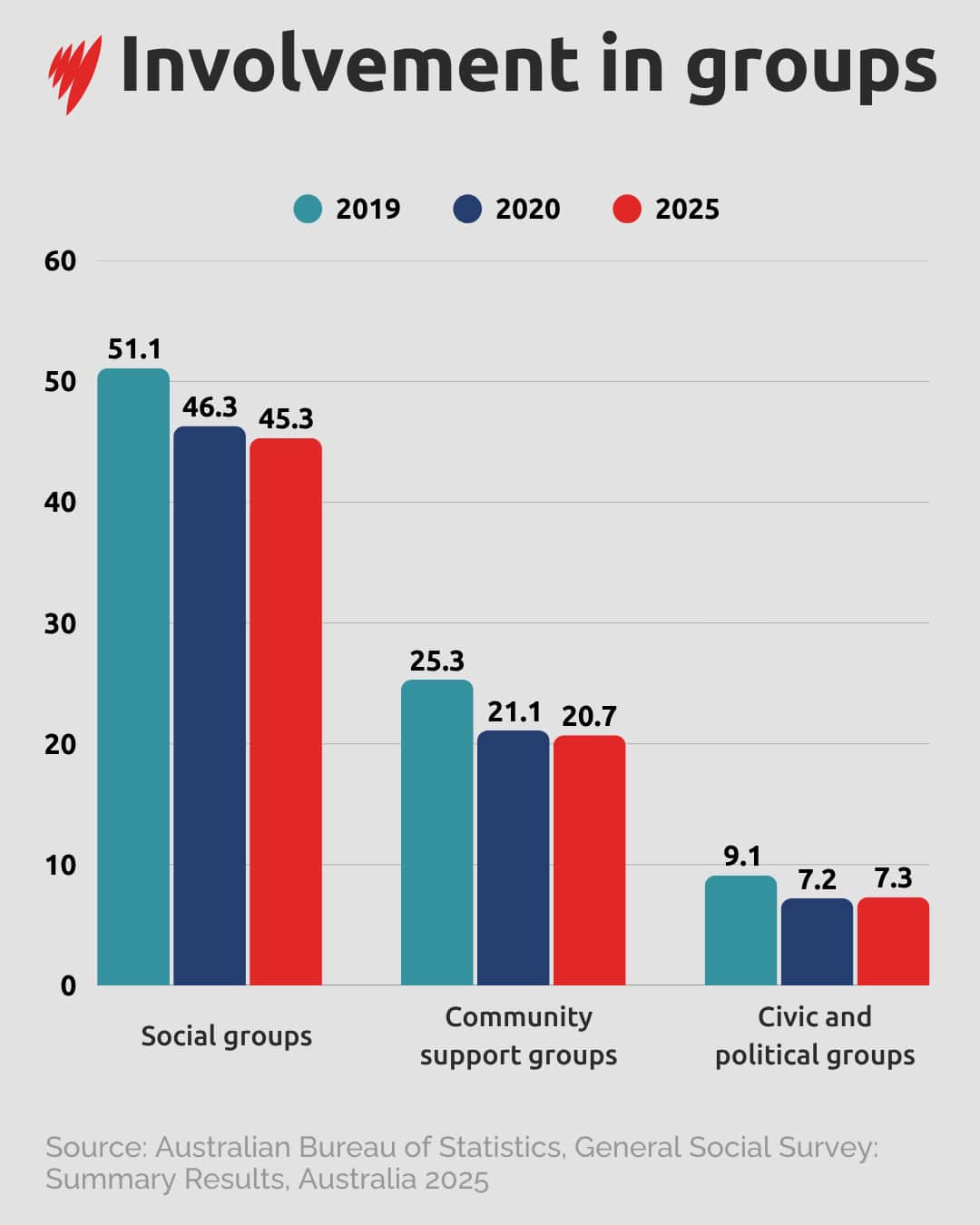
There was also a noticeable decline in people's involvement in groups from 2019, which Lycett said might be leading to a decrease in social cohesion, but might also be an indication that people have less time and money to participate in groups.
"Being social requires resources, and right now those are challenging for people to find," she said.
Lycett said these findings presented the government with opportunities for reform.
"Wouldn't it be great to actually think that next year, when we have a new federal budget, that this data is included and we're budgeting on some of these things to make a difference?"
For the latest from SBS News, download our app and subscribe to our newsletter.







