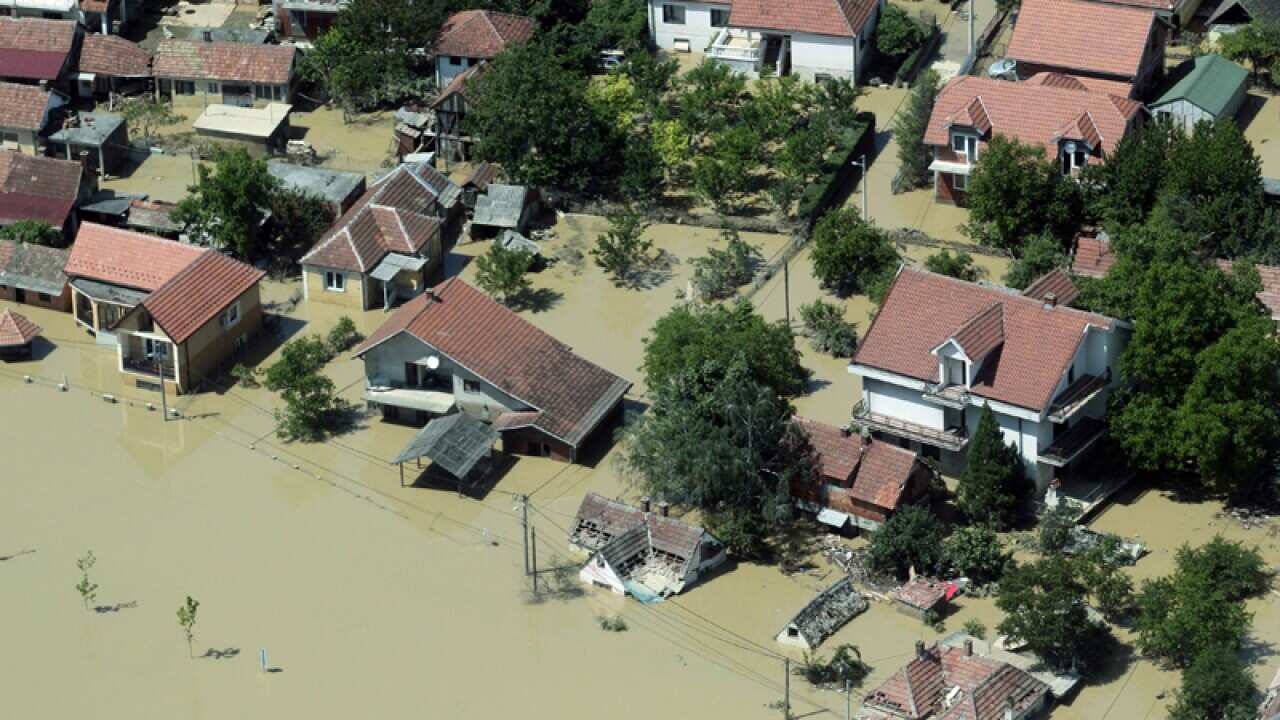
Bosnia is witnessing "the biggest exodus" since the 1990s war after the worst floods in a century inundated huge swathes of the Balkans, killing at least 47 people.
Muddy waters from the Sava River have submerged houses, churches, mosques and roads in Bosnia, Serbia and Croatia after record rainfall last week wreaked havoc across the region.
There were fears that dead bodies and animal carcasses could lead to disease outbreaks, while officials warned that 120,000 unexploded mines from the conflicts of the 1990s could be dislodged.
"More than 100,000 people" have been evacuated in Bosnia alone, said Stanko Sliskovic of Bosnia's emergency services, with tens of thousands more displaced in neighbouring countries.
"This is the biggest exodus since the end of the 1992-1995 war," he said on Monday.
Dozens of towns and villages have been cut off and over 2000 landslides already reported, with water levels expected to continue rising in the coming days.
In Kosova, a hamlet between the northwestern Bosnian towns of Doboj and Maglaj which was badly hit by flooding, people's homes were almost visibly moving as the loose terrain shifted.
Around 20 homes "have slid down 30 metres since yesterday. They will not exist tomorrow," a rescue worker said.
Bosnian Foreign Minister Zlatko Lagumdzija said more than a quarter of the country's population of 3.8 million "has been affected by the floods" after the heaviest rainfalls on record began last week.
"Right now, more than one million people have no water," he said.
In Serbia, some 600,000 of its 7.2 million inhabitants were affected by "severe floods following the heaviest rains the Balkans have witnessed in 120 years", the UN's World Food Program said in a statement.
"This is Armageddon, I can't describe it otherwise," Nedeljko Brankovic told AFP from Krupanj, a town in the southwestern Serbia. "Houses are literally washed away and landslides are everywhere."
The death toll from the floods rose to 47 on Monday after two new victims were found overnight in a village near the western Serbian town of Sabac.
Neighbouring Croatia has also evacuated thousands of people from along the river Sava.
Rescuers told of wrenching scenes as they finally reached cut-off villages, with dozens of people huddling on top of the tallest houses with no water or food.
"It was like a tsunami," said Suad Garanovic, resident of the Bosnian village of Topcic Polje, as he looked over his house, now drowned in mud.
"This is the second time I've fled my house. The first time was during the war. Now, just like then, I've lost everything," said Nihad Smajlovic in a nearby hamlet.
More than half of Obrenovac's population of 20,000 had already been evacuated by Friday and Interior Minister Nebojsa Stefanovic on Monday ordered the rest be brought to safety.
Health authorities have ordered inhabitants not to return to their homes until they could be cleared from the debris and safe from diseases.
Emergency teams were desperately trying to strengthen defences at the nearby Nikola Tesla power plant, which produces around half of Serbia's electricity and is currently only protected by temporary dikes built by thousands of volunteers along the swollen Sava River.
In Belgrade, thousands of volunteers were packing and lifting sandbags on the riverfronts of the Sava to secure the capital's lower areas from flooding expected in the coming days.
In a potentially deadly side-effect, officials in Bosnia warned on Monday that about 120,000 unexploded mines left over from the Balkan war of the 1990s could be dislodged and moved.
"Water and landslides have possibly moved some mines and taken away mine warning signs," Sasa Obradovic, an official of Bosnia's Mine Action Centre told AFP.
He warned residents to be "extremely cautious when they start cleaning their houses, land or gardens as the remaining mud could hide mines and other explosive devices brought by rivers".
Share


