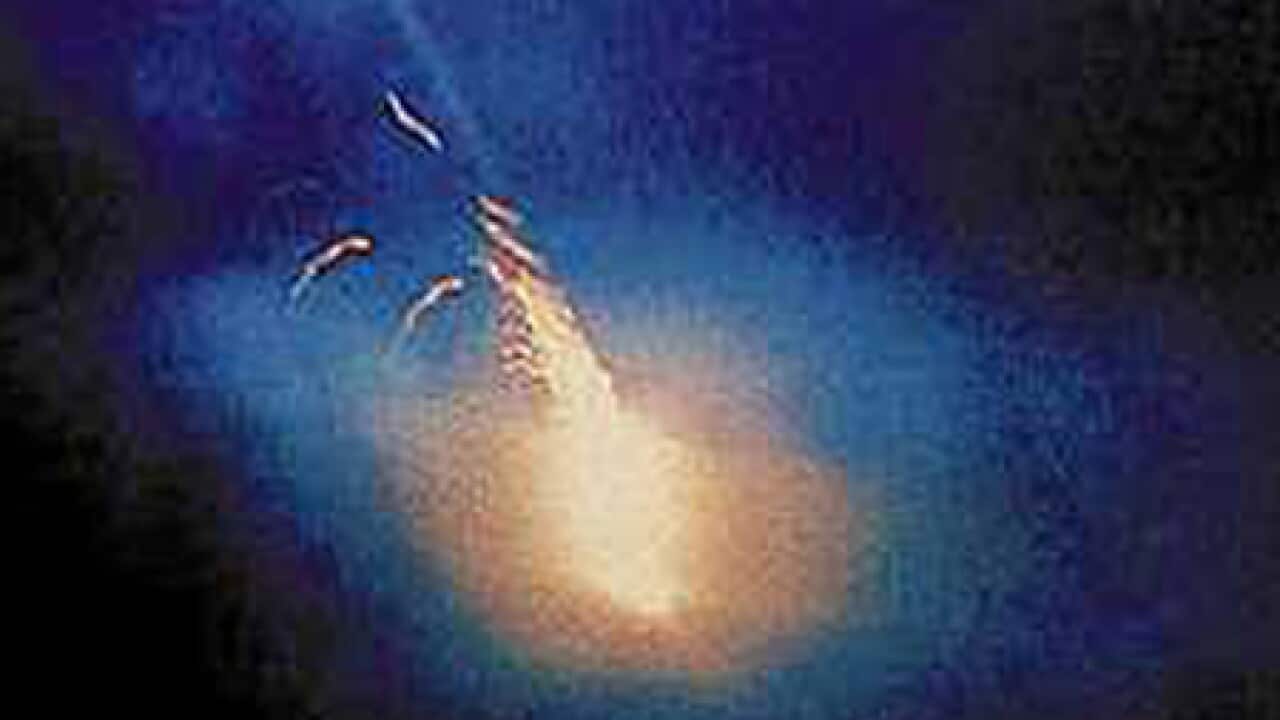
Space debris falling into the atmosphere may cause mysterious ball lightning, the New Scientist's Wendy Zukerman reports.
Thousands of people have seen floating orbs of light, sometimes during thunderstorms, but their origin has never been established.
Earlier this year, scientists proposed that ball lightning was merely a hallucination caused by magnetic fluctuations during storms.
News that makes sense
Your trusted source for staying up-to-date with the world around you. Get free daily news updates and analysis, straight to your inbox.
However, the weather was clear when Don Vernon, a farmer in Queensland, Australia, spotted two green balls descending from the sky on 16 May 2006. Oddly, the second rolled down a hill, bounced over a rock and then vanished.
Stephen Hughes, an astrophysicist at the Queensland University of Technology in Brisbane, set up an online survey to find out more. More than 100 people, scattered over a 600-kilometre-long strip along Australia's east coast, reported seeing a bright fireball like the first green ball that Vernon saw, but no else saw the bouncing ball.
The observations suggest that the first orb was probably a bright meteor caused by debris from Comet 73P, which came closer to Earth at that time than any other comet in 20 years. The second, Hughes says, was ball lightning triggered by the meteor.
Extra current
The cometary debris ionised the atmospheric gas it passed through, boosting the current that normally flows between the ionosphere – an electrically charged region in the upper atmosphere – and the ground, Hughes believes.
When this "supercharged" conduit hit the soil, it formed a plasma ball he argues. He says impacting space junk might also produce the effect.
"It is certainly plausible," says John Lattanzio, an astrophysist at Monash University in Victoria, Australia. But he adds: "It's almost impossible to prove anything with such an ephemeral event as this."
John Lowke, a ball lighting researcher at Australia's national science agency in Sydney, says space debris probably does not explain all observed ball lighting.
During a storm, when most observations have been reported, Lowke says, "it's far more likely that the electrical current is coming from a thundercloud 5 kilometres above the ground, rather than a direct line to the ionosphere 100 kilometres away."







